






Definition and Meaning
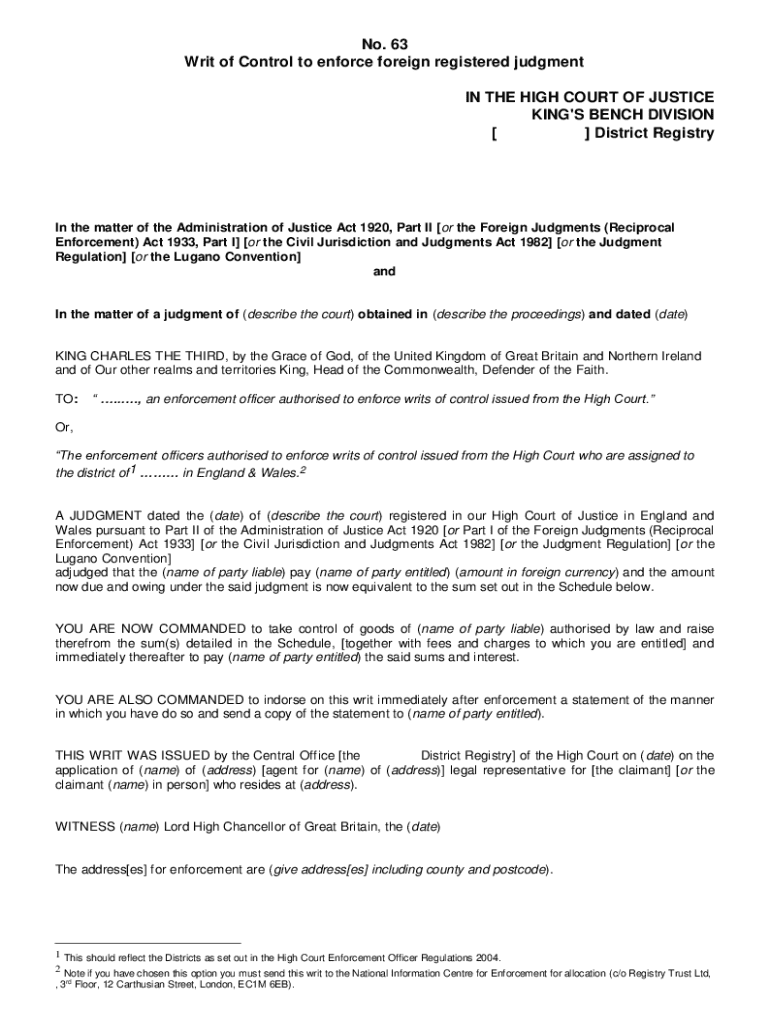
A Writ of Control to Enforce Foreign Registered Judgment is a powerful legal instrument that allows for the enforcement of a judgment awarded in a foreign country, specifically when the judgment has been registered in the jurisdiction where enforcement is sought. This writ, issued by the High Court of Justice in England, directs enforcement officers to seize and potentially sell the debtor's assets to satisfy the outstanding judgment debt, including any interest or legal costs accrued.
Understanding the scope and applicability of this writ is critical for those seeking to enforce foreign judgments across borders. In essence, the writ operationalizes the complex process of international judgment enforcement, transforming a foreign court's decision into actionable authority within a new jurisdiction. This transformation is crucial for creditors who need to leverage a foreign judgment to recover debts from judgment debtors who may have assets in different countries.
How to Use the Writ of Control to Enforce Foreign Registered Judgment
The Writ of Control to Enforce Foreign Registered Judgment involves several strategic steps to ensure effectiveness:
-
Registering the Foreign Judgment: The initial step involves applying to register the foreign judgment in the domestic court. This procedure includes providing authenticated documentation of the original judgment and ensuring compliance with any jurisdiction-specific rules for registration.
-
Applying for the Writ: Once the foreign judgment is registered, the creditor can apply to the court for a writ of control. This requires submitting relevant forms and affidavits that support the case for enforcement.
-
Execution of Writ: Upon issuance, enforcement officers are tasked to seize control of debtor assets. They identify personal property that can be legally seized and appraised for sale, ensuring that the process complies with local legal standards.
-
Collection of Debt: The assets under control may be sold at public auctions or through other authorized means. The proceeds are then allocated towards settling the judgment debt, interest, and associated legal costs.
Steps to Complete the Writ of Control to Enforce Foreign Registered Judgment
Effectively completing the Writ of Control to Enforce Foreign Registered Judgment requires a meticulous attention to legal detail:
-
Preparation of Required Documents: Gather the original judgment, certified copies, and any necessary attestations or notarizations.
-
Application Filing: Submit the application for the writ in the appropriate jurisdiction, along with a detailed affidavit that outlines the necessity and justification for the enforcement action.
-
Court Approval: Secure an order from the court granting the writ, ensuring all procedural norms and legal prerequisites have been satisfied.
-
Coordination with Enforcement Officers: Once the writ is issued, coordinate closely with enforcement officers to ensure they have full clarity on the judgment details and debtor’s assets scope.
-
Monitoring the Process: Regularly track the progression of the asset seizure to ensure compliance with both the domestic legal framework and any international legal obligations that may be in play.
-
Debt Recovery Reporting: After asset disposition, compile and submit a comprehensive report to the court detailing how the funds recovered were applied towards the judgment debt.
Who Typically Uses the Writ of Control to Enforce Foreign Registered Judgment
Various stakeholders could find the Writ of Control to Enforce Foreign Registered Judgment invaluable:
-
International Creditors: Corporate and individual creditors with cross-border dealings might utilize this writ to ensure compliance and collection in cases of default.
-
Legal Practitioners: Attorneys specializing in debt recovery, international law, or commercial litigation use this mechanism to advance their clients' interests.
-
Financial Institutions: Banks and financial service providers may use the writ to enforce lending agreements and recover outstanding loans from entities with international ties.
Understanding the typical users of the writ provides a window into its strategic value, illustrating the diversity of scenarios where enforcing a foreign judgment is necessary for debt recovery.


Legal Use of the Writ of Control to Enforce Foreign Registered Judgment
The legal use of the Writ of Control to Enforce Foreign Registered Judgment is grounded in structured and regulated processes:
-
Compliance with Legal Frameworks: The writ must be issued and executed in accordance with local legal statutes. This ensures all actions regarding seizure and asset control abide by domestic laws.
-
Judicial Oversight: Courts maintain oversight over the writ issuance and execution, ensuring the process respects legal standards like due process, notice requirements, and rights of appeal.
-
Asset Restrictions: Certain assets may be exempt from seizure, requiring profound knowledge of what can legally be controlled under the writ’s authority.
The legal nuances associated with this writ emphasize its role in balancing creditor rights with legal compliance, ensuring fair and justified application.
Key Elements of the Writ of Control to Enforce Foreign Registered Judgment
Key components underpin the effectiveness of the Writ of Control to Enforce Foreign Registered Judgment:
-
Identification Details: Specifies the judgment debtor and the amount owing including interest and costs, drawn from the foreign judgment.
-
Instruction to Enforcement Officers: Commands officers to take control of and potentially auction the debtor’s property, detailing permissible actions and restrictions.
-
Timeline for Enforcement: Sets defined periods for execution, ensuring actions are timely and respect limitations of the writ’s validity.
-
Documentation and Reporting Requirements: Mandates comprehensive record-keeping at every stage, ensuring transparency and accountability throughout the enforcement process.
Understanding these elements provides a comprehensive overview of why and how the writ functions as an effective tool for debt enforcement.
State-Specific Rules for the Writ of Control to Enforce Foreign Registered Judgment
Rules for the use of the Writ of Control to Enforce Foreign Registered Judgment can vary significantly across states, underscoring the need for state-specific legal insights:
-
Unique Filing Protocols: Certain states may have specific procedures for filing the writ, often requiring different documents and fees.
-
Enforcement Variations: Some states could offer alternative enforcement means or place restrictions on the types of assets eligible for seizure.
-
Legal Precedents: Court decisions within the state may affect how writs are interpreted or enforced, necessitating awareness of relevant case law.
To navigate these variations, users should consult local legal experts or resources to ensure state-specific compliance and effectiveness in executing the writ.
Required Documents for the Writ of Control to Enforce Foreign Registered Judgment
For effective execution of a Writ of Control to Enforce Foreign Registered Judgment, specific documents are mandatory:
-
Certified Copy of the Judgment: An authenticated version of the original foreign judgment is essential as a baseline document.
-
Translation of Judgment: If the judgment is not in the local language, a certified translation can be necessary.
-
Affidavit Supporting the Application: A sworn affidavit can substantiate claims for why and how the enforcement is justified.
-
Evidence of Debtor’s Assets: Documentation proving the existence and location of debtor assets within the jurisdiction can strengthen the enforcement application.
These documents form the backbone of the writ process, providing the legal foundation for subsequent actions.