







Definition and Overview of the Sample Crossover MS Medicaid
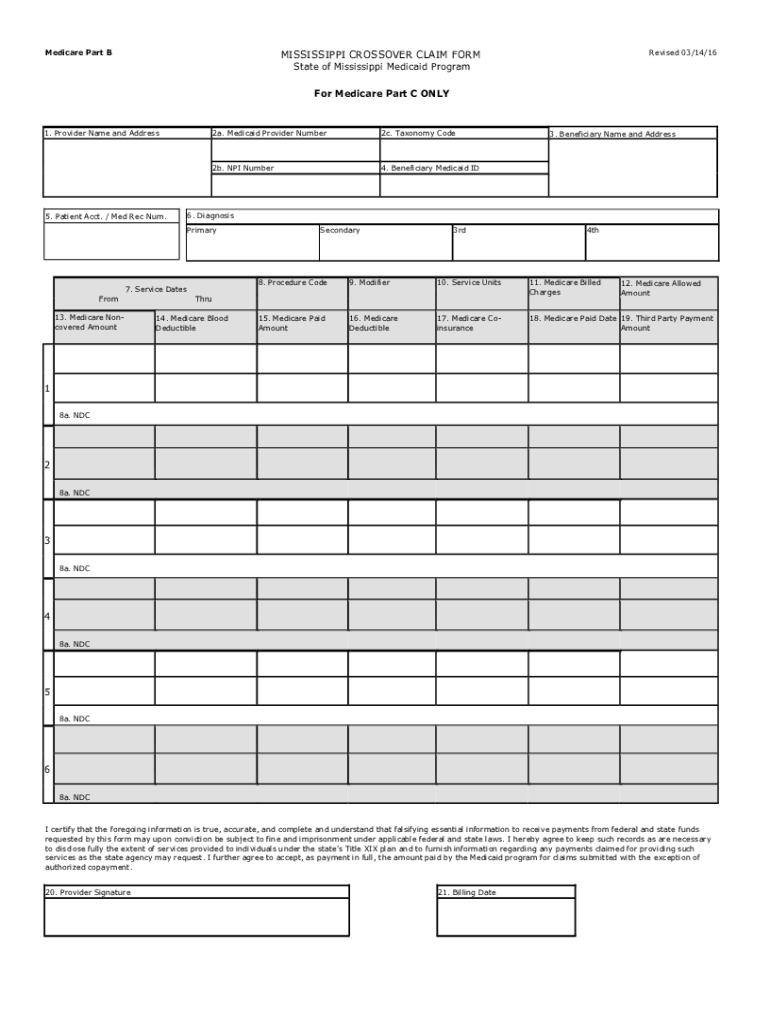
The "Sample Crossover MS Medicaid" form is primarily designed for healthcare providers to facilitate the accurate and efficient submission of crossover claims in the state of Mississippi. This form allows providers to bill Medicaid for the residual amount owed after Medicare has covered its portion of the claim. A typical scenario involves a healthcare provider who has treated a patient with dual eligibility for Medicare and Medicaid. Once Medicare pays its share, the provider uses the crossover form to claim the remaining allowable expenses from Medicaid.
Components of the MS Medicaid Crossover Form
- Patient Information: Captures details of the patient, including full name, date of birth, and Medicaid ID.
- Provider Information: Includes the provider's name, address, and Medicaid provider number.
- Service Details: Documents the specifics of the medical service rendered, such as date of service, procedure codes, and total charges.
- Medicare Coverage: Outlines the payment details from Medicare, detailing the covered and patient responsibility amounts.
Importance and Utility of the Sample Crossover MS Medicaid
The ability to streamline billing procedures is critical for healthcare providers, especially when dealing with patients who have more than one insurance provider. The MS Medicaid Crossover form is key to:
- Efficiently managing the billing process, reducing administrative overhead.
- Ensuring that providers receive the complete reimbursement they are entitled to when treating Medicare and Medicaid patients.
- Standardizing claims submission to minimize errors and delays in processing.
Benefits for Healthcare Providers
- Accurate Reimbursement: Providers can secure complete payments by utilizing the crossover form efficiently, receiving what is not covered by Medicare directly from Medicaid.
- Administrative Ease: Automates the flow of claims between Medicare and Medicaid, reducing the need for manual tracking or resubmission of claims.
Steps to Complete the Sample Crossover MS Medicaid
Completing the crossover form accurately is crucial to avoid processing delays or claim rejections. Here are the steps typically involved:
- Gather Necessary Information: Collect patient details, service information, and documentation of the Medicare payment.
- Fill Out the Patient and Provider Sections: Enter all required personal and provider identifiers accurately.
- Enter Service Details: Use standardized codes for procedures and ensure all dates and amounts match those billed to Medicare.
- Document Medicare Payment: Accurately enter the amount paid by Medicare and any amounts left for Medicaid to cover.
- Review for Errors: Double-check all entries for accuracy, as errors can lead to denied claims.
- Submission: Forward the completed form to Medicaid using the authorized submission method.
Legal Considerations for Using MS Medicaid Crossover
Healthcare providers must maintain compliance with state and federal regulations when using the crossover form. Key legal considerations include:
- Patient Consent: Ensure any patient data shared is authorized under HIPAA regulations.
- Accurate Reporting: Misrepresentation or incorrect reporting can lead to penalties, fines, or exclusion from Medicaid.
- Timeliness: Adhere to submission deadlines to avoid claim rejection.
Who Typically Uses the Sample Crossover MS Medicaid
The form is primarily used by:
- Healthcare Providers: Physicians, hospitals, clinics who treat dual-eligible patients.
- Billing Administrators: Charged with managing Medicare and Medicaid claims.
- Healthcare Systems: Larger institutions processing numerous crossover claims.


Use Cases and Examples
- Hospitals: When a patient treated in the emergency room is covered by Medicare, the hospital submits the crossover form for Medicaid to cover the remaining balance.
- Specialist Practices: Providers whose services are partially paid by Medicare, such as physical therapists, use this form for comprehensive payment.
Key Elements and Requirements of the Form
Critical components ensure completeness and compliance:
- Validity of Medicare Details: Ensure accurate reflection of Medicare’s payments.
- Correct Medicaid Identifiers: Use precise matching of patient's Medicaid ID to avoid processing issues.
- Procedure Codes: Utilize standard CPT or HCPCS codes for all billed services.
- Service Justification: Additional documentation might be needed to justify services rendered beyond the Medicare coverage explanation.
State-Specific Rules for Mississippi
Understanding state-specific guidelines is essential as regional variations may affect the submission process:
- Submission Deadlines: Ensure knowledge of Mississippi’s deadlines for Medicaid claim submissions post-Medicare payment.
- Technical Specifications: Mississippi may have specific electronic submission guidelines different from federal norms.
Examples of Using the Sample Crossover MS Medicaid
Real-world use often provides insight into practical application:
- Case Study - Rural Health Clinic: A rural clinic uses the form to streamline billing for dual-eligible patients, achieving faster claim turnaround with Medicaid.
- Urban Hospital Example: An urban hospital utilizes the crossover form to minimize administrative burden by automating concurrent Medicare and Medicaid billing processes.
Software Compatibility and Submission Methods
Healthcare providers benefit from integrating digital solutions:
- Electronic Health Record (EHR) Systems: Compatibility with software such as Epic or Cerner can enhance efficiency.
- Direct Uploads: Mississippi's Medicaid portal may support direct e-submission, saving time and resources.
Digital vs. Paper Submission Options
- Digital: Preferred for speed and error reduction.
- Paper: Still an option, may be needed in technologically limited scenarios or specific administrative requirements.
Conclusion
While the rich depth of the MS Medicaid crossover form reveals its integral role in ensuring complete provider reimbursement, its ultimate success lies in precision, timely submission, and alignment with Mississippi-specific guidelines.




