ACCIDENT QUESTIONNAIRE 2026

Get Form
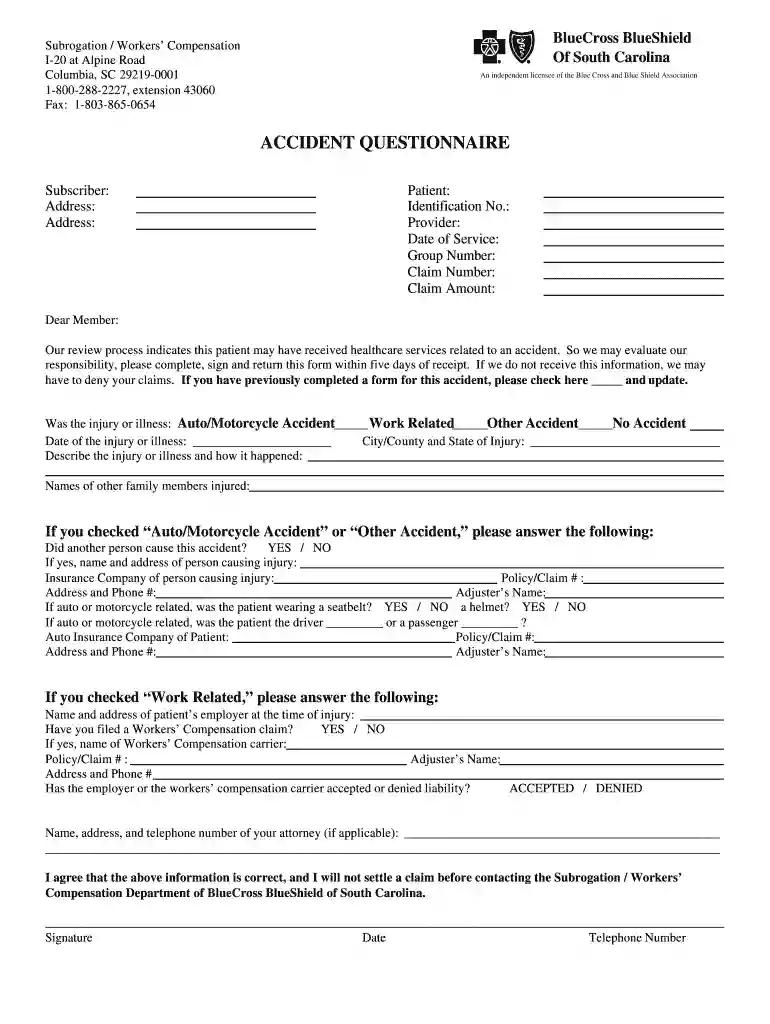
ACCIDENT QUESTIONNAIRE Preview on Page 1

Here's how it works

01. Edit your form online
Type text, add images, blackout confidential details, add comments, highlights and more.

02. Sign it in a few clicks
Draw your signature, type it, upload its image, or use your mobile device as a signature pad.

03. Share your form with others
Send it via email, link, or fax. You can also download it, export it or print it out.

Definition and Meaning

The Accident Questionnaire is a legal document used primarily in the context of healthcare and insurance. It gathers detailed information about the circumstances surrounding an individual's accident, particularly focusing on the healthcare services required due to the event. This form is crucial for insurers like BlueCross BlueShield of South Carolina who need this documentation for subrogation and workers' compensation purposes. Subrogation allows an insurance company to pursue a third party that caused an insurance loss to the insured. Understanding the specific details of the accident helps insurers establish liability and seek reimbursement for the medical expenses they cover.

How to Use the Accident Questionnaire

Using the Accident Questionnaire involves providing accurate and detailed responses to a series of questions about the accident. This includes the date, time, and location of the incident, as well as any involved parties and witnesses. It's essential to list all medical treatments received, specifying the healthcare providers involved. This documentation assists the insurer in understanding the nature of the claim and the potential for reimbursement from responsible parties.

Steps to Complete the Accident Questionnaire

  1. Gather Required Information: Collect all relevant information, such as accident reports, medical records, and witness statements.
  2. Answer All Questions Thoroughly: Ensure that you provide detailed responses for every question. Incomplete information may delay processing.
  3. Review for Accuracy: Double-check the form for errors or omissions before submission.
  4. Attach Supporting Documents: Include relevant documentation, such as police reports or medical bills.
  5. Submit the Form: Follow the specified submission instructions, whether online, via mail, or in-person.

Why Use the Accident Questionnaire

The Accident Questionnaire is vital for several reasons. It ensures that all parties have a clear understanding of the incident, which facilitates accurate insurance claims processing. By using this form, individuals can help expedite their claims and receive the appropriate compensation from their insurer or from a third party responsible for their injuries. It is also a legal requirement under many health contracts to provide such information due to clauses related to subrogation and workers' compensation.

Who Typically Uses the Accident Questionnaire

The primary users of the Accident Questionnaire include insured individuals involved in accidents, insurance companies, and healthcare providers. Individuals use it to report their accidents accurately to their insurers. Insurance companies rely on it to assess claims and determine liability. Healthcare providers may reference it to verify the services provided to the insured party. Moreover, legal representatives may also use this document during claims disputes or settlements to support their cases with detailed accident information.


decoration image ratings of Dochub

Important Terms Related to the Accident Questionnaire

  • Subrogation: The legal right held by insurance companies to pursue a third party that caused an insurance loss to the insured.
  • Workers' Compensation: A form of insurance providing wage replacement and medical benefits to employees injured in the course of employment.
  • Liability: The state of being responsible for something, especially by law, which is central to determining who should pay for damages in an accident.

Key Elements of the Accident Questionnaire

  • Accident Details: Date, location, and description of the event.
  • Involved Parties: Information about other individuals involved or witnesses.
  • Medical Information: Listing of healthcare providers and treatments received post-accident.
  • Insurance Information: Details of any other insurance policies that may cover the incident.
  • Supporting Documentation: Police reports, medical records, and any correspondence regarding the incident.

State-Specific Rules for the Accident Questionnaire

Rules can vary significantly from state to state regarding the use and submission of the Accident Questionnaire. Some states might have specific deadlines for submitting the form to ensure timely processing of claims, or unique stipulations regarding what constitutes acceptable documentation. It's crucial for users to familiarize themselves with their state's requirements to avoid delays or complications in their claims process.

Examples of Using the Accident Questionnaire

Consider a scenario where an individual suffered injuries in a vehicular accident. The Accident Questionnaire would require them to detail the accident's circumstances, including the date and location, any involved vehicles, and the immediate actions taken after the incident. Another example might involve a workplace accident, which would necessitate information about the employer, workplace safety measures, and any witnesses. These examples emphasize the form's role in ensuring that insurers have the necessary information to process and validate claims effectively.

be ready to get more

Complete this form in 5 minutes or less

Get form

Got questions?

We have answers to the most popular questions from our customers. If you can't find an answer to your question, please contact us.
Contact us
The common injuries and accidents in the home include: cuts, poisoning, choking, electric shocks, falls, drowning and burns. However, many serious injuries can be prevented if parents and other caregivers supervise children carefully and keep their environment safe. Almost all these injuries can be prevented.
Causes of Road Accidents Over Speeding. Drunken Driving. Distractions to Driver. Red Light Jumping. Avoiding Safety Gears like Seat belts and Helmets. Non-adherence to lane driving and overtaking in a wrong manner.
Some of the questions below will be applicable and some will not. Which questions are applicable depends on the nature and circumstances of the accident. How does the injured employee feel now? Who was injured? What were the causal factors of the accident? When did the accident occur? Why was the person injured?
10 Causes of Road Accidents Driver Distraction. Distractions are a leading cause of road accidents as well. Driver Impairment. Driver Fatigue. Recklessness Behind the Wheel. Failing to Look Before Turning or Merging. Assuming Other Drivers Will Move or Wait. Traffic Law Violations. Road Hazards and Defects.
The top three leading causes of preventable injury-related death (poisoning, falls, and motor vehicle) in 2023 account for 86% of all preventable deaths. No other preventable cause of death (including suffocation, drowning, fires and burns, and natural or environmental disasters) accounts for more than 3% of the total.

Security and compliance

At DocHub, your data security is our priority. We follow HIPAA, SOC2, GDPR, and other standards, so you can work on your documents with confidence.

Learn more
ccpa2
pci-dss
gdpr-compliance
hipaa
soc-compliance

People also ask

How long does a car accident settlement usually take? Most cases settle in 612 months. If you docHub MMI quickly and liability is clear, it could be faster. If litigation is required, it may take 12 years.
Definition and objectives of accident analysis Accident analysis is used to systematically investigate workplace accidents. During the investigation, the causes are determined, and individual measures are developed.

Related links