






Definition and Meaning
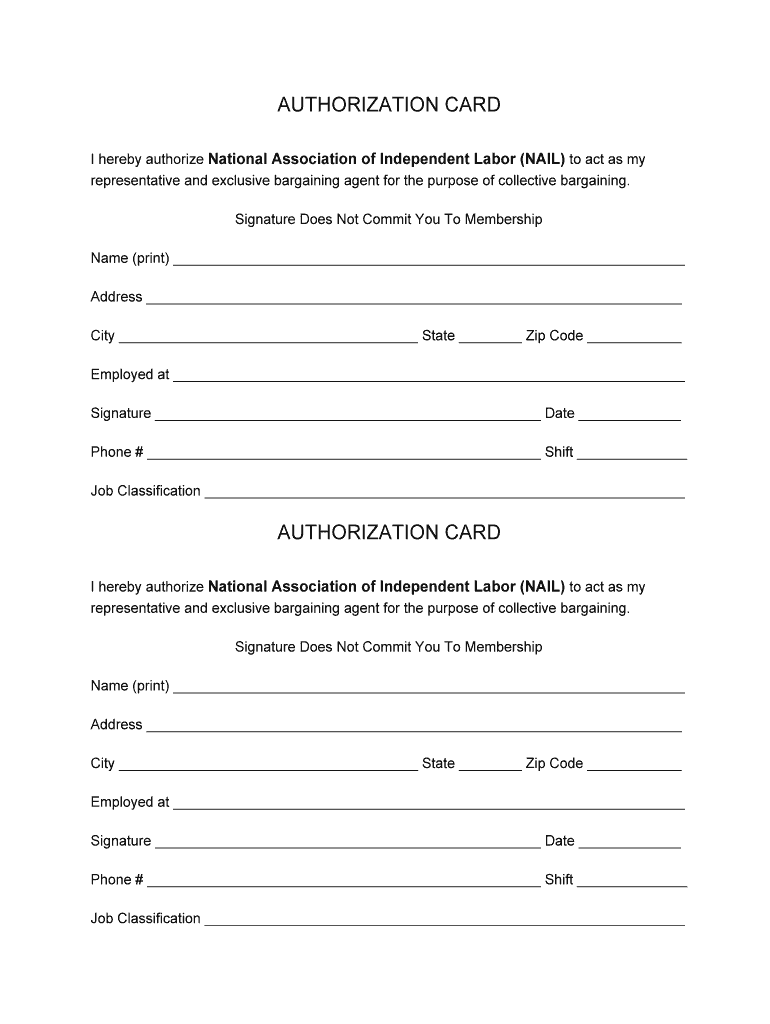
An authorization card, particularly the "Authorization card authorization card - National Association of - nail-union," is a legal document used by employees to designate a labor union as their exclusive bargaining agent. This specific card allows members of the National Association of Independent Labor (NAIL) to authorize the union to represent them in collective bargaining negotiations. Signing this card does not equate to union membership; rather, it signifies support for the union to negotiate on the employee's behalf.
Real-World Example
Consider an employee at a manufacturing company who wants NAIL to represent their interests in negotiations for better working conditions. By signing the authorization card, the employee grants NAIL the authority to act on their behalf during discussions with the employer, while still maintaining the freedom to choose when to become a full-fledged union member.
How to Use the Authorization Card
To utilize the authorization card effectively, employees must ensure accurate completion of all required sections. The process involves reviewing the card thoroughly, understanding all terms and conditions, and signing where indicated. The signed card is typically submitted to either a union representative or directly to the National Association of Independent Labor for further action.
Important Steps
-
Carefully Review the Card: Before signing, read all the details on the card to understand what you are authorizing.
-
Complete Personal Information: Fill in any required fields with accurate personal and employment information.
-
Submit the Card: Follow instructions provided by the union on how to submit the completed card, whether by mail or through a representative.
How to Obtain the Authorization Card
Acquiring this card involves contacting the National Association of Independent Labor or visiting the organization’s website. Employees can request the card directly from a NAIL representative who can provide additional information and assistance.
Additional Methods
-
Union Meetings: Attending a union meeting can be an opportunity to obtain the card and gain a deeper understanding of its purpose.
-
Online Platforms: Some labor unions might offer downloadable versions from their official websites for easier access.
Steps to Complete the Authorization Card
Completing the card accurately is essential for its acceptance. Here's a detailed guide:
-
Read Instructions: Begin by reading any guidelines provided with the card.
-
Fill in Personal Data: Ensure all personal and employment information is correct.
-
Understand Rights: Know your rights as a signer, such as the non-binding nature regarding union membership.
-
Sign the Card: Append your signature to confirm your authorization for NAIL to represent you.
-
Submit as Directed: Follow submission instructions, whether it's via mail or in-person handover to a stated representative.
Key Elements of the Authorization Card
Critical components that need attention include:
- Name and Contact Information: Clearly identify the employee by providing full legal name and up-to-date contact details.
- Employer Information: Company name, department, and position held should be accurately mentioned.
- Signature Field: A designated area for the employee’s signature which signifies agreement.
Examples of Errors to Avoid
- Missing Details: Incomplete information can invalidate the card.
- Illegibility: Ensure handwriting is clear if filled out manually.
Legal Use of the Authorization Card
This card serves a dual legal purpose: enabling workers to show support for union representation and allowing unions to collect proof of such support. Its legal standing is reinforced through labor laws that protect worker rights to collective bargaining.
Practical Scenario
Employees in a large corporation utilize this authorization to collectively agree to representation by NAIL in negotiating terms such as wages, benefits, and workplace conditions.
Who Typically Uses the Authorization Card
The card is commonly used by employees across various sectors who are eligible for union representation under national labor laws. It includes those in industries ranging from manufacturing to information technology that aspire for collective bargaining through a union like NAIL.


User Categories
- Employees in Unionizing Workplaces: Particularly those seeking improved labor rights.
- Union Representatives: Who collect and manage these cards to demonstrate workforce support.
State-Specific Rules
While the general usage of the authorization card is governed by federal labor laws, certain states may have localized regulations affecting how these cards are utilized and processed. Awareness of these differences is crucial for ensuring compliance.
Focus on Key States
- California: Known for stringent labor laws that may affect union card processing.
- New York: Has specific guidelines regarding union coordination and card submission.
Penalties for Non-Compliance
Failure to correctly process or comply with related labor laws in using authorization cards can lead to consequences. Penalties might include voiding the collected cards or legal action by employees or unions challenging employer practices.
Possible Repercussions
- Employer Penalties: For obstructing card signing or submission.
- Invalidation of Cards: If not submitted according to established protocols.
Form Submission Methods
Understanding submission methods ensures the proper delivery of these cards. Options typically include both physical and electronic submissions, depending on union protocols.
Detailed Methods
- Physical Delivery: Cards can be handed to a union representative in-person.
- Mail Submission: Allows sending the completed card via postal services to a designated address.
Eligibility Criteria
Employees must meet specific criteria to issue or sign the authorization card. These criteria might include employment status, job classification, and absence of conflicts with existing labor agreements.

Examples of Eligible Employees
- Full-Time Employees: More likely to benefit from union negotiations.
- Contract Workers: Can be eligible if contractual terms allow for union representation.