01. Edit your form online
Type text, add images, blackout confidential details, add comments, highlights and more.

Type text, add images, blackout confidential details, add comments, highlights and more.

Draw your signature, type it, upload its image, or use your mobile device as a signature pad.

Send it via email, link, or fax. You can also download it, export it or print it out.
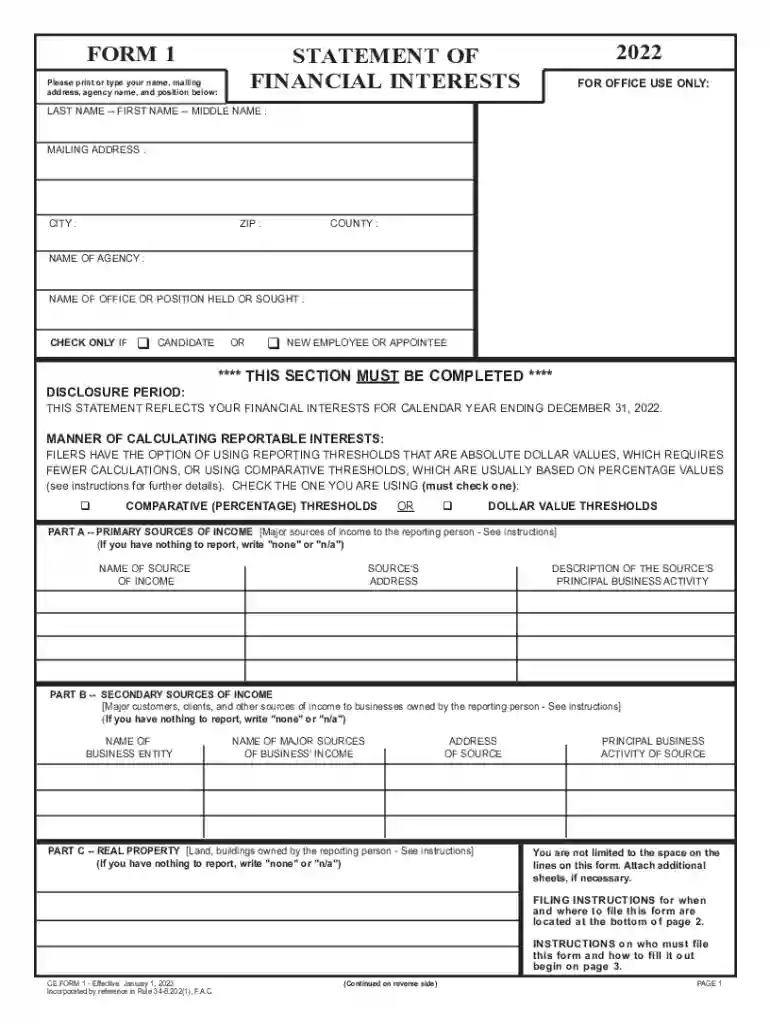
The "Form 1 - Florida Commission on Ethics" is a crucial document for public officials in Florida, focusing on the disclosure of financial interests. It ensures transparency and accountability among officials by mandating the reporting of various financial aspects for the calendar year ending December 31, 2022.
Timely submission is vital to avoid penalties. Public officials must file Form 1 by July 1 of the year following the reporting year. It is important to mark this date to ensure full compliance with state regulations.
Failure to file Form 1 on time may result in penalties. This could include fines and other disciplinary actions, which underscore the importance of adhering to deadlines. For exact fine rates and penalties, refer to the Florida Commission on Ethics guidelines.
Form 1 is generally used by public officials in the state of Florida. This includes elected officers and certain appointed public employees. Understanding whether you fall within the categories required to file is essential for compliance.


Form 1 plays a critical role in maintaining ethical standards within Florida's public service sector. It ensures that officials are operating transparently and without conflicts of interest, therefore reinforcing public trust.
Form 1 contains several sections that must be accurately filled out:
Both versions contain identical information. However, the digital version may offer convenience for completing and submitting the form securely and quickly. It often allows for better data entry accuracy with features like auto-calculation fields.
Understanding the terminology used in Form 1 will aid in accurate completion:
While Form 1 itself does not require specific software, utilizing document management platforms like DocHub can enhance the process of editing and submitting the form. These tools allow for ease in filling, signing, and securely storing the document. Additionally, DocHub integrates seamlessly with Google Workspace, streamlining workflows for digital submissions.
We've got more versions of the Form 1 - Florida Commission on Ethics form. Select the right Form 1 - Florida Commission on Ethics version from the list and start editing it straight away!
At DocHub, your data security is our priority. We follow HIPAA, SOC2, GDPR, and other standards, so you can work on your documents with confidence.