01. Edit your ga attorney online
Type text, add images, blackout confidential details, add comments, highlights and more.

Type text, add images, blackout confidential details, add comments, highlights and more.

Draw your signature, type it, upload its image, or use your mobile device as a signature pad.

Send ga provisions via email, link, or fax. You can also download it, export it or print it out.
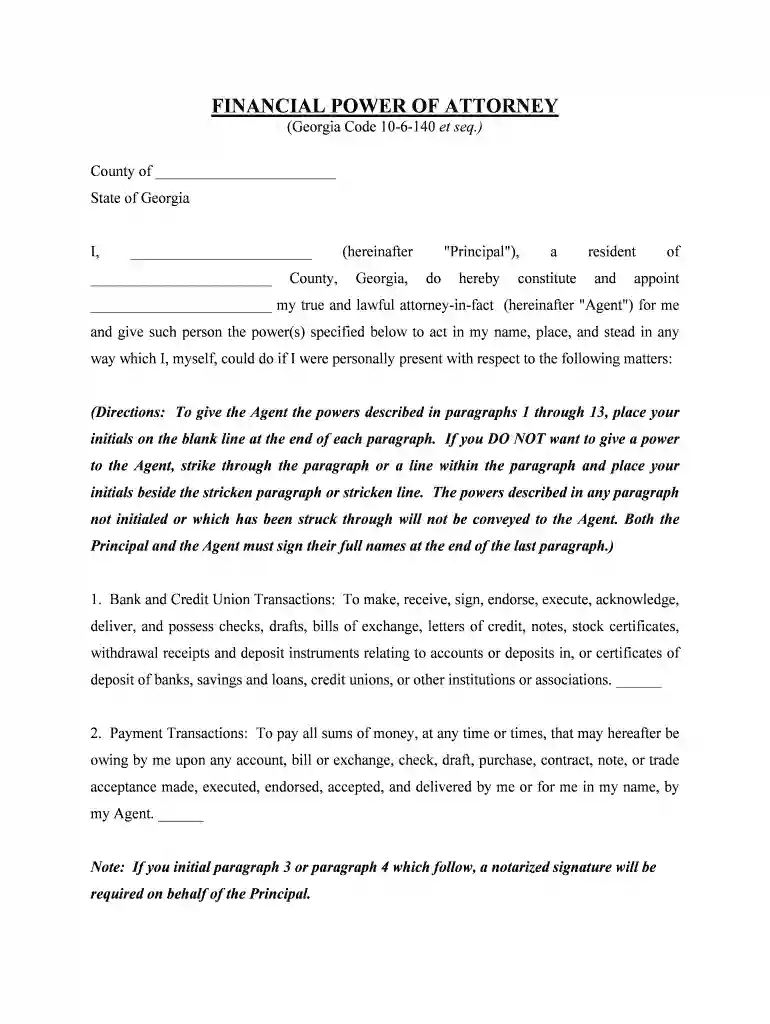
A Georgia (GA) Power of Attorney form is a legal document allowing an individual, referred to as the Principal, to appoint another person, known as the Agent, to act on their behalf in various financial matters. The document specifies the scope of authority granted to the Agent, which may include managing bank accounts, handling real estate transactions, dealing with insurance matters, and representing the Principal in legal proceedings. Typically, the document remains effective even if the Principal becomes incapacitated, unless it is explicitly revoked or a guardian is appointed. This feature ensures continued management of the Principal's financial affairs under circumstances where they may no longer be able to make decisions independently.
To effectively use a GA Power of Attorney, the Principal must first clearly define the powers granted to the Agent. This involves specifying particular financial actions the Agent can undertake, such as paying bills, managing investments, or signing legal documents on behalf of the Principal. The Principal can further tailor the document by restricting certain powers or providing specific instructions for the Agent to follow. It is crucial for the document to be notarized to ensure its legality and enforceability. Once fully executed, the Agent can begin to act in the capacity defined by the form, ensuring that all actions comply with the Principal's instructions and the legal requirements of the state.
The legal application of a GA Power of Attorney primarily involves financial decision-making. This includes, but is not limited to, the management of the Principal’s bank accounts, entering or terminating contractual agreements, investing in securities, and overseeing real estate transactions. Agents are expected to act in the best interest of the Principal, adhering strictly to the duties outlined in the document. They must maintain accurate records of all transactions and can be required to present them if questioned by the Principal or other authorized parties. Non-compliance with these duties or actions taken beyond those authorized by the GA Power of Attorney can result in legal consequences for the Agent.
Georgia has specific regulations that govern the creation and use of a Power of Attorney. For instance, the document should clearly comply with state laws, and any financial institution can request the Agent to provide proof of the document’s validity by checking for proper notarization and witnesses. Georgia law also grants the Principal the ability to revoke the document at any time, provided they are of sound mind. It is advisable for Principals to record any such revocations in writing and notify all parties that possess the original document about the changes.
Various individuals use a GA Power of Attorney, ranging from seniors who desire assistance with their finances to business professionals who require an Agent to manage corporate transactions in their absence. It is also commonly used by individuals with health conditions that necessitate external management of their affairs or by people traveling abroad for extended periods, who need someone domestically to manage their finances and legal responsibilities.


At DocHub, your data security is our priority. We follow HIPAA, SOC2, GDPR, and other standards, so you can work on your documents with confidence.