01. Edit your form online
Type text, add images, blackout confidential details, add comments, highlights and more.

Type text, add images, blackout confidential details, add comments, highlights and more.

Draw your signature, type it, upload its image, or use your mobile device as a signature pad.

Send it via email, link, or fax. You can also download it, export it or print it out.
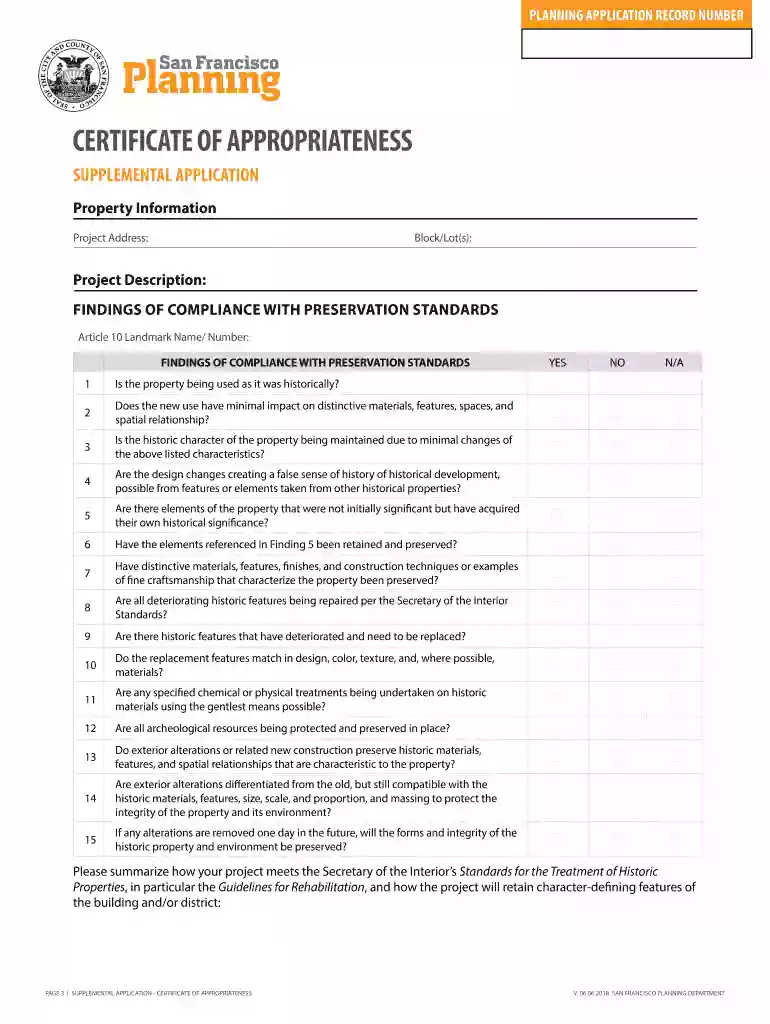
The Certificate of Appropriateness Application in San Francisco is a formal process overseen by the San Francisco Planning Department. This application is necessary for reviewing any proposed changes to the exterior of properties that are designated as City Landmarks or are located within landmark districts. The form serves as a tool to ensure that alterations, constructions, or demolitions comply with local preservation standards to maintain the historical and cultural integrity of the area.
To use the Certificate of Appropriateness Application effectively, applicants must follow a series of steps designed to facilitate a thorough review. The process begins with determining whether the property is subject to local preservation regulations.
Completing the Certificate of Appropriateness Application involves several detailed steps to ensure all necessary information is accurately presented to the San Francisco Planning Department.
To ensure thorough review and compliance, specific documents are required as part of the submission process for a Certificate of Appropriateness.
Once the Certificate of Appropriateness Application is submitted, it undergoes a review process which includes different stages to ensure compliance with preservation regulations.
Familiarity with key terms related to the Certificate of Appropriateness Application ensures clarity and aids in navigating the bureaucratic aspects of the application process.
Legally, the Certificate of Appropriateness is required to ensure that historic properties are modified in a way that meets the city's preservation objectives.
The application is predominantly used by property owners, developers, and architects engaging in projects involving designated historic buildings within San Francisco.


The regulations governing Certificates of Appropriateness can vary state-by-state, and specific rules applicable in San Francisco are encapsulated within its Planning Code.
By understanding these elements of the Certificate of Appropriateness, applicants can effectively navigate the complexities of modifying historic properties within San Francisco.
We've got more versions of the certificate of appropriateness application - San Francisco form. Select the right certificate of appropriateness application - San Francisco version from the list and start editing it straight away!
At DocHub, your data security is our priority. We follow HIPAA, SOC2, GDPR, and other standards, so you can work on your documents with confidence.