






Definition & Meaning
The "Special Education Problem Solving Process - State of Michigan" is a structured framework mandated by the Michigan Department of Education. It is designed to address and resolve disputes concerning the education of students with disabilities. This process includes collaborative methods such as informal and facilitated meetings, mediation, and a state complaint procedure. The ultimate goal is to ensure compliance with both the Individuals with Disabilities Education Act (IDEA) and Michigan law, providing equitable educational opportunities for students with disabilities.
How to Use the Special Education Problem Solving Process - State of Michigan
Engaging with the Special Education Problem Solving Process involves several steps. Initially, stakeholders such as parents and schools begin with informal meetings to discuss concerns openly. If issues persist, facilitated meetings involving a neutral third-party mediator help to guide discussions. Mediation serves as an alternative dispute resolution method if consensus isn't reached initially, providing a structured environment to explore solutions amicably. Every stage focuses on cooperation and reaching a mutually agreeable outcome while prioritizing the student's educational needs.
Key Elements of the Special Education Problem Solving Process - State of Michigan
Several components are critical to the efficiency of this process:
- Informal Meetings: Encourage initial dialogue and problem-solving between schools and parents.
- Facilitated Meetings: Involve an impartial facilitator who assists in managing discussions and focusing on educational strategies.
- Mediation: Offers voluntarily and confidentially, aimed at resolving disputes through a neutral mediator.
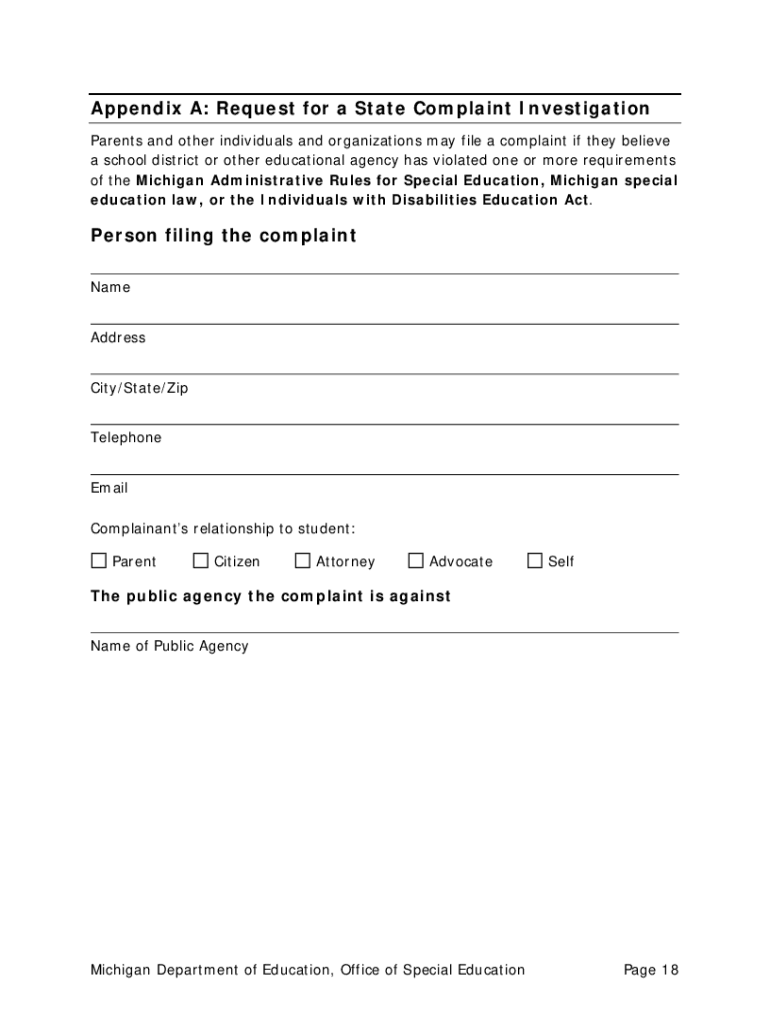
- State Complaint Process: Provides a formal avenue for filing grievances against school districts violating special education laws, ensuring procedural integrity.
Each step is integral to ensuring that the educational needs of students are met promptly and effectively.
Steps to Complete the Special Education Problem Solving Process - State of Michigan
- Identify Concerns: Parents or agencies recognize issues affecting a student's education.
- Schedule Informal Meeting: Initiate discussions with school officials to attempt a resolution.
- Engage in Facilitated Meeting: If necessary, request a facilitator to aid in problem-solving.
- Pursue Mediation: Engage in mediation if previous efforts do not resolve the conflict.
- File a State Complaint: As a last resort, submit a formal complaint to address unresolved disputes legally.
Each step is vital for systematically addressing and resolving the educational challenges concerning students with disabilities.
Why You Should Use the Special Education Problem Solving Process - State of Michigan
Utilizing this process ensures that the rights of students with disabilities are protected and that educational institutions honor their legal obligations under IDEA and state laws. Engaging in this process promotes collaborative decision-making, prevents escalation of disputes, and focuses on tailoring educational strategies to individual student needs. It serves not only as a compliance tool but also as an opportunity to build constructive relationships between parents and educators.
Who Typically Uses the Special Education Problem Solving Process - State of Michigan
The process is primarily utilized by:
- Parents and Guardians: Advocates for their children's educational needs.
- Educators and School Administrators: Seek to ensure compliance and address any potential deficiencies in educational delivery.
- Advocacy Groups: Support parents and provide additional resources and representation during the process.
These stakeholders collaborate to safeguard and advance the educational interests of students with disabilities.


State-Specific Rules for the Special Education Problem Solving Process - State of Michigan
In Michigan, specific regulations guide this process. These rules detail the protocols for filing state complaints, timelines for resolution, and procedures for conducting facilitated meetings and mediations. Each step is designed to align with federal and state guidelines while accommodating the particular needs of Michigan's educational landscape. Compliance with these rules ensures that the problem-solving process remains effective and legally sound.
Examples of Using the Special Education Problem Solving Process - State of Michigan
Real-world scenarios highlight the process's utility. For instance, a parent concerned about inadequate resources for a student's learning disability might start with an informal meeting. If this does not resolve the issue, they might escalate to a facilitated meeting or mediation. In another case, educators might utilize the process to address behavioral challenges collaboratively, ensuring the development of a suitable individualized education plan (IEP). These examples underscore the process's flexibility in addressing diverse educational challenges.