01. Edit your form online
Type text, add images, blackout confidential details, add comments, highlights and more.

Type text, add images, blackout confidential details, add comments, highlights and more.

Draw your signature, type it, upload its image, or use your mobile device as a signature pad.

Send it via email, link, or fax. You can also download it, export it or print it out.
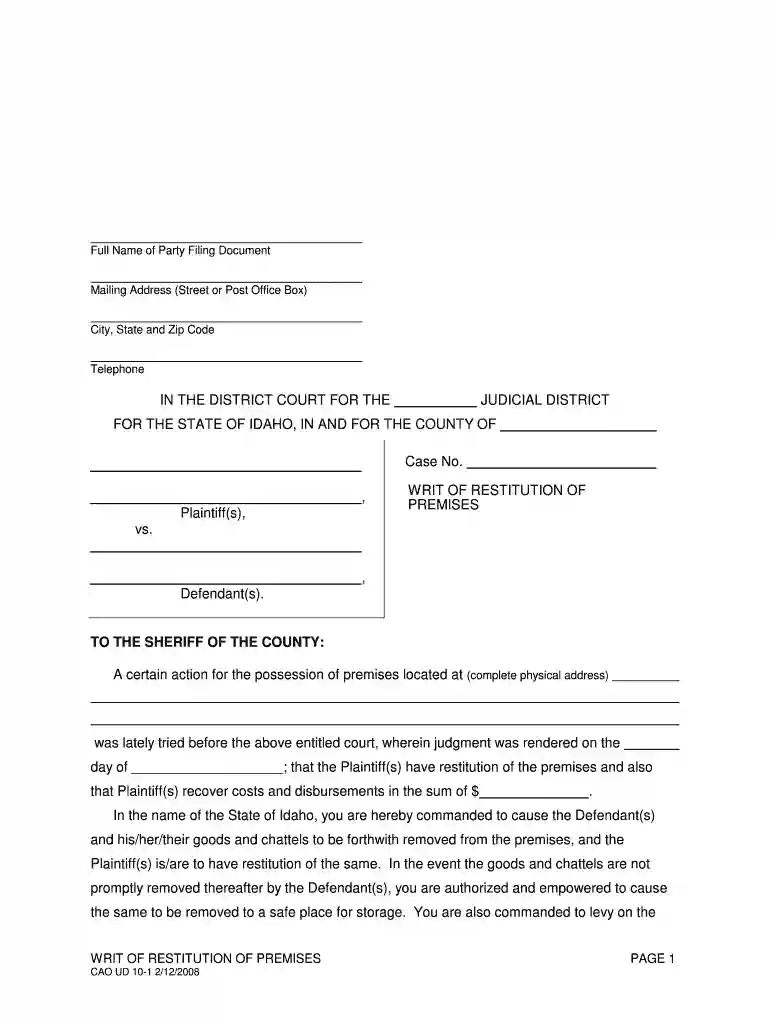
An "Idaho Eviction Writ of Restitution" is a legal order issued by a court in Idaho. This order mandates law enforcement, typically the sheriff, to carry out the removal of a tenant and their belongings from a property. This occurs after a landlord has won a judgment for possession of the premises. The writ is part of the eviction process, designed to restore the property to the landlord legally. It signifies the final step in the eviction process and ensures compliance with the court's decision. In addition, it serves to uphold the landlord's rights to reclaim their property.
Obtaining an Idaho Eviction Writ of Restitution involves several legal steps. First, the landlord must file a lawsuit against the tenant in the appropriate district court. This usually follows a failure of the tenant to comply with a notice to vacate the premises voluntarily. Once the lawsuit is filed, the court schedules a hearing to determine possession rights. If the court rules in favor of the landlord, the judge will issue a judgment for possession. After this judgment, the landlord can request the writ. It's essential for landlords to carefully follow all procedural steps to ensure their request for the writ is granted without delay.
File the Initial Eviction Complaint: Begin by filing a complaint in the district court having jurisdiction over the property.
Serve the Tenant: The tenant must be served with the complaint and a summons to appear in court. This can be done via personal delivery or other methods as prescribed by Idaho law.
Attend the Court Hearing: Both parties will present their case at the hearing. Evidence supporting eviction should be presented clearly.
Obtain Court Judgment: If the landlord wins the case, the court will issue a judgment for possession.
Request the Writ of Restitution: After obtaining the judgment, file a request for the writ with the court clerk.
Coordinate with Law Enforcement: Once the writ is issued, coordinate with local law enforcement for its execution, ensuring the tenant vacates the property.
Primarily, landlords or property managers utilize the Idaho Eviction Writ of Restitution. This legal instrument is used when tenants fail to vacate a property after receiving a notice for non-compliance or breach of lease terms. Legal representation is often involved to ensure adherence to eviction laws and to expedite the process in court. Additionally, real estate attorneys frequently assist landlords throughout this process to avoid any procedural errors that could delay the eviction.


The state of Idaho has specific statutes dictating how the writ of restitution is handled. Key points include:
Landlords must familiarize themselves with these state-specific rules to effectively manage the eviction process.
The Idaho Eviction Writ of Restitution must be used legally and ethically. Its primary purpose is to restore possession of a property to the landlord following a tenant's failure to comply with a lawful eviction notice. Landlords are prohibited from removing tenants or their belongings without a writ. Misuse of the writ can result in legal repercussions, including potential civil liability for the landlord. Therefore, it is crucial to follow the legal process entirely, ensuring that all statutory requirements and tenant rights are respected.
The writ contains several essential components, including:
These elements ensure clarity in the enforcement of the writ, giving the landlord legal grounds to recover their property.
Consider a scenario where a tenant stops paying rent and ignores notices to vacate. The landlord files an eviction lawsuit. After the court hearing, a judgment for possession is granted to the landlord. Subsequently, the landlord requests a writ of restitution, which law enforcement executes, restoring the property to the landlord. Another example is a tenant violating lease terms by conducting unauthorized business activities on the property. The landlord follows similar legal steps to regain possession, demonstrating the writ's role in upholding landlords' rights within legal frameworks.
We've got more versions of the Idaho Eviction Writ of Resititution form. Select the right Idaho Eviction Writ of Resititution version from the list and start editing it straight away!
| Versions | Form popularity | Fillable & printable |
|---|---|---|
| 2008 | 4.8 Satisfied (83 Votes) |
At DocHub, your data security is our priority. We follow HIPAA, SOC2, GDPR, and other standards, so you can work on your documents with confidence.