01. Edit your form online
Type text, add images, blackout confidential details, add comments, highlights and more.

Type text, add images, blackout confidential details, add comments, highlights and more.

Draw your signature, type it, upload its image, or use your mobile device as a signature pad.

Send it via email, link, or fax. You can also download it, export it or print it out.
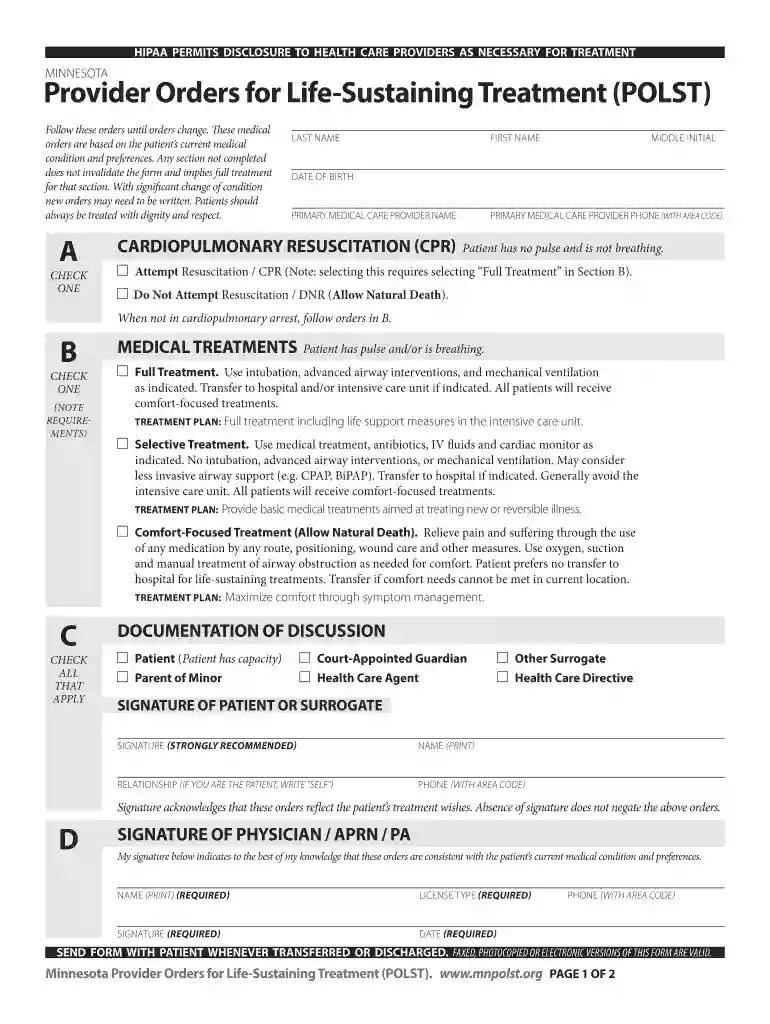
The "HIPAA Permits Disclosure of South Dakota MOST to Other" refers to a specific regulatory allowance under the Health Insurance Portability and Accountability Act (HIPAA) that enables the sharing of South Dakota Medical Orders for Scope of Treatment (MOST) with other relevant parties. MOST forms are vital for documenting a patient's preferences regarding medical treatments, and ensuring these are respected across different healthcare settings is crucial. The disclosure mechanism allows healthcare providers, insurers, and other legally recognized entities to access these medical orders in compliance with HIPAA guidelines.
Understanding how to appropriately utilize the disclosure permissions under HIPAA is essential for healthcare providers and related parties. Here’s a step-by-step guide:
Identify Authorized Entities: Ensure that the recipient of the South Dakota MOST information is authorized under HIPAA regulations. This typically includes healthcare providers, insurance companies, or entities involved in patient care.
Secure Patient Consent: Although HIPAA permits certain disclosures, obtaining patient consent where possible ensures transparency and maintains trust.
Verify Document Validity: Before sharing, verify that the MOST form is current, accurate, and applicable to the patient's current health situation.
Follow Secure Communication Practices: Use secure methods, such as encrypted emails or secure cloud services, for sharing the MOST documentation.
Record Disclosure: Maintain records of what information was disclosed, to whom, and for what purpose, ensuring compliance with HIPAA's auditing requirements.
Filling out and using the disclosure aspect involves several crucial steps:
Collect Necessary Patient Information: Gather all relevant details from patients, including their consent and identification.
Complete the MOST Form: Ensure that the MOST form includes clear instructions about medical treatments and patient preferences.
Incorporate into Health Records: Integrate the completed MOST form into the patient’s electronic health records to streamline access for authorized parties.
Ensure Access Control: Set up access permissions to ensure only authorized personnel can view or modify the MOST form.
Review Regularly: Update the MOST form as necessary, particularly if the patient's health status or preferences change.
Legal use under HIPAA for the disclosure of South Dakota MOST information requires adherence to several regulatory conditions:
Compliance with HIPAA: Ensure that all data handling practices comply with HIPAA standards, particularly regarding privacy and security.
Purpose Limitation: Use the disclosed information strictly for the purpose it was intended, such as patient treatment, payment, or healthcare operations.
Limited Data Set: Only disclose the minimum necessary information to achieve the intended purpose without compromising patient privacy.
Patient Rights Respect: Allow patients to review who has access to their MOST forms and give them the opportunity to revoke consent for disclosures not covered under mandatory regulations.
South Dakota may have additional rules impacting how MOST disclosures are handled:
State Legislation: Familiarize yourself with any South Dakota-specific laws or guidelines that complement HIPAA regulations regarding MOST.
State Health Department Directives: Follow any directives issued by the South Dakota Department of Health relevant to MOST disclosures.
Local Health Network Practices: Coordinate with local healthcare networks to ensure uniform practices in sharing MOST information.
To fully comprehend the disclosure process, focus on these key elements:
Form Completeness: Ensure that all sections of the MOST form are thoroughly completed and easily interpretable.
Clear Consent: Explicitly gather and document patient consent for disclosures when applicable.
Documentation Practices: Keep detailed records of disclosures for accountability and compliance.
Training and Awareness: Educate staff on HIPAA regulations and their application to South Dakota MOST disclosures.
Some terms are vital in understanding and using South Dakota MOST disclosures:
HIPAA Authorization: Specific permission given by a patient allowing the use or sharing of their protected health information.
Protected Health Information (PHI): Any information about health status, healthcare, or payment for healthcare that can be linked to an individual.
Scope of Treatment: Medical interventions a patient has agreed to receive or decline, as documented in the MOST form.
Real-world scenarios illustrate the practical use and benefits of MOST disclosures:
Emergency Room Situations: In an emergency, healthcare providers can access the MOST form to quickly understand patient treatment preferences.
Transfer Between Facilities: When a patient is moved from one healthcare facility to another, the MOST form ensures continuity of care by informing the receiving team of the patient’s directives.
Coordination with Insurers: Disclosing MOST information to insurers can expedite claim processing and support decision-making on covered treatments and procedures.
These structured insights aim to equip users with the critical knowledge needed to navigate and leverage the HIPAA permits for disclosing South Dakota MOST effectively.
We've got more versions of the HIPAA PERMITS DISCLOSURE OF SOUTH DAKOTA MOST TO OTHER form. Select the right HIPAA PERMITS DISCLOSURE OF SOUTH DAKOTA MOST TO OTHER version from the list and start editing it straight away!
| Versions | Form popularity | Fillable & printable |
|---|---|---|
| 2017 | 4.8 Satisfied (153 Votes) |
At DocHub, your data security is our priority. We follow HIPAA, SOC2, GDPR, and other standards, so you can work on your documents with confidence.