2019 MI MC 12-2026

Get Form
2019 MI MC 12 Preview on Page 1

Here's how it works

01. Edit your form online
Type text, add images, blackout confidential details, add comments, highlights and more.

02. Sign it in a few clicks
Draw your signature, type it, upload its image, or use your mobile device as a signature pad.

03. Share your form with others
Send it via email, link, or fax. You can also download it, export it or print it out.

Definition and Meaning of the 2019 MI MC 12

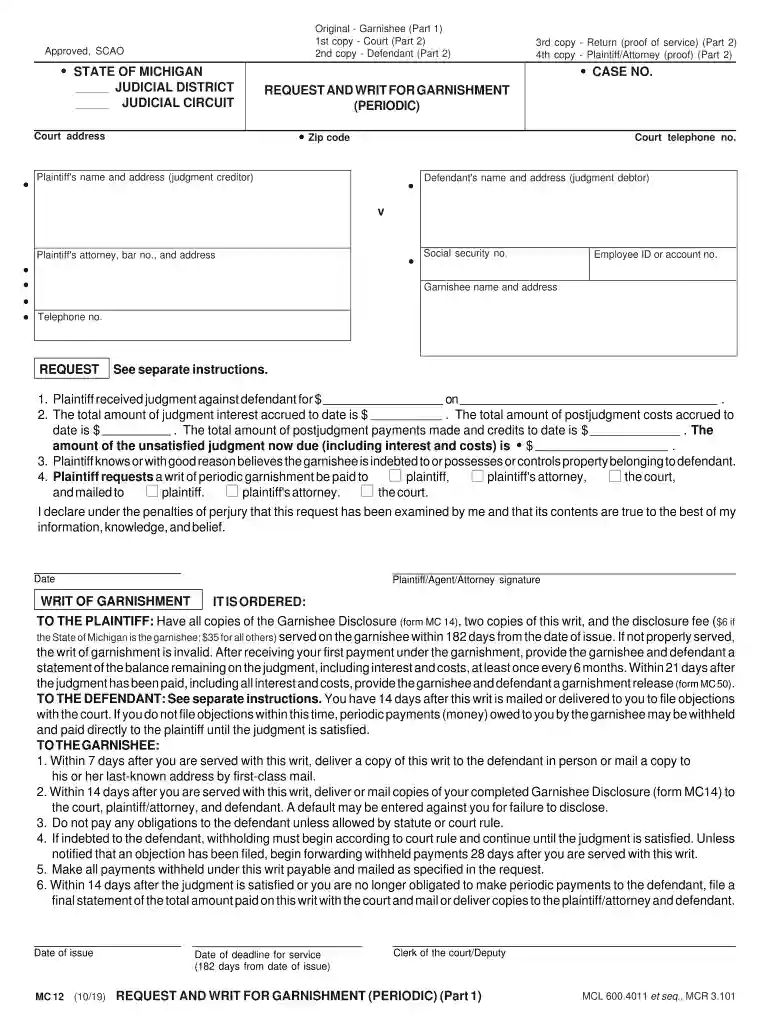
The 2019 MI MC 12 is a legal form commonly known as the Request and Writ for Garnishment (Periodic) in the State of Michigan. This form is integral to the garnishment process, where a plaintiff seeks to enforce a judgment by collecting dues from a defendant through a third-party garnishee. Garnishment involves withholding periodic payments from a defendant, ensuring the plaintiff receives the amount due. The 2019 MI MC 12 outlines responsibilities and rights of all parties involved, detailing the procedures for objections and exemptions.

How to Use the 2019 MI MC 12

The 2019 MI MC 12 is specifically utilized in legal proceedings where a creditor needs to garnish wages or other periodic payments due to a debtor. Here’s a step-by-step breakdown for using this form effectively:

  1. Identify the Parties: The form requires the identification of the plaintiff (creditor) and the defendant (debtor). You’ll also need to identify the garnishee, typically the employer or entity holding payments due to the debtor.

  2. Complete the Details: Accurately fill in the details, such as judgment amount and accrued interest. Include all required sections to avoid delays in processing.

  3. Submit the Form: Once completed, the form must be submitted to the appropriate court for approval. It’s essential to follow state-specific submission guidelines to ensure compliance and effectiveness.

  4. Serve the Garnishee: After court approval, the plaintiff is responsible for serving the garnishee with the writ. This notifies the garnishee to withhold specified amounts from the debtor’s payments.

  5. Monitor Compliance: The creditor should track compliance and ensure payments are received as stipulated. Non-compliance by the garnishee can result in legal consequences.

Key Elements of the 2019 MI MC 12

The 2019 MI MC 12 includes several key components that ensure the proper execution of garnishment:

  • Judgment Details: Information regarding the original judgment, including date and amount, is crucial.
  • Accrued Interest: This section addresses any interest that has accumulated since the judgment.
  • Garnishee Obligations: Specifies the garnishee’s duty to withhold and remit payments.
  • Defendant’s Rights: Outlines objections and exemptions rights available to the defendant under Michigan law.

Steps to Complete the 2019 MI MC 12

Filling out the 2019 MI MC 12 requires careful attention to detail:

  1. Review the Judgment Information: Gather all pertinent judgment documentation, including court case numbers and amounts.
  2. Provide Accurate Identification: Clearly list all parties involved, including third-party garnishee details.
  3. Calculate Interest and Fees: Accurately compute any additional amounts, like interest or fees due since the judgment.
  4. Court Filing: Submit the form with any necessary filing fees to the appropriate Michigan court for approval.
  5. Serve the Form: Use an approved method for serving the garnishee, ensuring legal and procedural compliance.

Important Terms Related to the 2019 MI MC 12

Understanding specific terminologies used in the 2019 MI MC 12 is vital for effective execution:

  • Garnishee: The third party holding the debtor’s funds.
  • Periodic Payments: Regular payments subject to garnishment, often including wages.
  • Exemptions: Protected income or assets the debtor may claim to avoid garnishment.

State-Specific Rules for the 2019 MI MC 12

Michigan's legal framework governs the 2019 MI MC 12. Key points to consider include:

  • Exemption Clauses: Michigan law provides several exemptions that protect portions of a debtor's income.
  • Timeline for Objections: Debtors have a specific period to object to any garnishment.
  • Court Authority: The Michigan judicial system oversees and enforces garnishment orders, ensuring compliance with state laws.

Legal Use of the 2019 MI MC 12

This form is used to legally collect judgments through wage garnishment, falling under Michigan’s umbrella of collection strategies:

  • Legally Binding: The writ serves as a court order, legally mandating compliance from the garnishee.
  • Regulated Process: The form ensures a systematic approach to debt collection, protecting rights of all involved parties.

Who Typically Uses the 2019 MI MC 12

The 2019 MI MC 12 is used by:

  • Creditors and Attorneys: Primarily, creditors or their legal representatives initiate this process to recover owed amounts.
  • Employers: Serve as garnishees, executing withholding instructions.
  • Debtors: Though indirectly involved, must respond to the served writ in compliance with Michigan laws.
decoration image ratings of Dochub
be ready to get more

Complete this form in 5 minutes or less

Get form

Got questions?

We have answers to the most popular questions from our customers. If you can't find an answer to your question, please contact us.
Contact us
Filing your Objection There is no cost to file an objection to a garnishment. You must file your objection with the court within 14 days of getting the notice of garnishment to stop the garnishment. For more information, read the instructions in Im Being Garnished for a Debt That Is Not Child Support.
Issuance of Writ of Garnishment After the request is filed, the court clerk or a judge signs the Request, and it becomes a Writ of Garnishment. The Writ of Garnishment orders the employer to hold any property (typically wages) of the employee that the employer has at the time the Writ is filed.
You have two main options: you can either negotiate a settlement to pay off the remaining balance or file a motion in court to contest the garnishment, especially if it was obtained without your knowledge or by default. You can choose to handle this yourself or hire a local attorney to assist you.
A writ of garnishment is a process by which the court orders the seizure or attachment of the property of a defendant or judgment debtor in the possession or control of a third party. The garnishee is the person or corporation in possession of the property of the defendant or judgment debtor.
Commonly Exempt Income and Assets Income/Asset TypeExempt from Garnishment? Social Security Benefits Fully exempt under federal law Supplemental Security Income (SSI) Fully exempt Veterans Benefits Fully exempt Unemployment Benefits Fully exempt3 more rows

Security and compliance

At DocHub, your data security is our priority. We follow HIPAA, SOC2, GDPR, and other standards, so you can work on your documents with confidence.

Learn more
ccpa2
pci-dss
gdpr-compliance
hipaa
soc-compliance

People also ask

In general, a writ of execution allows the sheriff or constable to seize property and assets in satisfying the judgment. Many types of property, money, and assets are included and can be seized as a result of a writ of execution.
To claim an exemption from garnishment in Michigan, file a Claim of Exemption form with the court that issued the garnishment order. You must provide documentation proving that your income qualifies as exempt, such as Social Security benefits, veterans benefits, or other protected income sources.

Related links