Employment History - NYC 2026

Get Form
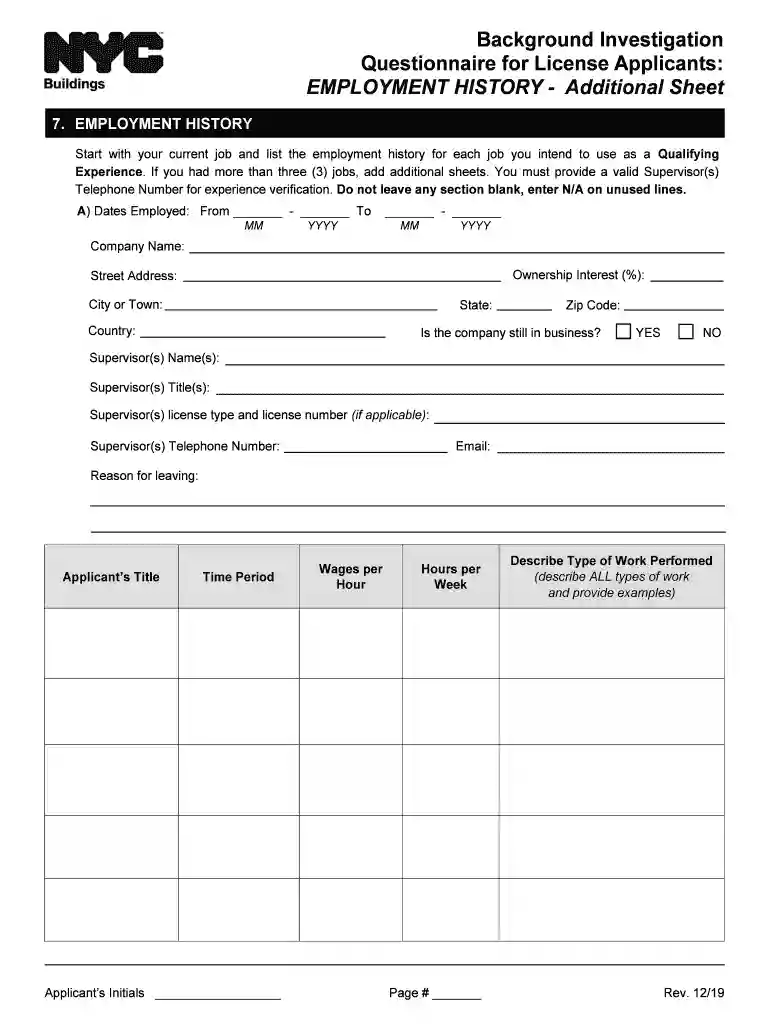
Employment History - NYC Preview on Page 1

Here's how it works

01. Edit your form online
Type text, add images, blackout confidential details, add comments, highlights and more.

02. Sign it in a few clicks
Draw your signature, type it, upload its image, or use your mobile device as a signature pad.

03. Share your form with others
Send it via email, link, or fax. You can also download it, export it or print it out.

Definition & Meaning

Employment History - NYC refers to a formal documentation requirement typically used by licensing bodies, employers, or immigration departments to verify an individual's past job experiences within New York City. This document captures comprehensive details such as job titles, employment duration, responsibilities, and supervisor contact information. The primary purpose of maintaining an employment history record is to provide a verified timeline of professional experiences, which employers can use to assess a candidate’s suitability for a particular position or opportunity. This formal record helps in maintaining credibility and transparency during the hiring process.

Steps to Complete the Employment History - NYC

Filing an Employment History - NYC requires careful attention to detail to ensure completeness and accuracy. Below are the essential steps to fill out this document efficiently:

  1. Prepare Necessary Information: Collect all relevant employment details, including job titles, start and end dates for each position, and responsibilities held. Keeping a personal record of your work history can greatly aid this process.

  2. List Previous Employers: Begin by listing all previous employers starting with the most recent position. Include the company’s name, location, and contact information for each entry.

  3. Provide Supervisor Details: For each job, provide contact information for your direct supervisor or a point of contact who can verify your employment details. This may include their name, job title, phone number, and email address.

  4. Describe Job Responsibilities: Write a concise yet comprehensive summary of your roles and responsibilities within each position. Highlight any achievements or skills acquired during your tenure.

  5. Verify Details for Accuracy: Before submission, verify all the entered information for accuracy. Ensure there are no discrepancies or missing details, as inaccuracies can lead to delays in processing.

Key Elements of the Employment History - NYC

Understanding the core components of the Employment History - NYC document can facilitate accurate and effective completion. The key elements include:

  • Personal Information: Your full name, current address, and contact details, allowing for clear identification.
  • Employment Details: A chronological record of employment, detailing each company’s name, address, and employment dates.
  • Supervisor Contacts: Names and contact information for individuals who can confirm employment validity.
  • Job Descriptions: Detailed accounts of job responsibilities and roles undertaken in each position listed.
  • Declarations and Signatures: Certification of truthfulness and accuracy, often requiring a signature to affirm the document’s authenticity.

Legal Use of the Employment History - NYC

The Employment History - NYC form serves several legal purposes in the United States, particularly within New York City. It is often required in:

  • Background Verification Checks: Many employers use this form to verify the details provided by a job candidate during the hiring process.
  • License Applications: Certain professional licenses in New York City require a documented employment history to verify experience in the relevant field.
  • Immigration Processes: For visa applications and immigration procedures, this form may be used to demonstrate employment continuity and stability.

Who Typically Uses the Employment History - NYC

The primary users of the Employment History - NYC form include:

  • Job Seekers: Individuals applying for new jobs within NYC who need to present verified employment records.
  • Professional Licensing Boards: Agencies requiring evidence of employment history for issuing licenses to practice in specific professions.
  • Immigration Authorities: Bodies that need to assess an individual’s employment status as part of immigration or naturalization applications.
decoration image ratings of Dochub

Form Submission Methods (Online / Mail / In-Person)

There are various methods available for submitting the Employment History - NYC form, depending on the requirements of the requesting entity:

  • Online Submission: Many modern employers and agencies provide digital platforms where individuals can submit employment history documents electronically for faster processing.
  • Mail Submission: Some entities may still require physical copies, which can be mailed directly to their office to ensure delivery.
  • In-Person Submission: Certain applications may require in-person verification, where documents are submitted directly to a representative for immediate processing.

Important Terms Related to Employment History - NYC

Understanding specific terms associated with Employment History - NYC helps in accurately completing the form. Key terms to know include:

  • Verification: The process of confirming the accuracy and authenticity of the information provided on the form.
  • Chronological Order: Arranging previous employment details from the most recent to the oldest.
  • Reference Check: The act of contacting listed supervisors or employers to verify employment history.

State-Specific Rules for the Employment History - NYC

While the concept of employment history documentation is widespread, there may be particular rules applicable in New York City:

  • Regulation Compliance: Ensuring that the information provided adheres to local labor laws and regulations, which may differ from other states.
  • Formal Verification Requirements: NYC may have specific standards for verifying employment history, such as requiring notarized letters from past employers.

Why Should You Use the Employment History - NYC

Providing a documented employment history offers several advantages:

  • Enhanced Credibility: Demonstrates professionalism and integrity by offering a transparent and verified work background.
  • Qualification Proof: Validates the required experience for certain job roles or professional licenses, opening avenues for career advancement.
  • Legal Compliance: Ensures conformity with various NYC-specific employment and professional licensing requirements.
be ready to get more

Complete this form in 5 minutes or less

Get form

Got questions?

We have answers to the most popular questions from our customers. If you can't find an answer to your question, please contact us.
Contact us
Salaried employees in New York can work up to 40 hours in a standard workweek. Certain salaried employees in New York can receive overtime pay if they exceed 40 hours of work per week. If a non-exempt employees work hours exceed 40, they are eligible for overtime compensation at 1.5 times their regular hourly rate.
Employers in New York City are prohibited from requesting information about job applicants previous pay or benefits. If an employer already has that information, it is prohibited from using that information to set pay.
A job application can request information about applicants compensation expectations or demands, but may not include a request for information about applicants salary history, even if the employer makes clear that a response is voluntary.
You can verify that an individual is a current or former employee of New York City by contacting the Department of Citywide Administrative Services. You will need to provide the individuals Social Security Number. You can also verify employment by contacting the human resources department at the employees agency.
Section 194 of the Labor Law prohibits employers from restricting employees ability to inquire about, discuss, or disclose wages with other employees.

Security and compliance

At DocHub, your data security is our priority. We follow HIPAA, SOC2, GDPR, and other standards, so you can work on your documents with confidence.
Learn more
ccpa2
pci-dss
gdpr-compliance
hipaa
soc-compliance