Florida Motion for Default Motion with Damages 2026

Get Form
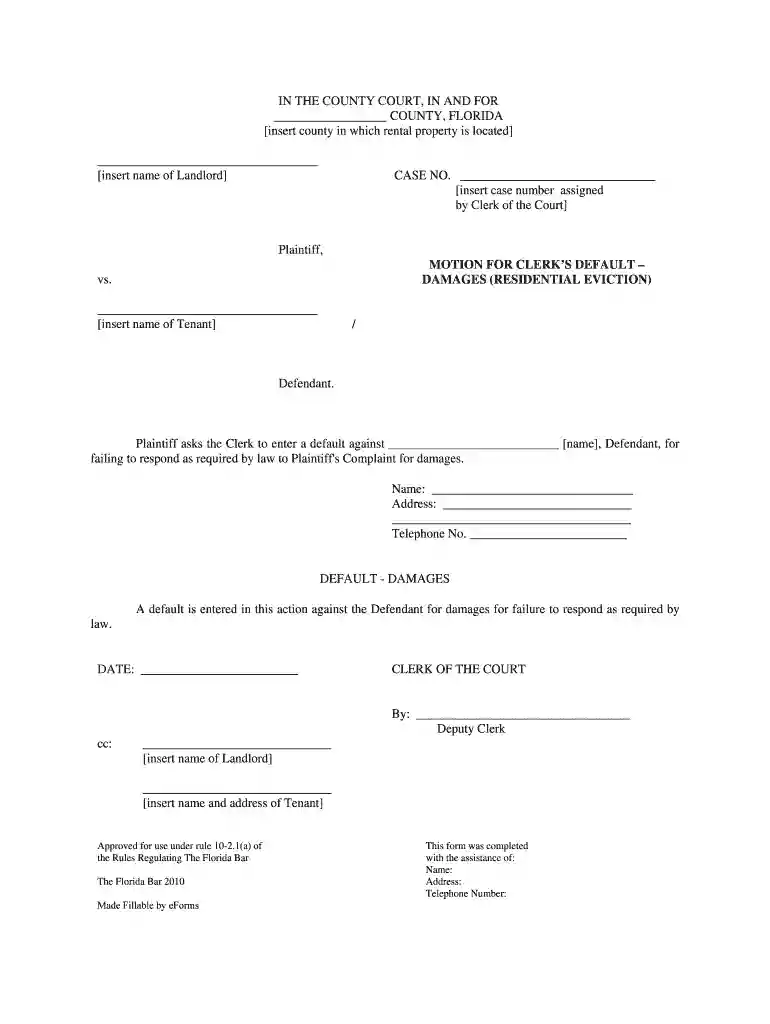
Florida Motion for Default Motion with Damages Preview on Page 1

Here's how it works

01. Edit your form online
Type text, add images, blackout confidential details, add comments, highlights and more.

02. Sign it in a few clicks
Draw your signature, type it, upload its image, or use your mobile device as a signature pad.

03. Share your form with others
Send it via email, link, or fax. You can also download it, export it or print it out.

Definition & Meaning

The "Florida Motion for Default Motion with Damages" is a legal document filed in Florida County Courts. It allows a landlord to request a default judgment against a tenant who has failed to respond to a complaint for damages related to residential eviction. By filing this motion, the landlord seeks to secure a judgment without a trial due to the tenant's inaction.

Key Elements

  • Default Judgment: When a tenant doesn't respond, they default on their right to contest the landlord's claims.
  • Damages: Refers to monetary compensation sought for any loss or injury caused by the tenant's actions or inactions.
  • Legal Standing: The landlord must ensure all legal prerequisites, like proper service of notice, are met to file this motion.

Practical Example

A landlord in Miami files this motion when the tenant, having not paid rent for three months, fails to appear or respond in court. This enables the landlord to expedite the eviction process and claim unpaid rent and any additional costs incurred.

How to Use the Florida Motion for Default Motion with Damages

Using this form effectively requires understanding its components and ensuring all procedural steps are meticulously followed.

Steps to Use

  1. Verify Tenant's Default: Confirm the tenant has not filed a response or appeared in court.
  2. Prepare the Motion: Use a clear and comprehensive structure outlining the case details and the basis for damages.
  3. File with the Clerk: Submit the completed motion to the county court clerk where the initial complaint was lodged.

Procedural Insights

  • Review Deadlines: Each court may have specific deadlines, often dictated by county-specific judicial procedures.
  • Consult Legal Counsel: It's advisable to consult with an attorney to mitigate filing errors.

How to Obtain the Florida Motion for Default Motion with Damages

Obtaining the appropriate form is a critical step in the process.

Sources for the Form

  • County Court Website: Many counties provide downloadable forms directly from their websites.
  • Legal Assistance Providers: Organizations offering legal aid might provide free access to these forms.

Example Scenario

A Broward County landlord accesses the court’s official website, navigating to the forms section to download the necessary documents for filing.

Steps to Complete the Florida Motion for Default Motion with Damages

Filling out this legal document accurately is crucial to achieving the desired legal outcome.

Detailed Completion Guide

  1. Gather Necessary Information: Have all case details, including the tenant's name, property address, and complaint details, ready.
  2. Fill Out Form Fields: Enter precise information into designated sections, ensuring no required fields are left blank.
  3. Sign and Date the Document: Legally acknowledge the motion with the preparer's signature and date of filing.

Considerations

  • Review for Errors: Double-check entries for spelling and numerical accuracy to avoid dismissal or delays.
  • Seek Help if Needed: Legal professionals can offer guidance on complex sections to ensure compliance.

Key Elements of the Florida Motion for Default Motion with Damages

The key components of this form contribute to its effectiveness in seeking legal resolution.

Main Sections

  • Case Information: Details like the court name, case number, and parties involved are fundamental.
  • Grounds for Default: Clearly state why the default judgment is sought.
  • Damages Specification: Explicitly detail the monetary compensation requested, backed by evidence.
  • Legal References: Cite relevant statutes or case law that support the motion.

Real-World Application

In a case where a tenant moves out without notice leaving unpaid utilities, the landlord specifies these expenses as part of the damages, supported with utility bills as evidence.

Legal Use of the Florida Motion for Default Motion with Damages

Understanding the legal implications of using this form reinforces its appropriate application.

Legal Context

  • Court Jurisdiction: Ensure the motion is filed in the correct jurisdiction to avoid nullification.
  • Statutory Compliance: Adhere to state statutes governing default and eviction processes.

Scenarios

A landlord with a tenant who has continuously violated lease terms files this motion as a last resort after repeated warnings and legal notices.

State-Specific Rules for the Florida Motion for Default Motion with Damages

Florida has particular rules governing filing and executing a Motion for Default with Damages.

Florida Specific Requirements

  • Service of Process: This requires proof that the tenant was properly served with the original complaint.
  • County Variations: Different counties may have slight procedural differences or additional requirements.

Considerations for Variance

A landlord in Orange County should be aware of potential additional document submission requirements that may not apply in other counties.

Examples of Using the Florida Motion for Default Motion with Damages

Examining real-world applications provides practical insights into using this legal tool effectively.

Common Situations

  • Non-payment of Rent: A landlord files for default when a tenant is significantly behind on payments and has been unresponsive.
  • Property Damage Compensation: Used when a tenant vacates without addressing significant damage to the property, demanding repair costs as damages.

Practical Example

In a situation where a tenant abandoned the property, leaving behind damage exceeding $5,000, the landlord successfully obtains a default judgment for repair costs through this motion.

Who Typically Uses the Florida Motion for Default Motion with Damages

Understanding typical users can guide the intended application of this legal form.

decoration image ratings of Dochub

Primary Users

  • Landlords: Individuals or companies owning rental properties.
  • Property Managers: Acting on behalf of property owners to maintain and manage tenant relations.

Contextual Case

In a multi-property management business, the managers frequently utilize this form for tenants in default across various rental units to streamline the eviction and damage recovery process.

be ready to get more

Complete this form in 5 minutes or less

Get form

Got questions?

We have answers to the most popular questions from our customers. If you can't find an answer to your question, please contact us.
Contact us
If the defendant has never responded, then the plaintiff need not even serve the defendant with the motion for default judgment. If the court is satisfied with this evidence, it will then grant the default judgment, making the defendant liable in some amount to the plaintiff.
Rule 1.500 establishes three types of defaults: by the clerk (section (a)), by the judge (section (b)), and Final (section (e)). The clerk default is simple. If you were sued and you failed to file or serve any document in response, the courts clerk may enter a default.
A motion for new trial or for rehearing must be served not later than 15 days after the return of the verdict in a jury action or the date of filing of the judgment in a non-jury action. A timely motion may be amended to state new grounds in the discretion of the court at any time before the motion is determined.
DEFAULTS AND FINAL JUDGMENTS THEREON. (a) By the Clerk. When a party against whom affirmative relief is sought has failed to file or serve any paper in the action, the party seeking relief may have the clerk enter a default against the party failing to serve or file such paper.
EXECUTIONS AND FINAL PROCESS. (a) Issuance. Executions on judgments shall issue during the life of the judgment on the oral request of the party entitled to it or that partys attorney without praecipe.

Security and compliance

At DocHub, your data security is our priority. We follow HIPAA, SOC2, GDPR, and other standards, so you can work on your documents with confidence.


Learn more
ccpa2
pci-dss
gdpr-compliance
hipaa
soc-compliance