






Definition & Meaning
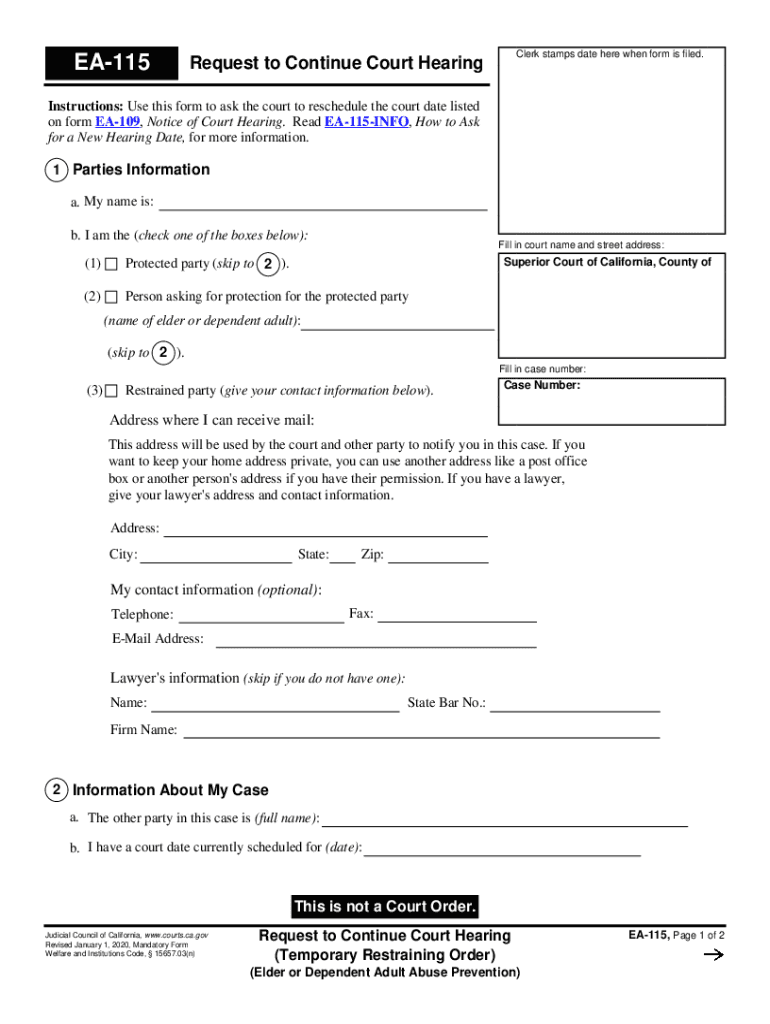
The EA-115 form, known as the "Request to Continue Court Hearing" under the Judicial Council forms, is specifically designed for situations involving elder or dependent adult abuse prevention. This document is intended for use when parties involved in such cases need to reschedule their court hearings. The form includes fields for listing the parties involved, detailing the case information, and providing specific reasons for requesting the continuation. Privacy is a major emphasis, ensuring sensitive details are handled with care. Filling out this form correctly is crucial, as it directly impacts the scheduling and proceedings of court cases.
How to Use the EA-115 Request to Continue Court Hearing
To effectively use the EA-115 form, individuals or attorneys must follow a specific process. First, ensure that the form is accurately filled out, providing all requested information, such as the names of the parties involved, case numbers, and detailed reasons for the request to continue the hearing. The completed form must be submitted to the court handling the case.
- Verify Eligibility: Confirm that your case involves elder or dependent adult abuse prevention.
- Complete the Form: Fill in personal and case details, clearly stating reasons for continuation.
- Submit the Form: Deliver the form to the appropriate court, either online, by mail, or in person, depending on the court's accepted submission methods.
It is important to check with the local court for any specific submission guidelines to ensure the form is processed correctly and your request is considered.
Steps to Complete the EA-115 Request to Continue Court Hearing
When completing the EA-115 form, follow these structured steps to ensure accuracy and compliance:
- Gather Information: Collect all necessary case details, including case numbers and party information.
- Begin with Party Information: Fill in the names, addresses, and contact information of all parties involved.
- Detail Case Information: Include the court location, case number, and date of the original hearing.
- State Reasons for Continuation: Clearly articulate the reason for requesting a different date, such as scheduling conflicts or the need for more time to gather evidence.
- Sign the Form: Ensure that the party requesting the continuation or their attorney signs and dates the form.
Before submission, double-check for completeness and accuracy to avoid delays in processing.
Key Elements of the EA-115 Request to Continue Court Hearing
The EA-115 form consists of several key components essential for its intended purpose:
- Party Information: Lists the plaintiff and defendant details, ensuring clear identification.
- Case Information: Contains the current hearing date, case number, and court location.
- Reason for Continuation: Requires a detailed justification for why the hearing should be rescheduled.
- Confidentiality Notices: Highlights the importance of maintaining the privacy of all involved parties.
Each section must be thoroughly completed to ensure the request is considered valid and meets judicial expectations.
Important Terms Related to EA-115
Certain terms are central to understanding and completing the EA-115 form:
- Continuance: The official legal term for postponing a court hearing.
- Petitioner: The individual or entity requesting the continuation.
- Respondent: The opposing party in the legal case.
- Judicial Council: The body responsible for overseeing court procedures and the issuance of forms like the EA-115.
A clear understanding of these terms is crucial for accurately completing and submitting the form.
Legal Use of the EA-115 Form
The EA-115 form is used within a legal context that requires following specific procedures:
- Filing for Continuation: Legally permits a change of court dates in elder or dependent adult abuse cases.
- Court Approval: The form must be approved by the court, which evaluates the reasonableness of the request.
- Adherence to Protocols: Strict adherence to court-established protocols and deadlines is necessary to avoid potential rejection.
Understanding these legal frameworks ensures appropriate and effective use of the EA-115.
Examples of Using the EA-115 Form
Examples demonstrate practical application of the EA-115:
- Scheduling Conflicts: A petitioner knows ahead of time that they will be unable to attend the scheduled court date due to a prior commitment, such as a medical appointment or work obligation.
- Incomplete Evidence Gathering: Legal counsel requires additional time to collect necessary evidence or witness testimony critical to the case.
- Negotiation Extensions: Parties are engaged in settlement discussions and wish to continue these efforts before proceeding to court.
In each scenario, the EA-115 provides a formal mechanism to adjust the court hearing to better suit the needs of both parties involved.
State-Specific Rules for EA-115 Forms
Though the EA-115 is used broadly, certain states may have specific rules that affect its use:
- Submission Deadlines: Some states impose deadlines for filing continuance requests, often requiring submission well ahead of the originally scheduled hearing.
- Supporting Documentation: Certain jurisdictions may necessitate additional documentation to substantiate the request for a continuation.
Reviewing state-specific regulations prior to filing ensures compliance and enhances the likelihood of acceptance.
Form Submission Methods (Online / Mail / In-Person)
The EA-115 can be submitted through multiple channels:
- Online Submission: Many courts offer electronic submission portals for convenience and speed.
- Mail Submission: Physical forms can often be sent via certified mail to the courthouse.
- In-Person Submission: Forms may be hand-delivered to the court clerk's office, providing immediate confirmation of receipt.
Selecting the right method depends on court preferences and personal comfort level.