Definition and Purpose of a Chattel Lien in Washington State
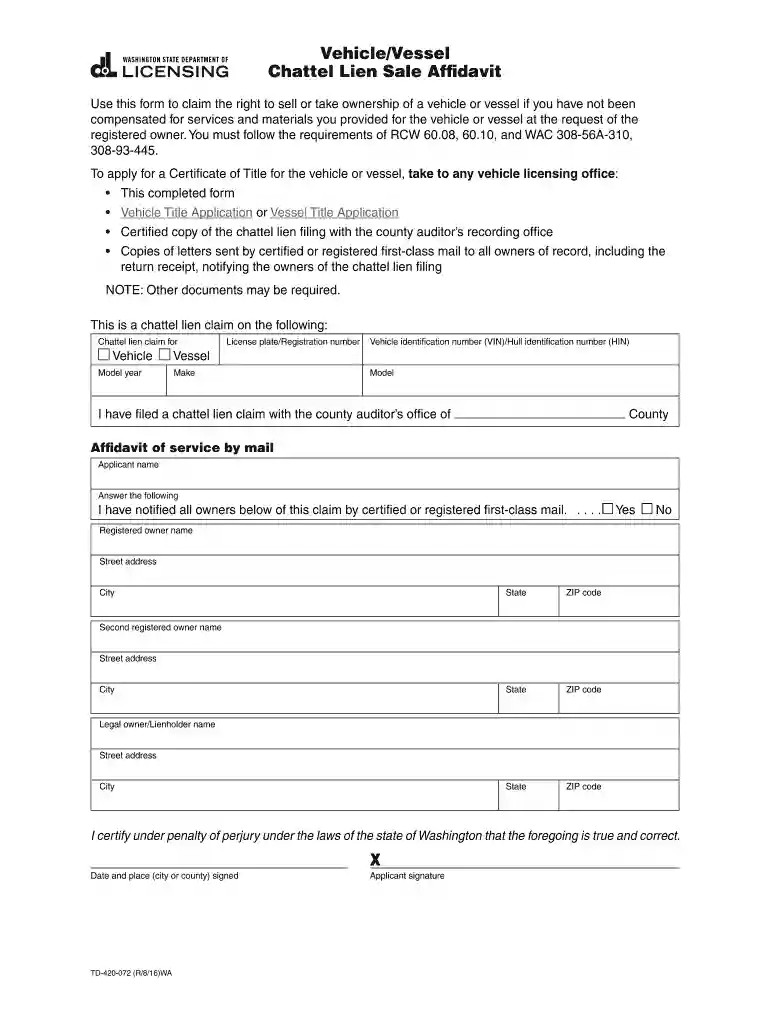
A chattel lien in Washington State is a legal mechanism that allows a service provider or materials supplier to claim an interest in a debtor's personal property, such as a vehicle or vessel, when the debtor has failed to fulfill payment obligations. This type of lien is utilized to recover the costs of labor or materials provided. The process involves filing a chattel lien sale affidavit form, which serves as a formal declaration of intent to sell or repossess the property to recover the owed amount.
Components of a Chattel Lien
- Lienholder Details: This includes information about the claimant such as name, address, and contact information.
- Debtor Information: Details about the owner of the property against whom the lien is being filed.
- Description of the Property: A thorough description of the vehicle or vessel, including Vehicle Identification Number (VIN) or Hull Identification Number (HIN).
- Amount Owed: Specification of the costs for services or materials that remain unpaid.
- Date of Services Provided: The dates during which the services were performed or materials were supplied.
Process of Filing a Chattel Lien in Washington State
To file a chattel lien in Washington State, you must follow a series of precise steps to ensure compliance with state laws and maximize the chances of lien enforcement.
Steps to File a Chattel Lien
- Service Completion Verification: Ensure that the services have been fully rendered or materials completely supplied.
- Prepare a Chattel Lien Sale Affidavit: Accurately complete the affidavit form detailing all relevant information.
- File with County Auditor: Submit the affidavit to the county auditor's office where the property is registered.
- Notification to Owners: Send notifications to all registered owners, informing them of the lien filing.
- Wait for Response Period: Allow the statutory response period, typically 30 days, for the owner to respond or settle the dues before proceeding with the sale or repossession.
Legal Framework and Compliance
The legal framework governing chattel liens in Washington State ensures that lien filings follow a structured process to protect the rights of both creditors and owners.
Statutory Compliance
- Filing Deadlines: The lien notice must be filed promptly, generally within 90 days from the date of service completion.
- Notification Obligations: Creditors must notify all interested parties, including secured creditors, to comply with notification requirements.
- Enforcement Regulations: If the owner does not respond, the lienholder may proceed with the sale of the property to recoup unpaid costs.
Required Documentation for Filing
The following documents are necessary to file a chattel lien:
- Chattel Lien Sale Affidavit: An official document that outlines the lien details.
- Proof of Service/Materials Provided: Invoices, contracts, or receipts demonstrating the nature and cost of services/materials.
- Previous Notifications Sent: Copies of notices sent to the debtor and other parties.
Optional Attachments
- Photos of the Property: To verify the condition and existence of the property at the time of lien filing.
- Correspondence Records: Emails or letters exchanged with the debtor regarding the owed amount.
Key Participants in the Chattel Lien Process
Understanding who typically uses and who is involved in the chattel lien process can provide clarity and manage expectations.
Main Participants
- Service Providers and Mechanics: Often the principal users who file liens due to unpaid repair services.
- Material Suppliers: Businesses providing materials for vehicle or vessel maintenance may also file liens.
- Property Owners: Individuals or entities that own the encumbered property are central to the lien resolution.
Differences in State-specific Lien Regulations
While chattel liens are common across various states, Washington State’s regulations have specific nuances.
Washington State Specific Rules
- Legal Thresholds: Certain dollar limits may trigger additional compliance obligations.
- Reporting Mandates: Unique state requirements stipulate how lien filings must be reported to public records.
Examples and Use Cases
To better understand the utility and application of chattel liens, observing real-world examples can be illustrative.
Common Scenarios
- Unpaid Mechanic Services: A garage that has completed significant auto repairs may file a lien if the car owner fails to pay.
- Defaulted Vessel Storage Fees: A marina may apply a lien against a boat for which storage fees are overdue.
Understanding and properly filing a chattel lien in Washington State can lead to successful payment recovery for goods and services rendered. Each element of the process must be followed with diligence to ensure the enforceability of the lien.