01. Edit your form online
Type text, add images, blackout confidential details, add comments, highlights and more.

Type text, add images, blackout confidential details, add comments, highlights and more.

Draw your signature, type it, upload its image, or use your mobile device as a signature pad.

Send it via email, link, or fax. You can also download it, export it or print it out.
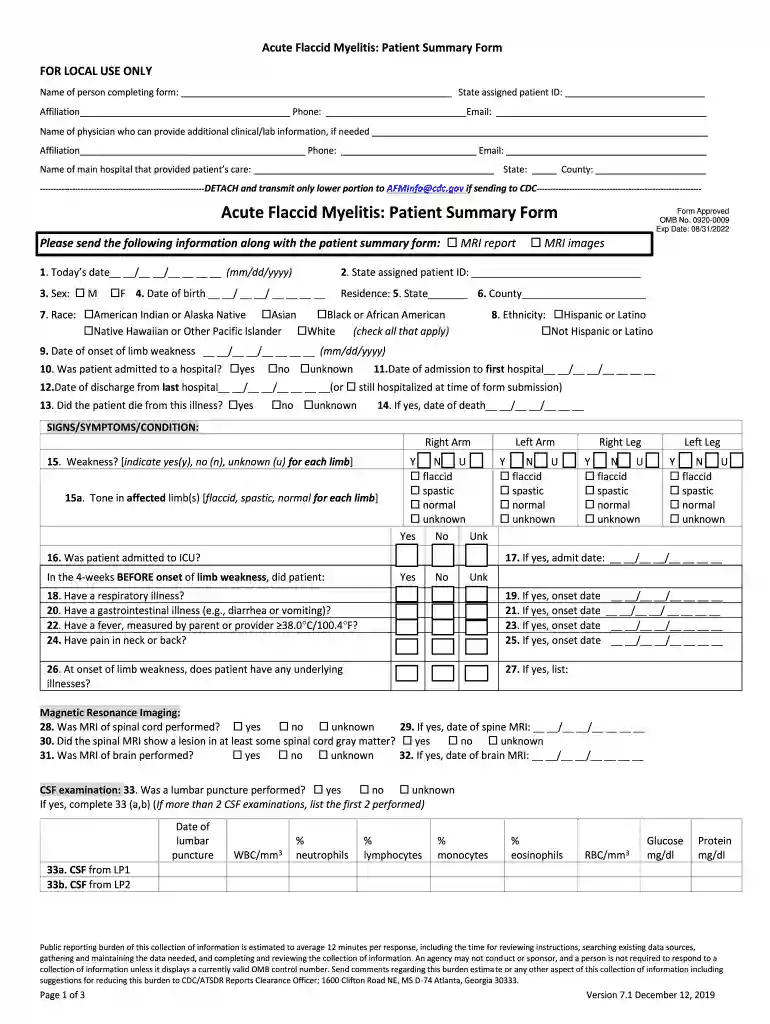
Acute Flaccid Myelitis (AFM) is a rare but serious condition that affects the nervous system, primarily in children. It causes severe muscle weakness and can lead to paralysis. Understanding AFM is crucial as it helps in managing and tracking cases effectively. The CDC emphasizes the importance of early detection and treatment to improve outcomes. By standardizing data collection, the AFM Patient Summary Form aids healthcare professionals and public health authorities in identifying trends and potential outbreaks.
The Acute Flaccid Myelitis Patient Summary Form serves to collect comprehensive data regarding individuals diagnosed with confirmed or probable AFM. This information includes demographics, clinical history, MRI results, and follow-up assessments. By gathering standardized data, the form helps in analyzing and understanding the epidemiology of AFM, facilitating research efforts to combat the disease and develop effective treatment strategies.
Patient Information Section: Start by entering basic demographic information about the patient. This includes name, age, gender, and contact details. Ensure accuracy as this information is critical for patient identification and follow-up.
Clinical History and Symptoms: Document the patient's medical history, focusing on the onset of symptoms related to AFM. Provide a detailed account of the symptoms, such as limb weakness, and any prior viral infections.
MRI and Neurological Findings: Include results and interpretations of MRI scans, which are fundamental for diagnosing AFM. Detail any abnormalities observed that support the diagnosis.
Follow-Up Results: Record any follow-up assessments, detailing improvements or deteriorations in the patient’s condition. This section helps in tracking the effectiveness of treatments and rehabilitation efforts.
The form can be accessed through the CDC’s official website or directly from public health departments. It is designed for both digital and paper submission, ensuring flexibility for healthcare providers. Online availability simplifies distribution and retrieval while maintaining data integrity.
Medical professionals, including pediatric neurologists and infectious disease specialists, predominantly use this form. Public health officials and researchers may also employ it to gather relevant data for epidemiological studies. Its use is crucial in hospitals, clinics, and research institutions focused on neurology and infectious diseases.
The form adheres to HIPAA guidelines, ensuring that patient information is used and shared legally and ethically. Healthcare providers must ensure patient consent is obtained where necessary, safeguarding privacy while allowing essential data collection for public health purposes.
Digital submission of the form is encouraged due to the ease of data integration and sharing among health authorities. However, paper versions are still available for institutions not equipped for digital submission. Both methods provide a secure channel for data collection, but electronic submissions typically facilitate quicker analysis and response.
Non-compliance with the requirement to submit accurate and timely AFM data can lead to public health data gaps, hindering effective intervention strategies. While there may be no direct legal penalties for individuals, healthcare institutions could face scrutiny and loss of credibility in the public health domain for failing to comply with reporting obligations.
While the primary AFM Patient Summary Form is tailored broadly for AFM cases, regional health departments may offer adapted forms to address specific local needs, such as language preferences or additional data points tailored to particular population demographics.
The form serves varied purposes: aiding in targeted clinical interventions, contributing to a national database for trend analysis, supporting public health research, and assisting in resource allocation for AFM management. Each use case underscores its role in enhancing our understanding and handling of AFM on both individual and collective health fronts.
We've got more versions of the Acute Flaccid Myelitis Patient Summary Form - Centers for form. Select the right Acute Flaccid Myelitis Patient Summary Form - Centers for version from the list and start editing it straight away!
| Versions | Form popularity | Fillable & printable |
|---|---|---|
| 2019 | 4.8 Satisfied (118 Votes) |
At DocHub, your data security is our priority. We follow HIPAA, SOC2, GDPR, and other standards, so you can work on your documents with confidence.