01. Edit your form online
Type text, add images, blackout confidential details, add comments, highlights and more.

Type text, add images, blackout confidential details, add comments, highlights and more.

Draw your signature, type it, upload its image, or use your mobile device as a signature pad.

Send it via email, link, or fax. You can also download it, export it or print it out.
Florida's Prescription Drug Monitoring Program (PDMP) is a state-mandated initiative aimed at reducing the misuse of prescription medications, especially controlled substances. The PDMP collects and analyzes dispensing information to monitor and prevent prescription drug abuse. By creating a centralized database, it provides healthcare professionals with critical insights into a patient's prescription history, aiding in responsible prescribing practices and enhancing patient care. The program is essential for promoting public health and ensuring controlled substances are prescribed appropriately.
Utilizing the PDMP involves several steps that healthcare practitioners must follow to access and interpret data effectively.
Registration and Access: Health professionals must register with the PDMP to gain access. Registration typically involves verifying credentials and agreeing to the terms of use.
Data Access: Once registered, users can log in to the PDMP portal to access prescription data. The interface allows searches by patient name, medication, or prescriber.
Interpreting Data: The system provides comprehensive dispensing records which professionals use to analyze patterns and identify any signs of prescription drug misuse.
Integration into Practice: Incorporate PDMP data into routine practice to help determine appropriate treatment plans and improve patient safety.
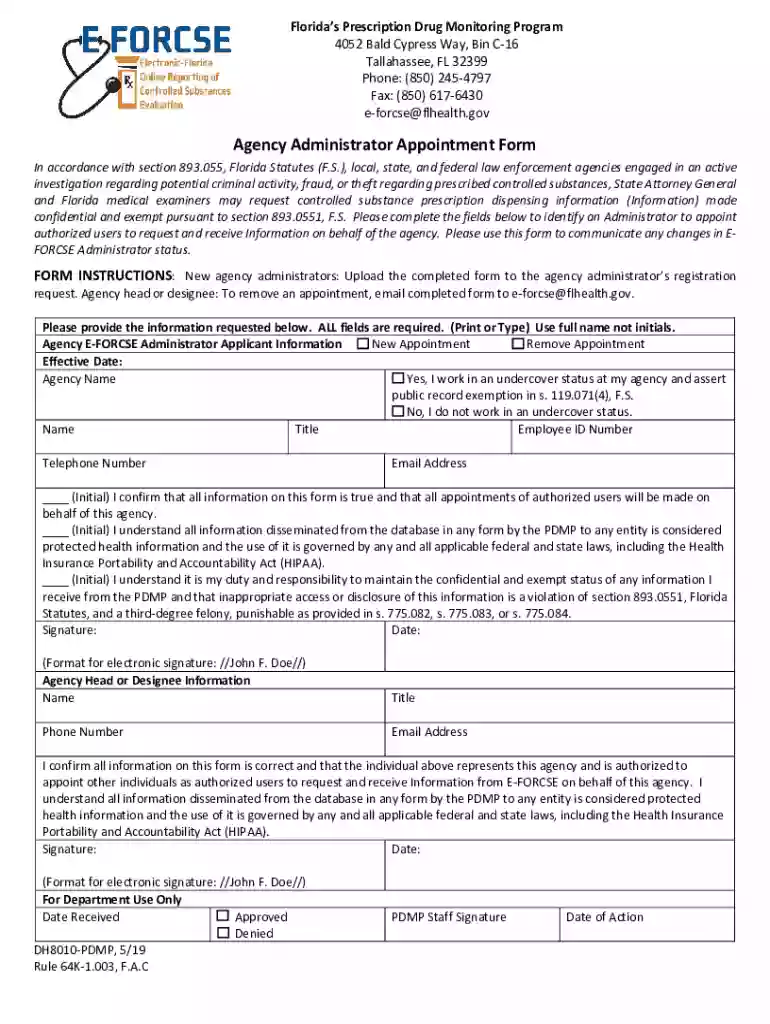
Completing the PDMP form for appointing an agency administrator involves sequentially addressing specific requirements.
Agency Information: Begin by filling out the agency's details, including the official name, address, and contact information.
Administrator Details: Provide the full name, contact information, and credentials of the proposed administrator.
Authorization and Consent: The current administrator or authorized personnel must sign the form, indicating consent to appoint the new administrator.
Submission: Submit the completed form to the designated Florida state department as outlined in the official submission guidelines.
The PDMP's legal framework ensures its utilization for controlled substance monitoring while protecting patient privacy. The program adheres to state laws governing health information confidentiality and is used strictly for authorized purposes such as:
Prescription Monitoring: Identifying patterns of controlled substance prescriptions and preventing over-prescription.
Investigation of Misuse: Assisting law enforcement and regulatory bodies in investigating potential abuse or diversion of prescription drugs.
The PDMP comprises several critical components that ensure its effectiveness:
Database Structure: A comprehensive, state-managed database storing prescription information securely.
Data Security: Robust data protection measures, including encryption and authentication protocols, to safeguard sensitive information.
User Access Controls: Access is limited to registered healthcare professionals and authorized state personnel, ensuring responsible use of data.
Real-time Data Reporting: Continuously updated prescription data provides timely insights for healthcare decision-making.
To register for the PDMP, healthcare professionals need to submit various documents:
Professional Credentials: Copies of medical licenses or other relevant certifications verifying eligibility.
Identification Proof: A government-issued ID for identity verification.
State Application Form: A completed PDMP registration form, available from the state health department's website.
There are multiple ways to submit forms related to the PDMP:
Online Submission: Preferred method for speed and efficiency, forms can be submitted through the state's dedicated PDMP portal.
Mail-In Option: Paper forms can be mailed to the designated state department address, though this may extend processing times.
In-Person Delivery: Less common but allows for direct submission and immediate receipt acknowledgment.
Non-compliance with PDMP regulations carries significant penalties aimed at ensuring adherence to legal and ethical standards.
Fines and Sanctions: Health professionals who fail to utilize the PDMP as required may face fines or disciplinary actions by medical boards.
License Revocation: Severe violations can result in the suspension or revocation of medical licenses.
Understanding and utilizing Florida's PDMP effectively is vital for healthcare providers committed to responsible prescribing and combating prescription drug abuse.
We've got more versions of the Floridas Prescription Drug Monitoring Program form. Select the right Floridas Prescription Drug Monitoring Program version from the list and start editing it straight away!
At DocHub, your data security is our priority. We follow HIPAA, SOC2, GDPR, and other standards, so you can work on your documents with confidence.