01. Edit your form online
Type text, add images, blackout confidential details, add comments, highlights and more.

Type text, add images, blackout confidential details, add comments, highlights and more.

Draw your signature, type it, upload its image, or use your mobile device as a signature pad.

Send it via email, link, or fax. You can also download it, export it or print it out.
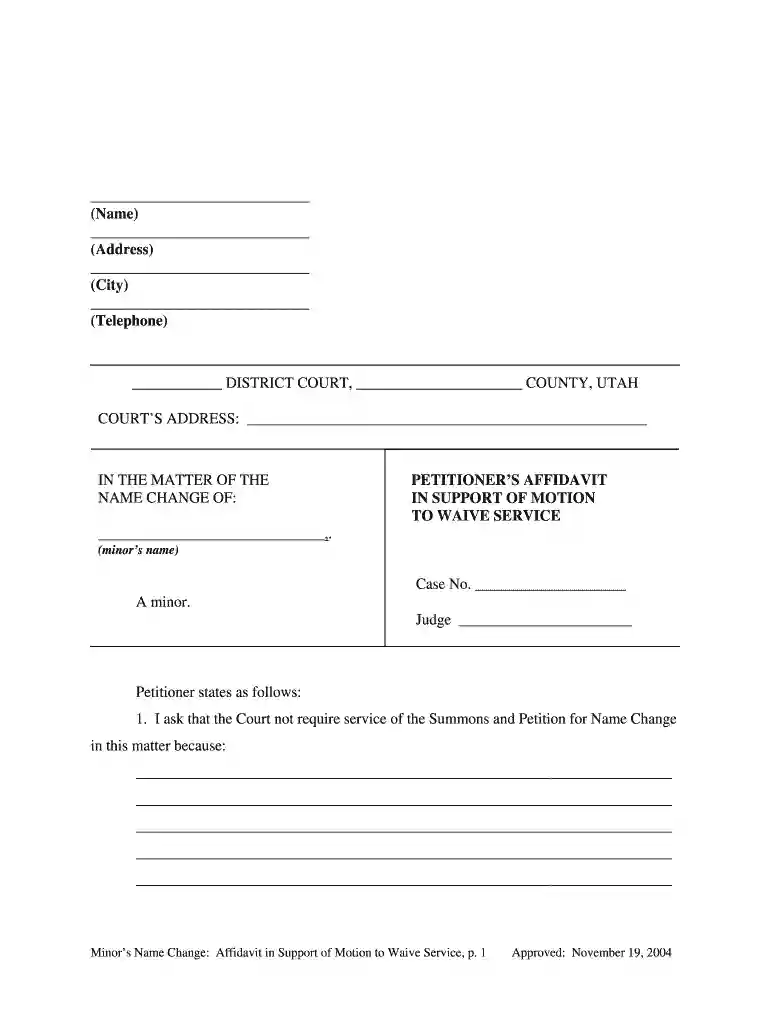
A Petitioner's Affidavit in Support of Motion to Waive Service is a legal document submitted by a petitioner in a court proceeding. This affidavit requests the court to waive the requirement for serving a Summons and Petition, commonly used in cases like minor's name changes. The affidavit includes the petitioner's sworn statement, confirming their identity and voluntary submission, along with the minor's details. It serves as an official acknowledgment to streamline the legal process, emphasizing the petitioner's intent and compliance with procedural needs without undergoing formal service requirements.
Using the Petitioner's Affidavit involves a structured process to ensure compliance with local and state laws. Typically, this affidavit supports motions in situations like minor's name changes or other family law matters.
Completing the Petitioner's Affidavit requires meticulous attention to detail. Follow these steps to ensure a correct submission:
For a minor's name change, submit alongside a petition, including reasons for the request and any relevant legal grounds. Reviewers will often find it submitted in cases where formal notice requirements may otherwise impede progress.
Understanding the key elements is essential for completing the affidavit effectively. These components ensure the document is comprehensive and valid:
Legal contexts vary widely state by state. It's crucial to understand the relevant regulations governing affidavits in your jurisdiction.
Researching state-specific statutes or consulting legal professionals ensures you align closely with regional requirements.
Legal compliance involves ensuring the affidavit meets statutory standards and ethical practices. It establishes accountability and transparency within legal proceedings.
Determining eligibility for using this affidavit can be crucial, especially when seeking court approvals for petitions involving minors.


Individuals or their representatives need to meet essential criteria to utilize this affidavit effectively.
Familiarity with key terminology enhances comprehension of this affidavit’s purpose and application.
Real-world understanding of these terms facilitates smoother navigation in legal settings and documentation accuracy.
We've got more versions of the PETITIONERS AFFIDAVIT IN SUPPORT OF MOTION TO WAIVE SERVICE form. Select the right PETITIONERS AFFIDAVIT IN SUPPORT OF MOTION TO WAIVE SERVICE version from the list and start editing it straight away!
| Versions | Form popularity | Fillable & printable |
|---|---|---|
| 2004 | 4.8 Satisfied (79 Votes) |
At DocHub, your data security is our priority. We follow HIPAA, SOC2, GDPR, and other standards, so you can work on your documents with confidence.