Definition & Meaning
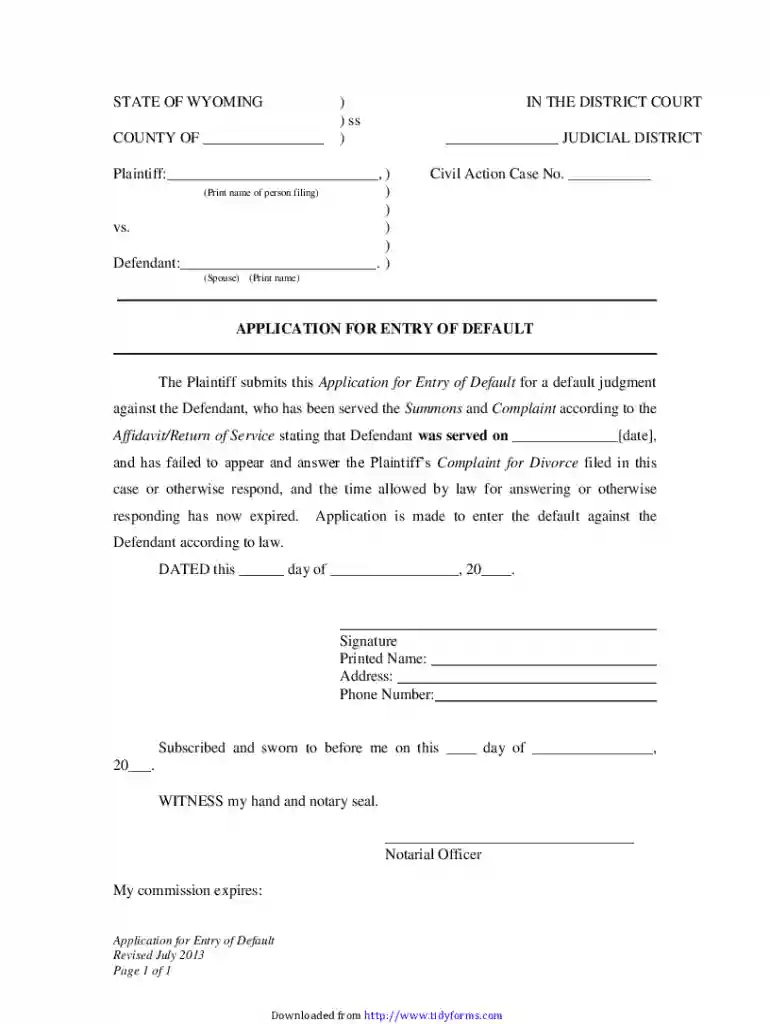
The 2013 Wyoming Application for Entry of Default is a legal document used in civil cases when a defendant fails to respond to a summons and complaint within the specified legal timeframe. This lack of response allows the plaintiff to request a default judgment from the court, essentially granting the plaintiff a victory due to the defendant's inaction. This form is particularly relevant in divorce proceedings where one party does not contest the divorce, enabling the court to proceed without their input.
How to Use the 2013 WY Application for Entry of Default
To effectively use the 2013 Wyoming Application for Entry of Default, follow these steps:
- Serve the Defendant: Ensure the defendant was properly served with the summons and complaint according to Wyoming law.
- Wait for Response: Allow the legal response period, typically twenty days, for the defendant to reply.
- Prepare the Application: If no response is received, fill out the application accurately, noting the lack of defendant reply.
- File with Court: Submit the completed application to the court that is handling the case.
- Await Judgment: The court will review the application and, if approved, will issue a default judgment.
Steps to Complete the 2013 WY Application for Entry of Default
- Obtain the Form: Access the form from the Wyoming court’s website or obtain a physical copy from the court clerk.
- Fill Out Personal Information: Enter the plaintiff and defendant's names, case number, and court details.
- Proof of Service: Attach documentation that shows the defendant was served.
- Indicate Non-Response: Clearly state that the response period has expired with no reply from the defendant.
- Sign and Date: Ensure the application is signed and dated by the plaintiff or their legal representative.
- Submit: File the application in-person, by mail, or via an online court system if available.
Key Elements of the 2013 WY Application for Entry of Default
- Plaintiff and Defendant Identification: Essential for court processing and record-keeping.
- Case Information: Including the docket or case number and court location.
- Proof of Service: To demonstrate the defendant was properly notified.
- Statement of Non-Response: Verifying the timeline and lack of reply.
- Signature and Date: Legally binding the application.
State-Specific Rules for the 2013 WY Application for Entry of Default
Wyoming has specific regulations for the completion and submission of this form:
- Response Timeframe: The defendant is given twenty days to respond once served.
- Filing Locations: Applications must be filed in the appropriate district court handling the case.
- Local Court Variations: Certain court districts may have additional requirements or procedural steps.
Filing Deadlines / Important Dates
- Initial Filing Date: Calculate from the day the defendant was served.
- Response Period Deadline: Typically twenty days from the service date.
- Default Judgment Request: Available immediately after the response deadline expires, assuming no answer was received.
Required Documents
When completing the 2013 WY Application for Entry of Default, include:
- Completed Application Form: Accurate and fully filled.
- Proof of Service Documentation: Such as a signed affidavit from the serving officer.
- Copy of the Summons and Complaint: To show the court the original materials served to the defendant.
Legal Use of the 2013 WY Application for Entry of Default
The form is legally necessary to request a court's default judgment in scenarios where:
- A Defendant's Non-Participation: Sidesteps the need for continued litigation.
- Speeding Court Proceedings: Advances cases without undue delay when a response is not forthcoming.
- Ensuring Fair Process: The legal mechanism to hold defendants accountable for ignoring legal notices.