01. Edit your 433b online
Type text, add images, blackout confidential details, add comments, highlights and more.

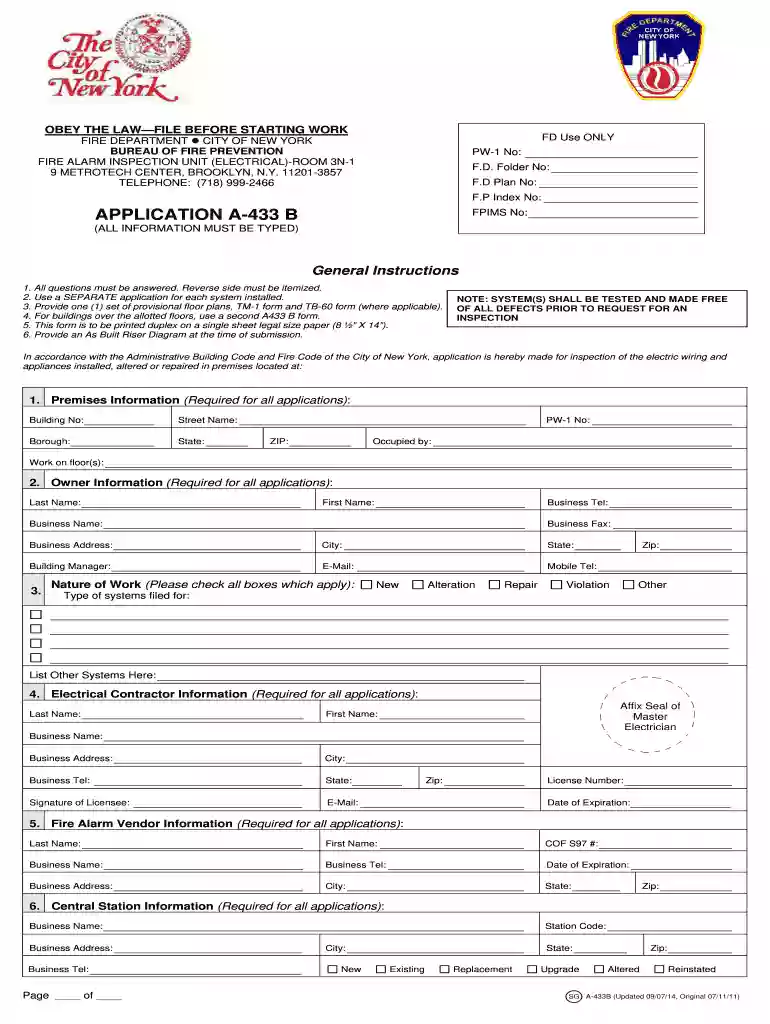
Type text, add images, blackout confidential details, add comments, highlights and more.

Draw your signature, type it, upload its image, or use your mobile device as a signature pad.

Send a433b via email, link, or fax. You can also download it, export it or print it out.
The A 433 B form, often known as the Collection Information Statement for Businesses, is a critical document used by the Internal Revenue Service (IRS) to determine a business's financial condition. It plays an essential role in organizing a taxpayer's financial data to evaluate an organization's ability to pay outstanding tax liabilities. This form encompasses diverse financial details, including income, expenses, assets, and liabilities, providing a comprehensive picture of the business’s financial status.
Successfully completing the A 433 B form requires precise attention to detail. Here’s a step-by-step guide to assisting businesses in navigating the process:
Gather Required Documents: Before initiating form completion, collect necessary documentation such as recent bank statements, income records, and lists of assets and liabilities. This ensures accuracy in reported data.
Section 1: Business Information: Fill out essential details including the business name, address, employer identification number, and type of establishment.
Section 2: Financial Condition: Report the company’s cash, accounts receivable, and other liquid assets. Documentation should support the numbers provided to ensure consistency and reliability.
Section 3: Assets: List all sizable assets owned by the business, including real estate, machinery, and vehicles, providing support documentation where available.
Section 4: Income and Expenses: Report business income, including gross receipts, and detail ordinary and necessary business expenses.
Review and Submit: Carefully review the form for any discrepancies before submitting to ensure accuracy and completeness.
The A 433 B form is primarily used by businesses experiencing difficulty in satisfying their full tax obligations due to financial constraints. Common users include:


Supporting documents are vital for corroborating the information provided in the form. Businesses should be prepared to furnish:
The IRS provides specific guidelines surrounding the A 433 B form to ensure comprehensive reporting. Key aspects include:
Failure to comply with the A 433 B form’s requirements can result in stringent consequences:
Businesses have multiple avenues for submitting the A 433 B form, allowing flexibility based on their preferences:
The availability of both digital and paper versions of the A 433 B form provides businesses with options depending on their operational setup:
We've got more versions of the 433b form. Select the right 433b version from the list and start editing it straight away!
| Versions | Form popularity | Fillable & printable |
|---|---|---|
| 2014 | 4.9 Satisfied (455 Votes) |
At DocHub, your data security is our priority. We follow HIPAA, SOC2, GDPR, and other standards, so you can work on your documents with confidence.