01. Edit your business financial statement form online
Type text, add images, blackout confidential details, add comments, highlights and more.

Type text, add images, blackout confidential details, add comments, highlights and more.

Draw your signature, type it, upload its image, or use your mobile device as a signature pad.

Send financial help for small business during pandemic in texas via email, link, or fax. You can also download it, export it or print it out.
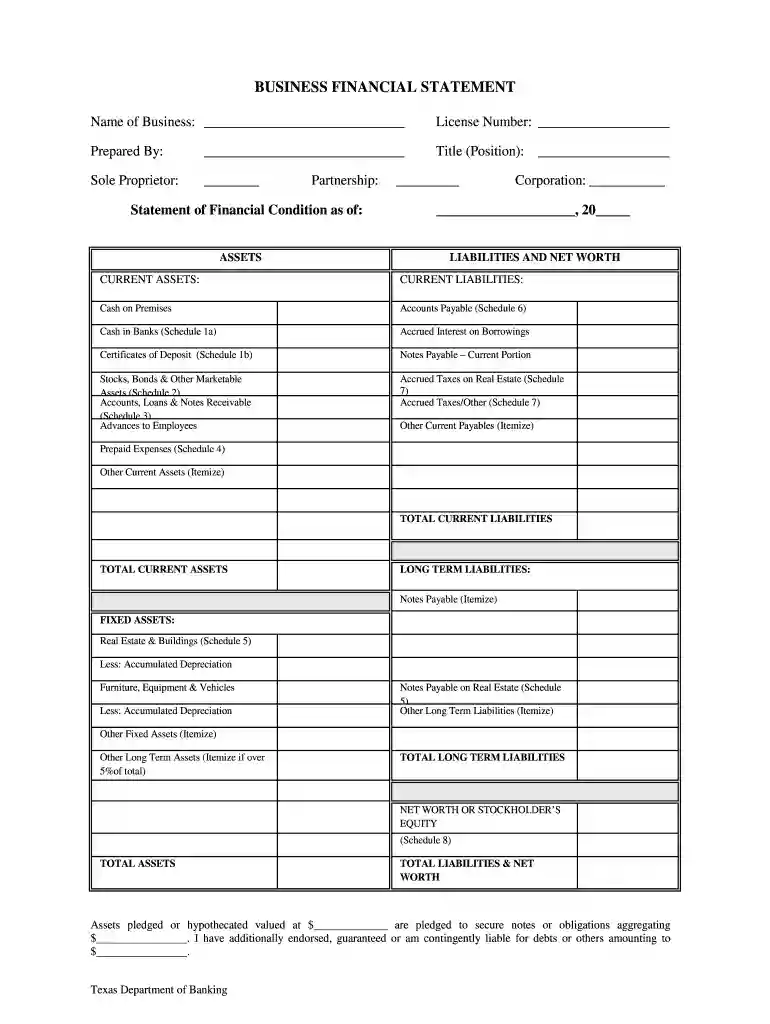
A "Texas Business Financial Statement" is a detailed document that provides a comprehensive overview of a business's financial position within the state of Texas. This statement includes an assessment of the company's assets, liabilities, and net worth as of a specific date. Its primary purpose is to give stakeholders—including owners, investors, and financial institutions—an accurate picture of the company's financial health. By organizing financial data into distinct categories, this statement supports informed business decisions.
A Texas Business Financial Statement is composed of several crucial sections:
Obtaining a Texas Business Financial Statement begins with either preparing it in-house or engaging a qualified accountant or financial advisor. Businesses can use financial software to aid in compiling essential financial data, ensuring accuracy and consistency. Texas businesses must regularly update their financial statements, aligning with both annual and quarterly reporting cycles to fulfill requirements for lenders and tax purposes.
Texas-specific regulations may influence how a business financial statement is prepared, particularly regarding state tax obligations and reporting standards. Businesses must adhere to Texas Comptroller's definitions and classifications for assets, liabilities, and net revenues. Moreover, companies operating within certain industries might face additional regulatory requirements or enhanced disclosure obligations.
Not adhering to the rules surrounding the Texas Business Financial Statement can result in several consequences:
Many businesses leverage technology to streamline their financial reporting processes. Software such as QuickBooks or TurboTax allows businesses to seamlessly compile and manage financial data relevant to the Texas Business Financial Statement. These tools often integrate cloud-based capabilities, ensuring quick access and real-time updates critical for maintaining accurate financial records.
Different forms of business entities can leverage a Texas Business Financial Statement for varied benefits:
Each of these business types can use the financial statement to mitigate financial risk, identify growth opportunities, and strengthen strategic planning initiatives.
At DocHub, your data security is our priority. We follow HIPAA, SOC2, GDPR, and other standards, so you can work on your documents with confidence.