01. Edit your form online
Type text, add images, blackout confidential details, add comments, highlights and more.

Type text, add images, blackout confidential details, add comments, highlights and more.

Draw your signature, type it, upload its image, or use your mobile device as a signature pad.

Send it via email, link, or fax. You can also download it, export it or print it out.
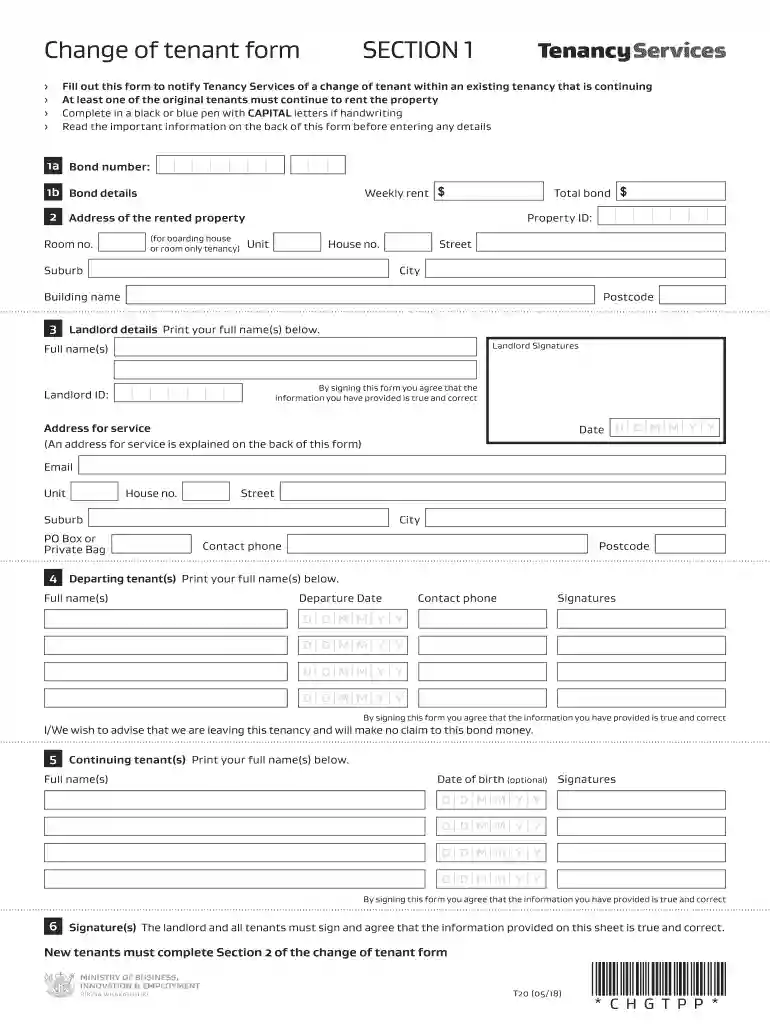
The "Change of Tenant" form is used to notify Tenancy Services about a change in tenants within an existing lease agreement. This form is essential for updating tenant records and ensuring that bond information is accurately processed. It captures details of departing, continuing, and new tenants, facilitating a smooth transition.
Gather Necessary Information: Collect details for all tenants involved, including their full names, contact information, and the date of the tenancy change.
Landlord Information: Provide the landlord’s contact details, including address and phone number.
Tenant Details: Fill in information about the outgoing tenant, as well as any remaining or new tenants. Ensure that each party reviews their details for accuracy.
Signatures: Obtain signatures from all parties, including the landlord. This is crucial as it acknowledges the agreement of all parties involved in the tenancy change.
Privacy Statement: Review the privacy statement section which outlines how personal data will be used and protected throughout the process.
Landlord and Tenant Information: This section captures the essential details of both the landlord and all tenants involved in the tenancy change, providing a comprehensive overview necessary for record updates.
Signatures Section: This is mandatory for all parties, ensuring that each has consented to the changes. It includes space for digital or wet signatures, confirming the authenticity of the modification.
Privacy Statement: Clearly explains how personal data submitted through this form will be safeguarded and the purposes for which it will be used, reinforcing confidence in the process.
The "Change of Tenant" form serves as a legally recognized document to formally update tenancy records. It ensures compliance with tenancy laws by documenting the consent of all parties involved and provides transparency in tenant transitions.
Landlords: Initiate the process to keep tenant records updated and prevent any legal misunderstandings.
Property Managers: Facilitate the smooth transition of tenants within properties they manage, ensuring compliance with all legal obligations.
Tenants: Both departing and new tenants participate by providing necessary information and signing the form, securing their respective responsibilities and rights.


Scenario 1: A tenant wishes to vacate an apartment, and another tenant is moving in. Both parties complete their sections and sign, ensuring the bond is transferred correctly.
Scenario 2: A group of roommates changes when one leaves, and a new tenant replaces them. The form updates tenancy details and adjusts the lease accordingly.
Alongside the form, additional documents such as proof of identity for new tenants and a copy of the current lease agreement are typically required. Submitting these documents ensures that all information aligns with the tenancy records.
Online: Most systems prefer digital submissions for efficiency. Use platforms like DocHub to fill, sign, and submit forms electronically.
Mail: Alternatively, print and mail the completed form to the specified address, but be mindful of postal delays.
In-Person: Some services may accept forms submitted directly to their office, providing a receipt for submission.
Failing to file the "Change of Tenant" form may result in legal action or fines against the landlord or remaining tenants due to unreported tenancy changes. It can also cause disputes over bond allocations, emphasizing the importance of timely completion and submission.
We've got more versions of the Fill out this form to notify Tenancy Services of a change of tenant within an existing tenancy that form. Select the right Fill out this form to notify Tenancy Services of a change of tenant within an existing tenancy that version from the list and start editing it straight away!
At DocHub, your data security is our priority. We follow HIPAA, SOC2, GDPR, and other standards, so you can work on your documents with confidence.