






Definition and Meaning
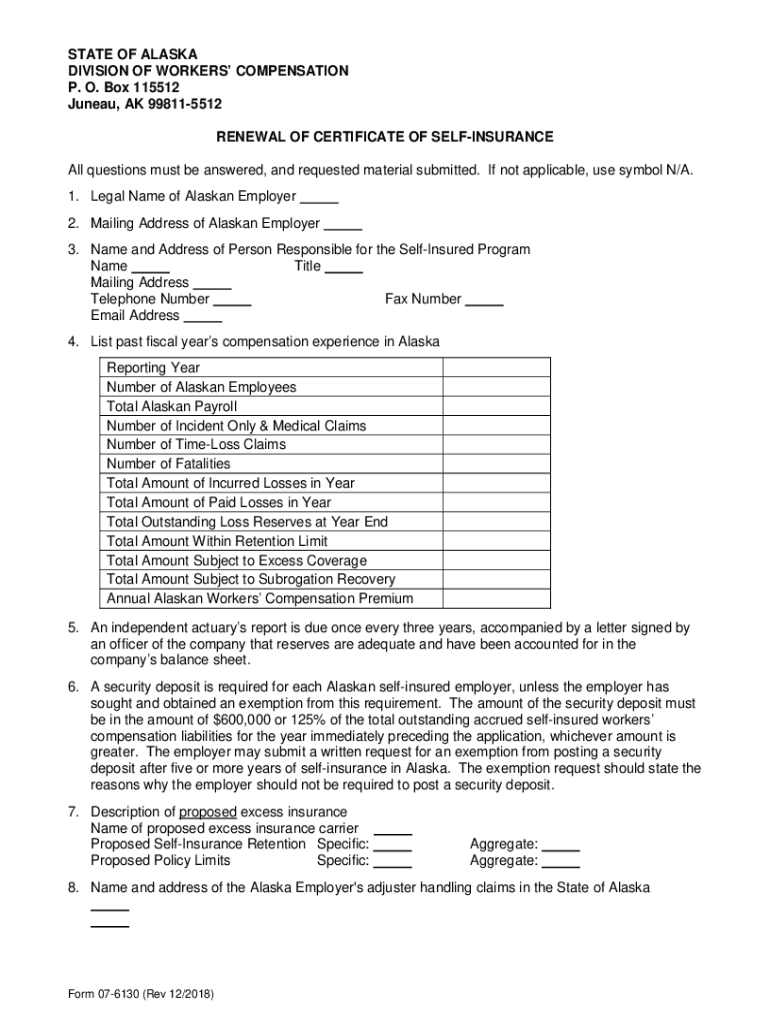
The Renewal of Certificate of Self-Insurance for the Alaska Department refers to the process by which a business or organization in Alaska ensures its ability to meet financial obligations stemming from potential workers' compensation claims. A self-insured entity bypasses traditional insurance policies by demonstrating sufficient financial stability to cover these claims independently. Successfully renewing this certificate indicates that the entity continues to meet the required legal and financial benchmarks set by the state.
Eligibility Criteria
To renew the Certificate of Self-Insurance in Alaska, entities must meet specific eligibility criteria. These include maintaining a comprehensive safety program to mitigate workplace accidents, having a minimum number of employees, and meeting financial thresholds that demonstrate the capability to independently manage workers' compensation claims. Additionally, the entity must provide necessary documentation such as audited financial statements that affirm financial stability. Compliance with these criteria ensures the entity's continued ability to self-insure.


Required Documents
The renewal process requires several key documents. Entities must submit current audited financial statements and an independent actuary’s review, both of which showcase the entity’s financial health. A detailed safety program report is necessary to illustrate ongoing adherence to workplace safety standards. Additionally, documentation regarding any joint ventures or subsidiaries involved in the self-insurance program should be included. These documents collectively help the state verify the entity’s capacity to self-insure.
Steps to Complete the Renewal
- Gather Documentation: Compile all required records, including financial statements and safety program reports.
- Review Financial Benchmarks: Ensure all financial prerequisites, such as specified minimum thresholds, are met.
- Submit Application: Send the completed renewal application, along with the necessary documents, to the Alaska Department.
- Await Evaluation: The department will evaluate the submission and may request additional information if needed.
- Receive Approval: Once the application is verified as complete and compliant, receive the renewed certificate.
State-Specific Rules and Conditions
Alaska imposes specific conditions on entities seeking to renew self-insurance certificates. These include adherence to local workers' compensation laws and the necessity of maintaining an operational framework that can independently handle claims without relying on external insurance providers. Security deposit requirements are another Alaska-specific condition, often involving a letter of credit or surety bond, to ensure claim coverage.
Importance of Renewing the Certificate
The renewal is crucial for maintaining the organization’s self-insured status, guaranteeing the ability to uphold workers' compensation obligations. Without a valid certificate, entities would need to purchase more expensive conventional insurance policies to cover liabilities, potentially impacting their financial standing. Renewal signifies readiness and capability to handle potential claims, reflecting sound financial health and robust internal controls.
Penalties for Non-Compliance
Failure to renew the Certificate of Self-Insurance can result in significant penalties. These penalties may include fines, legal action, and enforced compliance costs associated with purchasing traditional insurance policies. Non-compliance could also damage the organization's reputation and result in increased scrutiny from regulatory bodies, which could affect future business operations and negotiations within Alaska.
Digital Versus Paper Version
Renewal applications can typically be submitted through digital platforms or traditional paper methods. The digital option offers convenience and efficiency, allowing for quicker processing and immediate acknowledgment of receipt. However, traditional methods remain available for those who prefer paper documentation, though this may entail longer processing times and limited tracking capabilities during submission.
Form Submission Methods
Entities can submit their renewal applications through several channels:
- Online Submissions: Preferred for their speed and efficiency in processing.
- Mail Submissions: Suitable for those providing paper documentation, followed by confirmation through postal service tracking.
- In-Person Submission: Allows for direct interaction and the immediate rectification of any errors in the submission.
Choosing the appropriate submission method can affect the processing timetable and communication between the applicant and the department.
By adhering to these structured guidelines and regulations, an entity ensures that its self-insurance capabilities remain intact and legally recognized, meeting obligations towards both its employees and the state.