







Definition & Meaning
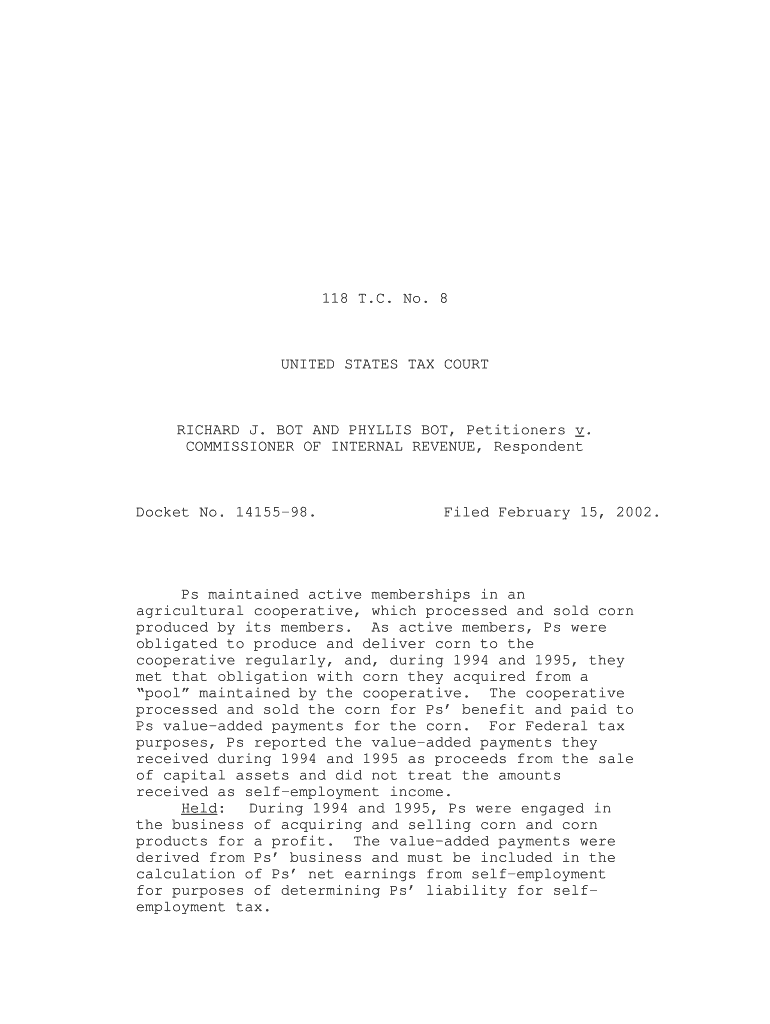
The case "BOT AND PHYLLIS BOT, Petitioners v" involves a tax dispute where Richard J. Bot and Phyllis Bot engaged with the Commissioner of Internal Revenue. The primary issue centers around their self-employment tax liabilities on value-added payments received from an agricultural cooperative in 1994 and 1995. These payments were determined by the court to be part of their net earnings from self-employment, resulting from their business activities in acquiring and selling corn. The court's decision clarifies that these payments should not be treated as capital gains or dividends but as income derived from trade or business activities. Understanding this case provides insight into how self-employment income is assessed by tax authorities.
How to Use the BOT AND PHYLLIS BOT, Petitioners v
To utilize the findings from the BOT AND PHYLLIS BOT case, taxpayers involved in similar agricultural cooperatives or business models must evaluate how their income is categorized for tax purposes. This involves examining whether payments received from cooperative sales should be included in net earnings from self-employment. Key steps include:
- Review the structure of the cooperative agreement and any payments received.
- Compare these payments against the criteria established in tax law and affirmed by the court.
- Consult with a tax advisor or legal professional to align business practices and reporting strategies according to IRS guidelines and court precedents.
Key Elements of the BOT AND PHYLLIS BOT, Petitioners v
- Trade or Business Requirement: The case emphasizes the definition of a trade or business for tax classification, underscoring the importance of activity engagement and regular practice for profit.
- Value-Added Payments: These payments are highlighted as part of the Bots' earnings from self-employment, requiring inclusion in taxable income.
- Court Decision Impact: The ruling affects how similar cases are treated, establishing precedent for other taxpayers in similar positions.
Important Terms Related to BOT AND PHYLLIS BOT, Petitioners v
- Self-Employment Tax: A tax comprising Social Security and Medicare taxes primarily for individuals who work for themselves.
- Value-Added Payments: Additional compensation received over and above standard sales profit, often distributed in agricultural settings from cooperative profits.
- Capital Gains vs. Self-Employment Income: Distinguishes between profits from business operations as part of regular activity and investment income.
IRS Guidelines
The IRS emphasizes the classification of income based on the type of business activities involved. In this case, the value-added payments related to the Bots' cooperative activities were subject to self-employment tax. Key points from the IRS include:
- Payments from ongoing business operations, particularly in a cooperative, may be taxable as income.
- Taxpayers must categorize their income correctly to avoid penalties.
Taxpayer Scenarios
- Self-Employed Individuals: Must carefully determine if income received falls under self-employment earnings.
- Farmers and Agricultural Cooperative Members: Specific attention must be paid to how payments or dividends are categorized under current IRS guidelines, considering this court decision.
- Partnerships and Businesses in Agriculture: Need to reassess how income from commodities and cooperative agreements is reported for tax purposes.


Penalties for Non-Compliance
Failure to correctly report income as demonstrated in the BOT AND PHYLLIS BOT case can lead to:
- Additional tax liabilities due to underreported income
- Interest and penalties on unpaid taxes
- Increased scrutiny and potential audits by the IRS
Software Compatibility
When preparing taxes, software like TurboTax or QuickBooks can assist in categorizing income correctly. These programs often include:
- Features to help classify types of income, aiding in compliance with IRS rulings
- Alerts for discrepancies in income reporting based on recent court decisions and IRS guidelines
- Assistance in simplifying complex tax obligations through automation and guided help
Who Issues the Form
In the context of tax transactions discussed in the BOT AND PHYLLIS BOT case, forms related to self-employment tax and cooperative earnings are typically issued by:
- IRS: Provides guidelines and enforcement for self-employment income.
- Cooperatives: Issues documentation, such as Form 1099s, detailing payments and distributions to members necessary for tax filing.
Understanding and applying these guidelines are crucial for correctly managing tax liabilities, and business owners must stay informed about legal precedents like the BOT AND PHYLLIS BOT case to ensure compliance and optimize tax outcomes.




