






Definition and Meaning of the Data Report - National Geodetic Survey - NOAA
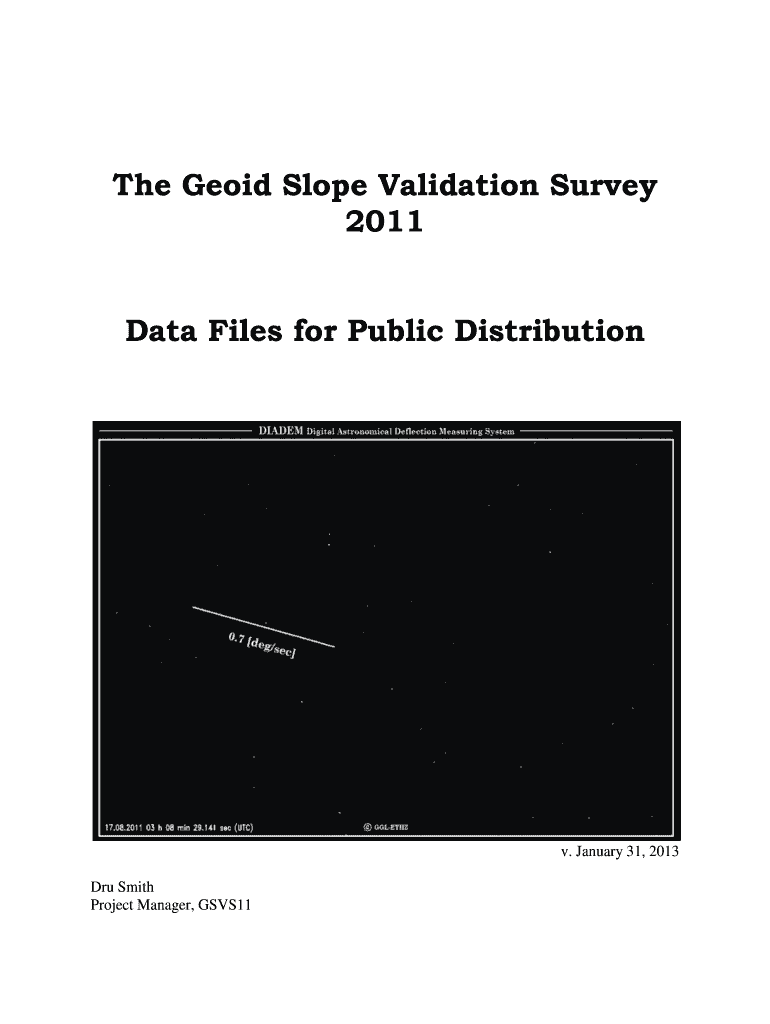
The "Data Report - National Geodetic Survey - NOAA" is a detailed document produced by the National Geodetic Survey (NGS), a division of the National Oceanic and Atmospheric Administration (NOAA). This report is part of the NGS mission to provide accurate geospatial data crucial for mapping and charting the Earth's surface. The document contains technical information about geodetic benchmarks, gravimetric geoid models, and survey methods. It is essential for professionals involved in geographical and geodetic studies, as it guides them around the nuances of precise mapping and land measurement.
How to Use the Data Report
To effectively use the Data Report from NGS, individuals should identify the specific geodetic needs of their projects, whether they are related to construction, navigation, or environmental analysis. This report includes key data like geoid heights and survey markers, which are used for calculating precise elevations and land positions. By aligning project objectives with the information within the report, users can ensure a high degree of accuracy in their geodetic computations. For example, construction firms could use data from the report in leveling and structure siting.
Obtaining the NGS Data Report
The NGS Data Report can be obtained directly through NOAA's online resources. The website provides access to various datasets and reports freely available for download. Users can search by survey type, location, or project year, ensuring they access the most relevant information. For those requiring historical data, NOAA offers an archive section where past reports can be found. Accessing these reports requires a stable internet connection, and familiarity with navigating large datasets can be beneficial.
Steps to Complete and Utilize the Data Report
- Identify Objectives: Determine the primary purpose for using the report, such as surveying, mapping, or analysis.
- Access the Report: Download the report from the NOAA website or request it if it's in a restricted-access format.
- Analyze Data: Evaluate the geodetic measurements and data applicable to the project requirements.
- Apply Findings: Use the data in Geographic Information Systems (GIS) or relevant software to apply geodetic corrections and enhance accuracy.
- Review Output: Ensure the applied data meets project standards and desired accuracy.
Key Elements of the Data Report
The Data Report contains several critical components including geoid models, elevation benchmarks, and geospatial coordinates. The geoid models are essential for understanding sea level variations and helping in elevation determination. Elevation benchmarks provide reference points that define precise local elevation data, vital for surveying and construction projects. Additionally, the report includes metadata that describes how and when the data was collected, ensuring context for users employing the data in various applications.
Who Typically Uses This Data Report
The primary users of the NGS Data Report are geodesists, cartographers, surveyors, and engineers. These professionals rely on accurate geodetic information for land surveying, construction, navigational charts, and scientific research. Government agencies, such as the U.S. Geological Survey (USGS) and state transportation departments, also use this data for planning infrastructure projects and monitoring land changes. Educational institutions and research organizations employ the data for academic studies and simulations.
Legal Use and Compliance
Using the NGS Data Report requires adherence to NOAA's data use policies, particularly when the data is applied to official documents or projects with legal implications. The report must be used in compliance with U.S. geographical data regulations, ensuring no manipulation or misrepresentation of the data occurs. Individuals and entities must also ensure that any published findings or analyses acknowledge the source of the data, upholding professional and legal standards.
Digital vs. Paper Version
The report is available in both digital and, less commonly, paper formats. The digital version is highly beneficial due to its accessibility and ease of use with software applications. It allows users to integrate data directly into computational tools and systems, facilitating complex analysis and modeling. In contrast, the paper version might be used for archival purposes or in scenarios where digital access is limited. Choosing between these versions depends on user preference and technological capability.