






Definition and Meaning
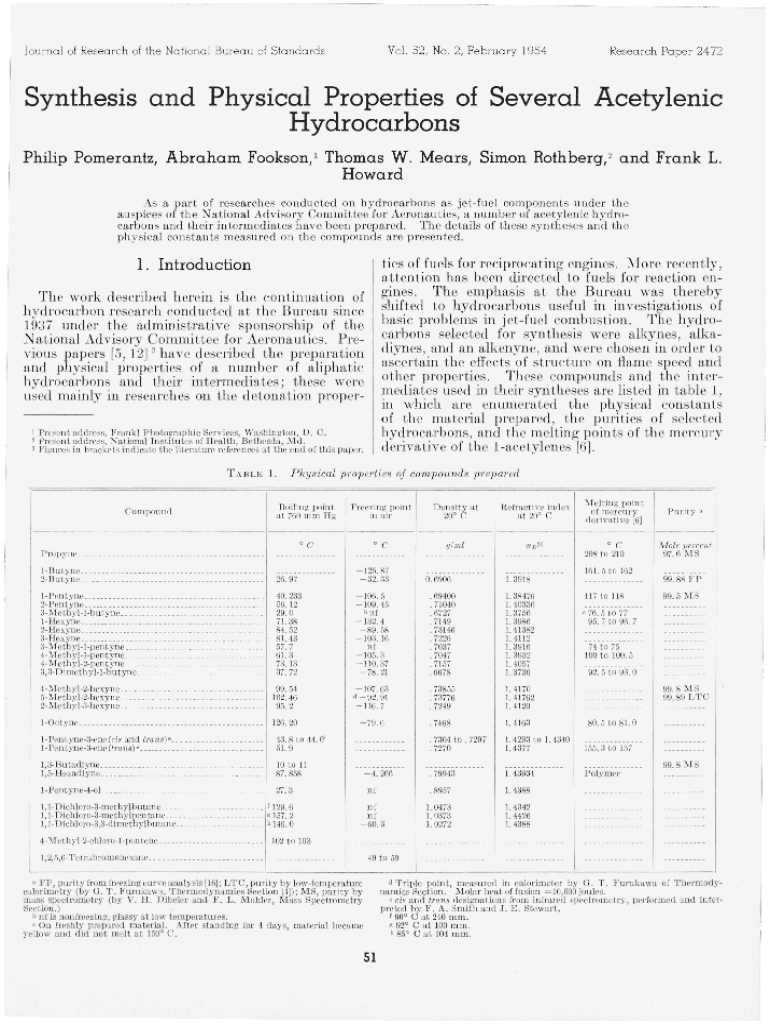
The synthesis and physical properties of several acetylenic hydrocarbons refer to the preparation and characterization of compounds containing carbon-carbon triple bonds, known as acetylenes. These compounds, which include alkynes, alkadiynes, and alkenynes, are investigated for their structural and combustion properties, particularly in the context of jet fuel performance. Understanding these properties is crucial for optimizing the efficiency and flame speed of fuels used in aerospace applications.
Key Elements of Acetylenic Hydrocarbons
Several key elements define the acetylenic hydrocarbons:
- Triple Bonds: The presence of the carbon-carbon triple bond is a distinguishing feature.
- Physical Properties: These include boiling and melting points, density, and solubility, all relevant to their application in fuels.
- Chemical Reactivity: Their reactivity under various conditions determines synthesis methods and potential applications.
- Combustion Characteristics: Their behavior during combustion is significant for fuel research, impacting flame speed and efficiency.
How to Use the Formulation Data
For researchers or industry professionals, the formulation data on acetylenic hydrocarbons is used to:
- Design Experiments: By understanding the chemical makeup and expected behaviors, researchers can create targeted experiments.
- Develop Fuels: Industry uses these insights to create more efficient, high-performance fuels.
- Optimize Combustion: The data helps in adjusting mixtures to enhance flame speed and combustion properties.
Practical Applications
- Jet Fuel Efficiency: Adjustments in formulations based on acetylenic hydrocarbons aid in developing more efficient jet fuels.
- Chemical Research: Provides a basis for further research into alternative fuels and material sciences.
Steps for Synthesis
Synthesis of acetylenic hydrocarbons involves several structured steps:
- Selection of Precursors: Choose appropriate starting materials that can form triple bonds.
- Catalyst Usage: Employ catalysts that facilitate the formation of carbon-carbon triple bonds.
- Reaction Conditions: Carefully control temperature and pressure to achieve desired yields and purity.
- Isolation and Purification: Use techniques such as distillation or chromatography to isolate the compounds.
- Characterization: Analyze physical properties using methods like spectroscopy or chromatography to confirm structure and purity.
Important Terms Related to Acetylenic Hydrocarbons
Understanding acetylenic hydrocarbons involves familiarity with several key terms:
- Alkynes: Hydrocarbons with at least one carbon-carbon triple bond.
- Alkadiynes: Compounds containing two triple bonds.
- Alkenynes: Structures with both double and triple bonds.
- Flame Speed: A measure of how quickly a flame propagates through a fuel.
Examples of Use in Industry
Acetylenic hydrocarbons have various practical applications:
- High-Energy Fuels: Used in the development of premium fuels with enhanced combustion characteristics.
- Polymer Precursors: Serve as starting materials for the synthesis of polymers with unique properties.
- Material Science: Integral in the study and creation of new materials with potential aerospace applications.
Who Typically Uses This Information
Professionals from multiple fields rely on this information:
- Aerospace Engineers: For fuel development and optimization.
- Chemists: Involved in synthetic organic chemistry.
- Researchers: Conducting studies into new energy sources and combustion processes.
State-Specific Considerations
Although acetylenic hydrocarbons are studied globally, certain regulatory conditions may apply at the state level within the United States, particularly concerning:
- Environmental Impact: Emphasis on adherence to state regulations on emissions.
- Safety Standards: Compliance with state safety guidelines for storage and handling of chemical compounds.
Legal Use in Research and Industry
The synthesis and application of acetylenic hydrocarbons involve regulatory compliance and ethical research practices:
- Intellectual Property: Ensure adherence to patent laws related to new synthetic methods or formulations.
- Safety Regulations: Follow strict safety and environmental guidelines during experimentation and industrial application, as stipulated by federal and state agencies.