






Definition & Purpose of Form LPT6A
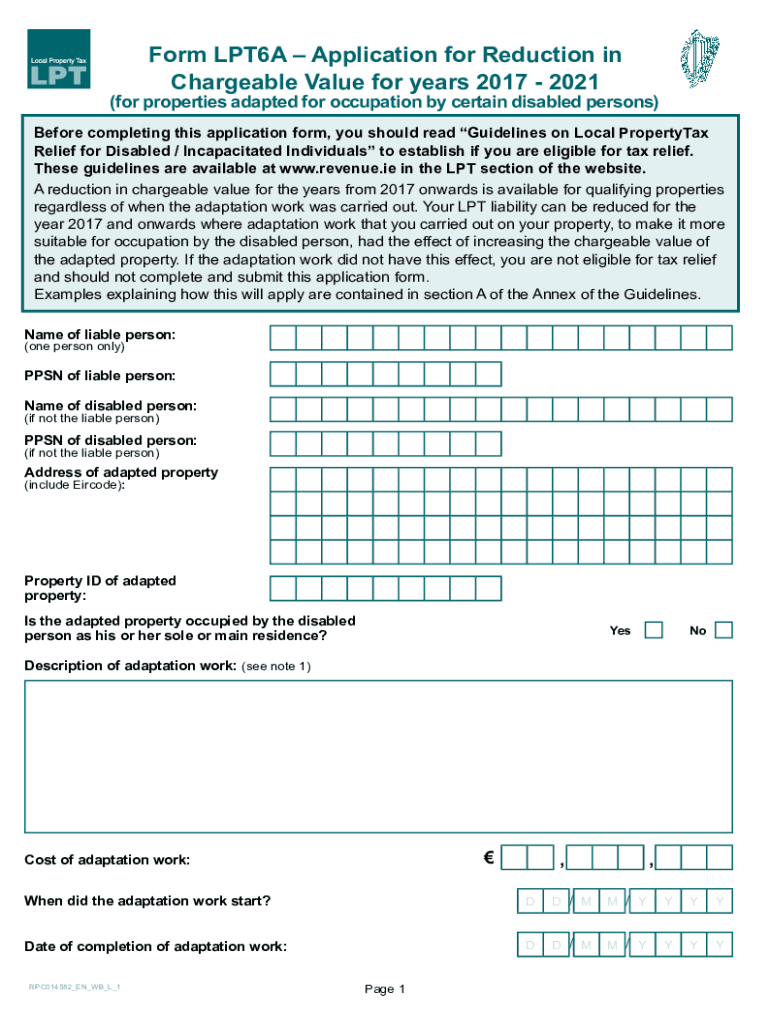
Form LPT6A is an application designed for property owners seeking a reduction in the chargeable value of their property for Local Property Tax (LPT) purposes, specifically for the years 2017, 2018, and 2019. This form is pertinent to properties that have been adapted to accommodate disabled individuals, aiming to provide financial relief by lowering the chargeable property value by up to €50,000. It is crucial to understand that this reduction is only applicable to properties that meet specific eligibility requirements related to the adaptation work done for the benefit of persons with disabilities.
Eligibility Criteria for Form LPT6A
To qualify for a reduction under Form LPT6A, properties must meet several criteria. The adaptations should be significant enough to require building work, tailored to assist a disabled person's mobility or access needs. The property must be occupied by the disabled person, and the adaptation must align with the guidelines provided in the form. A doctor’s certification is necessary to confirm the nature and impact of the disability on mobility. This certification must accompany the application as part of the required documentation to substantiate the claim for a reduction in chargeable value.


Application Process & Approval Time
Applying for a reduction via Form LPT6A involves several steps. First, ensure that all eligibility criteria are met and gather the necessary documentation, including the doctor’s certificate. Complete the application form with accurate details about the property, the adaptation work performed, and the intended benefits for the disabled individual occupying the property. Once submitted, the approval process may take several weeks, during which the tax authority reviews the application and the supporting documents. Applicants are usually informed of the decision via mail or electronic communication.
Steps to Complete Form LPT6A
- Gather Required Documentation: Include the doctor's certification, details of the adaptation work, and personal identification.
- Fill Out Personal and Property Details: Provide accurate details regarding the property, owner, and disabled occupant.
- Describe the Adaptation Work: Explain clearly the modifications made to the property and their purpose.
- Attach Supporting Docs: Ensure you include all necessary documentation to support your claim.
- Submit the Application: Depending on the method, either mail the completed form or submit it electronically if available.
- Await Confirmation: Keep an eye out for any communications from the tax office about the status of your application.
Required Documents
The application for Form LPT6A mandates several key documents:
- A certified letter from a doctor explaining the disability and its impact on mobility.
- Detailed records of the adaptation work, potentially including invoices or contracts.
- Proof of residency for the disabled individual at the adapted property.
- Any additional documents as specified in the application guidelines, which may help verify the adaptations' necessity and execution.
Legal Considerations
The use of Form LPT6A must adhere to legal requirements set by tax authorities, ensuring that all provided information is truthful and accurate. Misrepresentation of facts or failure to include necessary documentation can lead to application rejection or penalties. Understanding these legal implications is crucial for applicants.
Common Scenarios for Using Form LPT6A
Property owners who have adapted their homes for family members with disabilities most frequently use Form LPT6A. Scenarios include modifications like installing ramps, widening doorways, or converting living spaces to accommodate wheelchairs. Each case must clearly demonstrate how these adaptations specifically support the disabled person’s needs.
Important Terms Related to Form LPT6A
- Chargeable Value: The property’s value used to calculate LPT, which could be reduced through Form LPT6A.
- Adaptation Work: Modifications made to a property to enhance accessibility for individuals with disabilities.
- Liable Person: The individual responsible for paying LPT for the property, usually the property owner.
State-Specific Considerations
While Form LPT6A applies nationally, states might have slightly different procedures for submitting applications or additional requirements. It is essential to check regional guidelines to ensure compliance with local tax laws.
Digital vs. Paper Submission
Applicants can submit Form LPT6A either via mail or potentially through an online tax system, if supported. Each method has its own benefits; online submission can expedite processing times, whereas paper forms might require additional time for delivery and processing.
Application Completion Tips
Several tips can streamline the process of completing Form LPT6A:
- Double-check all entered data for accuracy to avoid rejection due to errors or inconsistencies.
- Use clear and concise language when describing adaptations and their benefits.
- Keep copies of all submitted documentation to have a record for future reference if required.
Real-World Examples of Form LPT6A
Consider a couple who modifies their home to make it wheelchair accessible for their child. They install a ramp, widen doors, and remodel a bathroom. Submitting Form LPT6A with the proper documentation, they successfully secure a reduction in the taxable property value, alleviating some financial burden.
Conclusion
Form LPT6A serves an essential role in providing financial relief for property owners adapting their homes for disabled individuals. Understanding the form's requirements, approval process, and necessary documentation can significantly impact applicants’ success in achieving a reduction in their local property tax burden.