01. Edit your form online
Type text, add images, blackout confidential details, add comments, highlights and more.

Type text, add images, blackout confidential details, add comments, highlights and more.

Draw your signature, type it, upload its image, or use your mobile device as a signature pad.

Send it via email, link, or fax. You can also download it, export it or print it out.
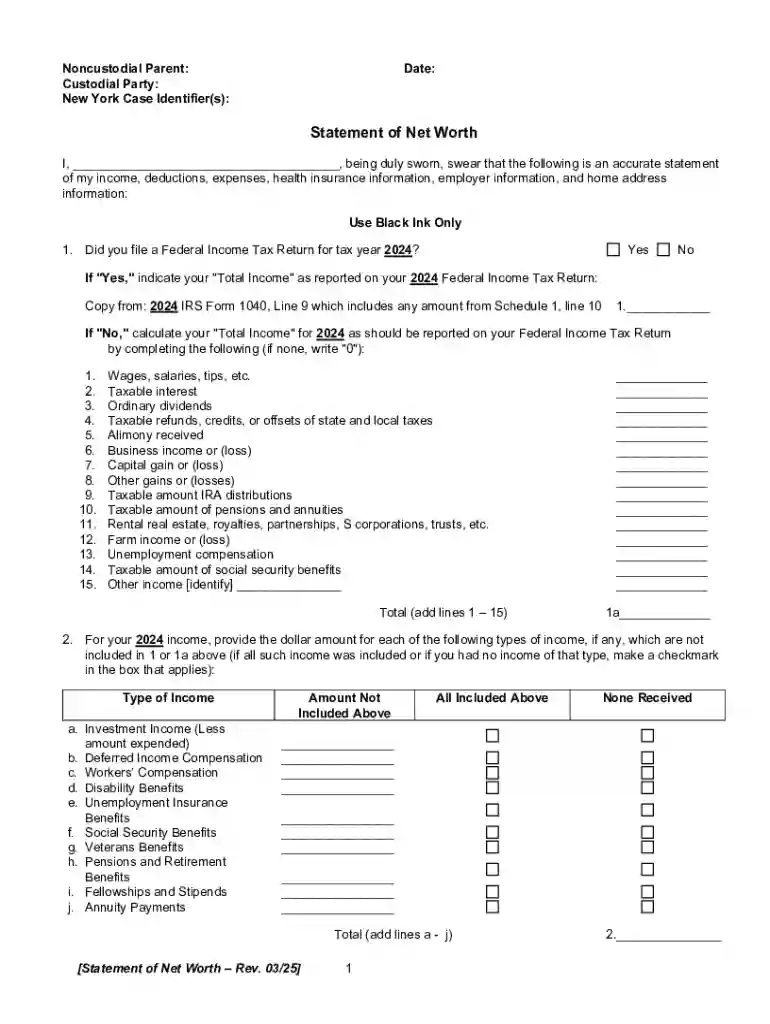
The Statement of Net Worth is a financial document primarily used to provide a comprehensive overview of an individual's economic standing. It outlines a person's assets, liabilities, income, and expenses, offering a snapshot of their financial health at a given point in time. This form is essential for noncustodial parents in New York, serving as a foundational document for assessing financial responsibilities and obligations, particularly in child support cases. By presenting an accurate depiction of financial resources, the statement aids in determining equitable contributions towards child support.
In the context of family law, the Statement of Net Worth plays a critical role in legal proceedings related to child support and custody. Accurate completion of this form ensures that all parties involved have a clear understanding of each parent's financial capabilities, which is crucial for fair decision-making in support obligations. Failure to provide precise information can lead to disputes or legal consequences.
Filling out the Statement of Net Worth requires careful attention to detail. Here is a step-by-step guide to ensure accuracy and completeness.
Gather Financial Documents: Before starting, collect all relevant financial documents such as bank statements, tax returns, and loan agreements.
List Assets and Liabilities: Accurately record all assets, ensuring to include both tangible and intangible items, and list all liabilities to get a clear picture of your net worth.
Include Income Information: Gather recent pay stubs and tax returns to self-report annual and monthly income accurately.
Detail Expenses: Document all regular expenses, ensuring to capture every cost that might affect financial assessments.
Review and Validate: Double-check all entries for accuracy and completeness, making sure there are no omissions or misstatements.
Attach Supporting Documents: Where applicable, attach supporting documents to substantiate the information provided in the form.
The form is divided into several sections to capture various aspects of financial life:
This document is legally binding in court proceedings, especially those concerning child support and custody in New York. Accuracy is paramount, as any falsification can lead to penalties, contempt of court, or adjustments to legal judgments. The information submitted becomes part of the case record, influencing decisions on financial obligations.
Individuals can typically acquire the form from legal professionals or directly from court services. In New York, this form is particularly relevant for noncustodial parents involved in family law cases.
While primarily utilized by noncustodial parents in New York, particularly in child support cases, this form can be beneficial for any individual undergoing a financial review in legal processes. It is also used by financial advisors to provide a comprehensive assessment of a client's financial position.


In New York, specific regulations apply to the Statement of Net Worth, emphasizing the need for accurate disclosures. It is important to be aware of these rules to ensure compliance and to avoid any potential legal repercussions.
Completing the Statement of Net Worth requires various supporting documents. These include:
Timeliness is crucial when dealing with the Statement of Net Worth. Courts will often set strict deadlines for submission, and late filing may result in penalties or delayed proceedings.
We've got more versions of the Statement of Net Worth Statement of Net Worth form. Select the right Statement of Net Worth Statement of Net Worth version from the list and start editing it straight away!
At DocHub, your data security is our priority. We follow HIPAA, SOC2, GDPR, and other standards, so you can work on your documents with confidence.