






Definition & Meaning
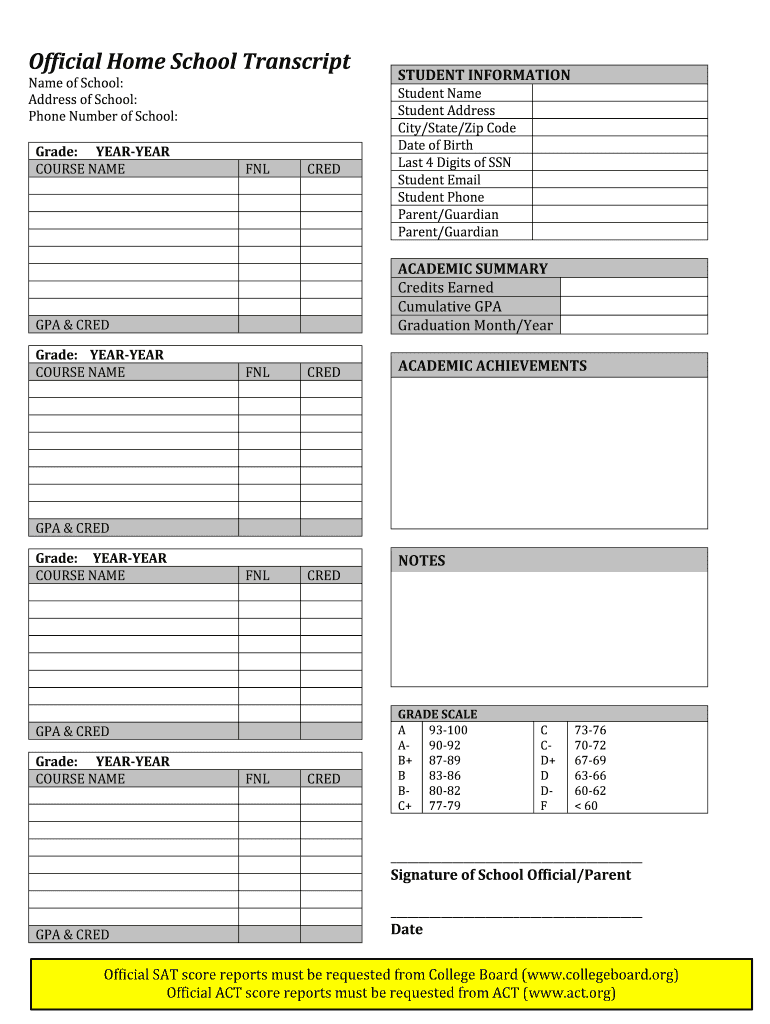
A homeschool transcript is a formal document that records a student's academic achievements during their homeschooling years. This transcript is essential for students who need to demonstrate their educational background for college admission or employment. Typically, these transcripts contain school information, student details, grades for each course, GPA, credits earned, and the grading scale used. As homeschooling becomes more prevalent, maintaining a detailed and accurate transcript is crucial for providing a complete picture of a student's education.
Key Elements of the Homeschool Transcript
The homeschool transcript comprises several critical elements to ensure a comprehensive academic record:
- Student Information: Includes the student's full name, date of birth, and contact information.
- School Information: Lists the homeschooling entity, which might be the parent or a homeschooling organization, along with contact details.
- Academic Summary: Provides an overview of courses taken, grades awarded, and credits earned.
- Course Grades: Details each subject and the respective grade, offering insight into the student's performance.
- GPA and Credits: Details the cumulative GPA and total credits earned, providing a quantitative measure of academic success.
- Grade Scale: Indicates the grading system used, ensuring external parties understand what each grade signifies.
Steps to Complete the Homeschool Transcript
- Collect Student Records: Gather all relevant educational materials, including course descriptions, grades, and assessments.
- Organize the Academic History: Arrange courses chronologically or by subject matter, according to what best represents the student's strengths.
- Calculate Credits and GPA: Use a consistent method to calculate credits and GPAs to maintain credibility.
- Format the Transcript: Use a structured format that clearly presents academic information, making it easy for colleges or employers to review.
- Verify and Finalize: Double-check all entries for accuracy, ensuring there are no errors in data or calculations.
State-Specific Rules for the Homeschool Transcript
Each U.S. state has distinct requirements and guidelines for homeschooling, which can affect how a homeschool transcript is constructed:
- Some states require specific subjects or standardized tests that must be included in the transcript.
- Documentation may be necessary to prove compliance with state homeschooling laws.
- Differences in state recognition of homeschool credits or diplomas can impact transcript content.
Understanding these regional variations is vital for creating an effective and compliant homeschool transcript.
Legal Use of the Homeschool Transcript
Homeschool transcripts serve multiple legal and formal purposes:
- College Applications: Many colleges accept homeschool transcripts as part of their admissions process.
- Employment: Employers may request transcripts to verify educational background.
- Scholarships: Homeschool transcripts are often required to apply for scholarships and grants.
- Legal Status Verification: In some cases, the transcript may be needed to prove legal compliance with educational laws.
It's important to ensure that the homeschool transcript meets all legal criteria to avoid complications.
Why Use a Homeschool Transcript?
Using a homeschool transcript is beneficial for several reasons:
- It provides a formal educational record that can be easily shared with educational institutions and employers.
- A well-prepared transcript highlights the student's achievements and readiness for higher education or the workforce.
- It serves as a tool for self-assessment, helping parents and students track educational progress and planning.
Examples of Using the Homeschool Transcript
- College Admissions: A student with a comprehensive homeschool transcript gains entry into a university by demonstrating academic competence and breadth through detailed course descriptions and high GPA.
- Job Applications: An employer accepts a homeschool transcript from a job candidate as evidence of their completed education, supplemented with references to specific skills learned.
- Scholarships: A homeschool student applies for a scholarship, using their detailed transcript to showcase academic performance and eligibility.
Form Submission Methods: Digital vs. Paper Version
Homeschool transcripts can be shared in both digital and paper formats:
- Digital Version: Offers convenience and quick dissemination through email or educational platforms, often including formatted PDF versions for consistency.
- Paper Version: Still relevant for official submissions where digital formats are not accepted or for formal presentations. It may include official seals or signatures.
Understanding both formats ensures that the transcript meets any institution's requirements, be it a university or a potential employer, resulting in broad acceptance and utility.