





Definition & Purpose of the APA Citation Generator and APA Format Guide
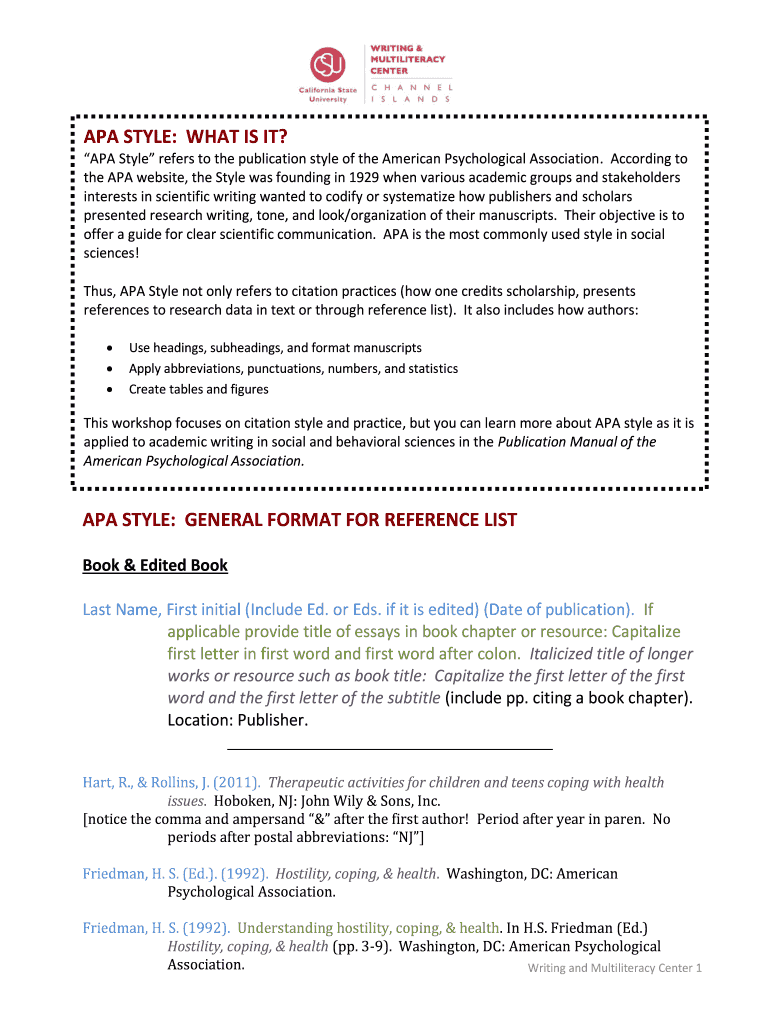
The Easy to Use APA Citation Generator and APA Format Guide is a comprehensive tool designed to assist users in creating accurate APA-style citations and formatting documents in accordance with the standards set by the American Psychological Association. Established in 1929, APA Style is widely used for academic writing in the social sciences. This guide simplifies the creation of citations for books, journal articles, electronic sources, and more, ensuring adherence to APA rules for in-text citations and references.
How to Use the APA Citation Generator
- Select the Source Type: Begin by choosing the type of source you wish to cite (e.g., book, journal, webpage).
- Enter Source Details: Input the required bibliographic information, such as author's name, publication date, title, and publisher.
- Generate Citation: The tool automatically formats the entered data into a correct APA citation, which can be used in your document.
- Copy Citation: Once generated, simply copy the citation and paste it into your reference list.
The generator offers an intuitive interface that makes the citation process straightforward, greatly reducing the potential for errors.
Obtaining the APA Citation Guide
The APA Format Guide can usually be accessed online through trusted academic resources, library websites, or directly through platforms like DocHub. This guide provides detailed instructions on how to apply APA formatting to various elements of writing, including title pages, headings, and page numbers. It also offers insights into style and tone, aligning with professional norms.
Steps to Complete APA Formatting
- Title Page Formatting: Create a title page with a running head and paper title centered in the upper half, followed by the author's name and institution.
- Abstract and Keywords: An abstract is a brief summary of the paper, followed by a list of keywords that represent the main topics.
- Body Structure: Use headers to organize sections, applying a consistent system of headings for clarity.
- In-Text Citations: Ensure all sourced information includes an in-text citation with the author's last name and year of publication.
- Reference Page: List all citations in an alphabetical order on a separate page at the end of the document, adhering to APA style.
Usage of these steps helps maintain coherence and credibility in academic writing.
Importance of Using APA Citation Tools
The primary benefit of using an APA citation tool is accuracy. It mitigates human error by automatically checking citation formats against the latest guidelines. Additionally, it saves time for researchers, students, and professionals, allowing them to focus on other critical aspects of their work. Consistent and correct citations are crucial for credibility and avoiding plagiarism.
Key Terms in APA Formatting
- Running Head: A shortened version of the paper's title, appearing in the page header.
- DOI (Digital Object Identifier): A unique alphanumeric string to identify content and provide a persistent link to its location on the Internet.
- Parenthetical Citation: A method of in-text citation that includes the author's last name and year of publication.
A clear understanding of these terms is essential for properly applying APA Style in any document.
Examples of Using the APA Citation Guide
Consider a scenario where a student is writing a research paper on the psychological impacts of social media. The citation guide will provide instructions for citing journal articles and books related to the topic, ensuring the paper adheres to academic integrity and formatting standards. Examples might include in-text citations directly relating to sourced theories or prior studies, as well as a detailed reference page at the document's conclusion.
Form Submission Methods for Academic Papers
Academic papers formatted in APA Style are generally submitted electronically through learning management systems like Blackboard or Canvas. In some cases, papers may also be submitted via email or printed for in-person submissions, depending on institutional requirements. When submitting electronically, ensure the document format is compatible with required submission guidelines.
A meticulous approach to preparation and submission enhances the potential for favorable evaluation and feedback.