Definition and Meaning
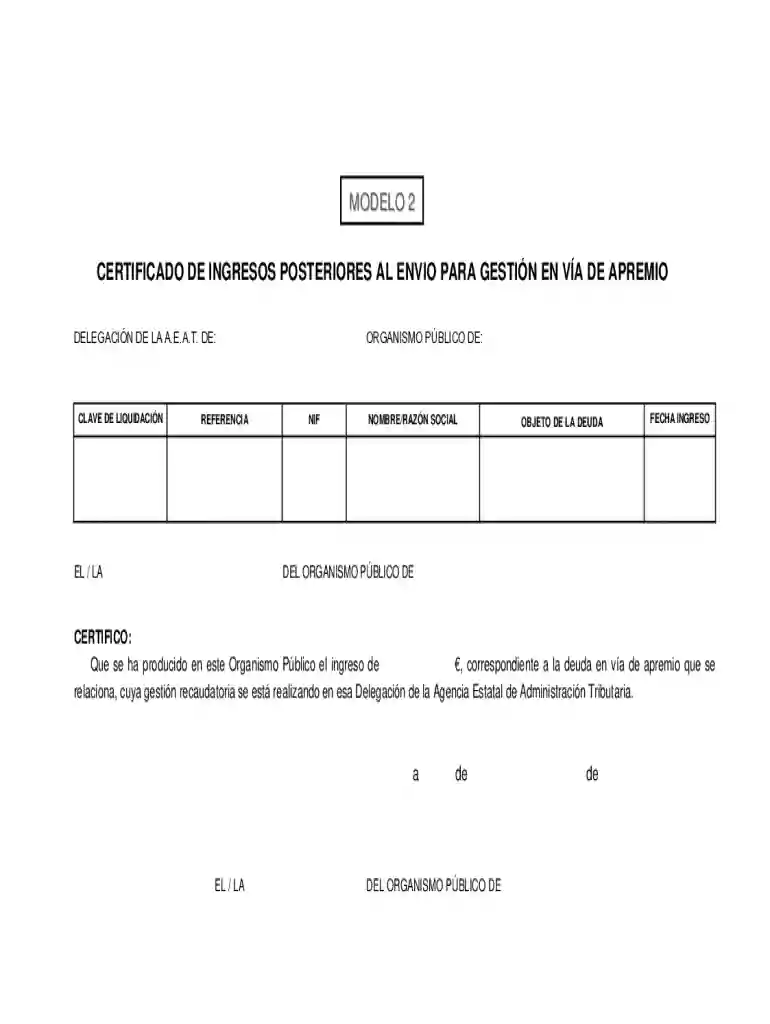
The "Certificado de Ingresos Posteriores al Envío para Gestión en Vía de Apremio" is a document used for certifying income records after the issuance of a collection notice by the Agencia Estatal de Administración Tributaria (A.E.A.T.). This certificate plays a significant role in verifying financial information related to debts under collection, serving both collection agencies and individuals by confirming income details that affect debt management.
Purpose of the Certificate
- Facilitates Debt Collection: Ensures accurate reporting of income for the effective pursuit of outstanding debts.
- Legal Clarity: Provides a structured format to confirm payments and income, reducing disputes in collection processes.
- Comprehensive Record: Offers detailed verification of income that can support various legal and financial proceedings.
Who Typically Uses the Certificate
Recognizing the key users of this certificate helps in understanding its application scope within different sectors.

- Individuals Owing Back Taxes: Often required to illustrate payment capacity or prior earnings during a tax collection process.
- Tax Authorities: Used by A.E.A.T. to assess an individual's financial status in correspondence to their outstanding debt.
- Financial Advisors: Assist clients in compiling accurate financial histories during audits or debt settlements.
Common Scenarios of Use
- Debt Negotiation: Provides income proof during discussions for debt restructuring or negotiation with tax authorities.
- Legal Proceedings: Utilized in court cases where income verification is crucial for determining payment responsibilities.
How to Obtain the Certificate
Acquiring the Certificado de Ingresos Posteriores al Envió para Gestión en Vía de Apremio involves interacting with Spanish tax authorities, potentially requiring translated documentation for U.S.-based users with cross-border financial transactions.
Steps to Obtain
- Contact A.E.A.T: Initiate the request process through the Spanish tax agency either online or by visiting the nearest administrative office.
- Complete Required Forms: Submit necessary personal and financial information as requested by the agency.
- Submit Documentation: Provide supporting documents, such as previous tax filings and proof of income.
- Await Processing: Allow for verification and processing time, which may vary depending on workload and specifics of each case.
Typical Timeframe
- Standard Requests: Generally processed within a few weeks, depending on the complexity of the individual's financial situation and completeness of submitted documentation.
- Expedited Requests: May be available in urgent cases, though this could involve additional fees or formal justification.
Key Elements of the Certificate
Understanding the components of this certificate ensures accurate completion and compliance with legal requirements.
Critical Sections
- Income Details: Lists all reported income figures post-initial collection notice, verifying amounts and sources.
- Debtor Information: Includes personal identifiers of the individual or entity to whom the certificate pertains.
- Confirmation of Payments: Verifies any secured payments against the outstanding debt during the specified period.
Information Requirements
- Accurate Record-Keeping: Ensures that figures align with documented taxes and declared earnings.
- Authentication: Often requires notarization or official validation to confirm authenticity in legal contexts.
Important Terms Related to the Certificate
Ensuring clarity of terminology can prevent misunderstandings and ensure accurate usage of the certificate.
- Vía de Apremio: Refers to the urgent procedure followed when debts remain unpaid past the due date, justifying rapid income verification.
- Ingreso Posterior: Post-issuance income, emphasizing funds acquired after initial notification of debt.
Examples of Terms in Context
- Waiver Periods: Special conditions under which overdue penalties might be waived upon certification of subsequent income changes.
- Subsequent Payment Notices: Notifications provided when payments are made after the deadline via certified income details.
Legal Use of the Certificate
Compliance with legal frameworks is critical in the application and interpretation of this certificate.
Compliance Requirements
- Adherence to Spanish Law: Must comply with Spanish tax laws and regulations, particularly in cross-jurisdictional cases.
- Document Authenticity: Legal use demands proper certification, potentially requiring translation for parties outside Spain.
Common Legal Contexts
- Debt Settlement Cases: Used to finalize or negotiate settlements based on certified income levels.
- Evidentiary Use in Court: Serves as proof of income in financial disputes or legal claims related to tax liabilities.
Steps to Complete the Certificate
Completing this certificate involves precise adherence to procedural guidelines to ensure validity and acceptance by the relevant authorities.
Step-by-Step Completion Process
- Gather Necessary Information: Collect all relevant financial documents, previous tax filings, and income proofs.
- Fill Out Form: Carefully complete each section with accurate and up-to-date information.
- Verify Data: Double-check figures and details to prevent errors that could delay processing.
- Submit with Supporting Documents: Attach all requested documentation and submit through the approved channels.
Common Mistakes to Avoid
- Incomplete Information: Missing details or documentation can cause processing delays or rejection.
- Inaccuracies: Any discrepancy in reported figures may lead to legal complications or penalties.
Examples of Using the Certificate
Drawing from real-life scenarios can help in modeling the appropriate use of this certificate for effective management of debts.
Practical Use Cases
- Business Scenario: A small business owner in Spain needs to prove post-declaration income to negotiate terms with the tax authority.
- Individual Case: An expatriate dealing with old tax issues in Spain uses the certificate to finalize delayed tax dues following recent income changes.
Each scenario demonstrates the certificate's vital role in financial transparency and debt resolution, supporting both legal and personal financial strategies.