
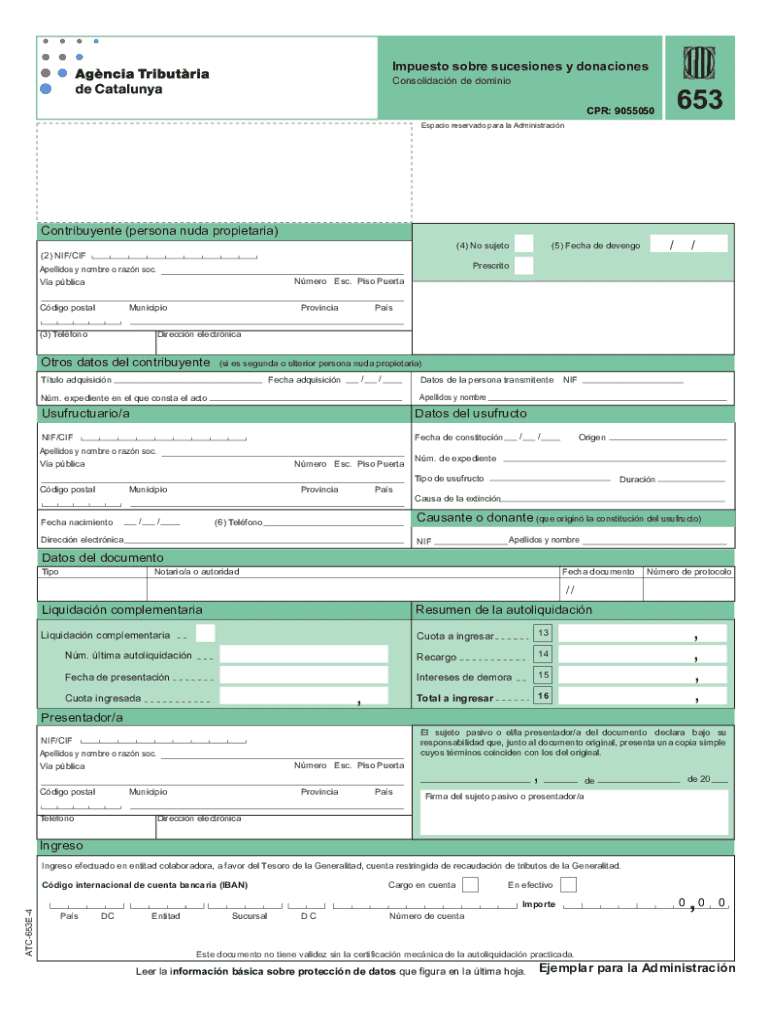







Definition & Meaning
The "Impuesto Sobre Sucesiones Y Donaciones" is a tax levied on property transfers resulting from inheritances and donations. In essence, it governs the financial responsibilities involved when a beneficiary gains assets through these transfers. This tax primarily ensures that the transfer of wealth is legally documented and appropriately taxed according to the recipient's relationship to the donor and the value of the property received. For instance, in Catalonia, this tax is a part of regulatory measures designed to oversee property inheritances and donations, providing an important revenue stream for governmental operations.
Important Terms Related to Impuesto Sobre Sucesiones Y Donaciones
Understanding the key terminology associated with this tax is crucial for accurate filing and compliance:
- Usufruct: A legal right to use and derive profit from someone else's property without altering it.
- Donor: The individual or entity that gives the property.
- Beneficiary: The recipient of the inheritance or donation.
- Taxpayer: The person responsible for declaring and paying the tax.
- Valuation: The calculated worth of the transferred property for tax purposes.
These terms form the foundation of the tax process, affecting how obligations are calculated and fulfilled.
Steps to Complete the Impuesto Sobre Sucesiones Y Donaciones
- Collect Required Documents: Gather all necessary paperwork, including the donor's will (if applicable), property deeds, valuation reports, and recipient identification.
- Property Valuation: Have the inheritances or donations professionally assessed to determine their fair market value.
- Calculate Tax Liability: Use the determined valuations and consider any applicable exemptions or deductions to compute the tax owed.
- Declare Personal Data: Complete the sections of the form requesting information about the donor and recipient to comply with identity verification protocols.
- Submit the Form: This can be done in person, by mail, or sometimes online, depending on your jurisdiction.
- Payment: The tax amount due must be paid by the specified deadline to avoid penalties.
These steps ensure the efficient completion and filing of the form, helping taxpayers to remain compliant.
Filing Deadlines / Important Dates
Filing deadlines for the Impuesto Sobre Sucesiones Y Donaciones can vary by jurisdiction, but typically, you must file and pay the tax within six months from the date of the donor's passing or from the date the donation was received. Extensions may be available, but they must be requested before the original deadline. Keeping track of these dates is vital to avoid late fees or additional penalties.
Examples of Using the Impuesto Sobre Sucesiones Y Donaciones
Consider a scenario where an individual inherits a family home valued at $250,000. They must evaluate if any familial relationship exemptions apply (e.g., if the beneficiary is a spouse or child) to determine the tax rate. Another example could be a donation of a cash gift valued at $10,000, where proper documentation is required to declare it under the Impuesto Sobre Sucesiones Y Donaciones guidelines.
Required Documents
Submitting the Impuesto Sobre Sucesiones Y Donaciones requires several critical documents:
- Will or Donation Contract: To prove the transfer of ownership.
- ID Documents: For both the donor and beneficiary to verify identities.
- Property Appraisal: To establish the fair market value at the time of transfer.
- Prior Tax Filings: If applicable, to declare previous property taxes paid.
Having these documents ready ensures a faster and smoother processing experience.
Key Elements of the Impuesto Sobre Sucesiones Y Donaciones
This form encompasses several essential aspects that need thorough understanding:
- Tax Calculations: Determining the basis of tax including applicable deductions or exemptions.
- Data Protection Compliance: Correctly handling personal data in accordance with privacy laws.
- Payment Options: Being aware of how to process tax payments securely.
- Legal Considerations: Understanding the legal ramifications of incorrect declarations.
Addressing these elements helps taxpayers fulfill their financial obligations without legal issues.
Who Typically Uses the Impuesto Sobre Sucesiones Y Donaciones
This form is generally used by individuals who are beneficiaries of an estate or gift. This can include:
- Heirs and Family Members: Those receiving assets through inheritance.
- Donation Recipients: Individuals or organizations receiving gifts.
- Estate Executors: Responsible for distributing the estate and ensuring tax obligations are met.
Understanding who must use this form ensures compliance and proper estate management.


Legal Use of the Impuesto Sobre Sucesiones Y Donaciones
In the U.S.-centric context, while the tax itself is not applicable, understanding similar concepts such as the federal estate and gift taxes can be beneficial. These concepts outline the legal framework for wealth transfers, ensuring compliance with federal regulations and potentially influencing state-level tax interactions where local equivalents to this tax exist.
Exploring each of these elements allows individuals and organizations to accurately and efficiently navigate the complexities of inheritance and donation taxes.




