01. Edit your form online
Type text, add images, blackout confidential details, add comments, highlights and more.

Type text, add images, blackout confidential details, add comments, highlights and more.

Draw your signature, type it, upload its image, or use your mobile device as a signature pad.

Send it via email, link, or fax. You can also download it, export it or print it out.
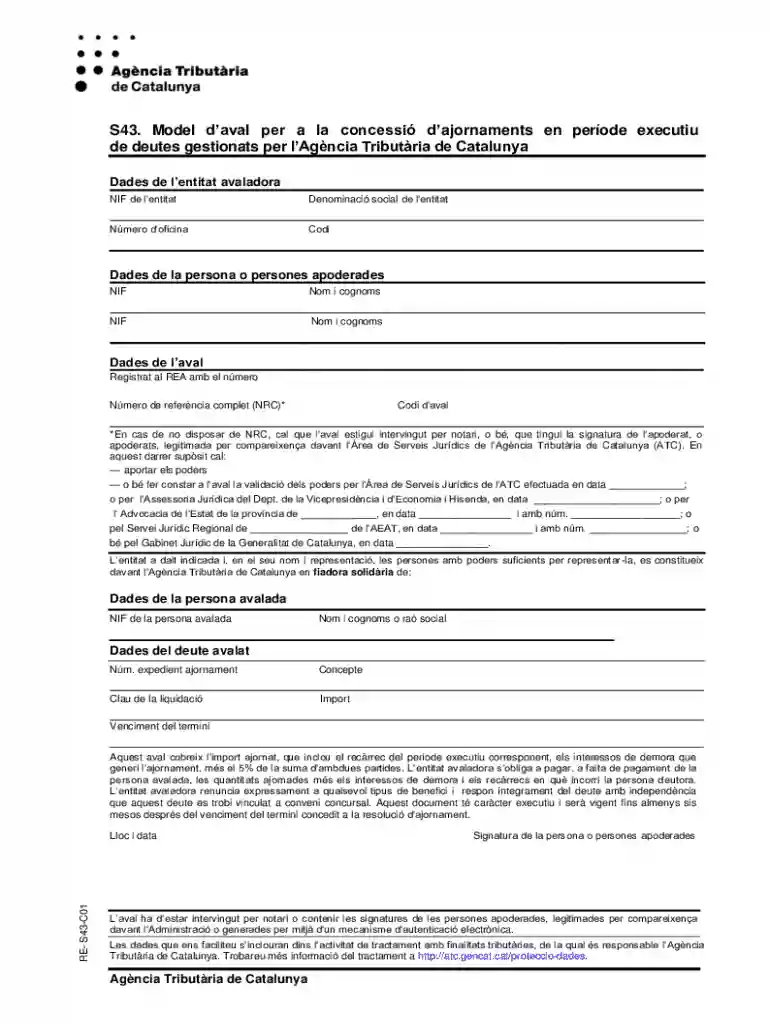
Form S43 serves as a standardized financial document primarily used for deferring debts with the Agència Tributària de Catalunya. It establishes the terms under which a guarantor agrees to take responsibility for a debtor's financial liabilities. This document not only stipulates the deferred amounts, including any applicable penalties and interest, but also mandates that a guarantor is fully accountable for the debt. Key details captured in the form include the identities of both the guarantor and debtor, along with any authorized representatives involved.
Understanding key terminology is crucial for completing Form S43. Essential terms include:
Clarifying these terms ensures all parties involved can accurately fulfill their roles and responsibilities as outlined in the document.
Completing Form S43 requires careful attention to detail and adherence to specific procedural steps:
Following these steps will help ensure a smooth completion process and reduce the likelihood of errors or delays.
The legal implications of Form S43 are significant as it binds the guarantor with full responsibility for the debtor's obligations should the debtor default. The document is required to be notarized or have authenticated signatures, bolstering its validity in legal contexts. Additionally, the form remains in effect for a minimum of six months past the deferral period, providing ongoing security for the creditor.
While Form S43 is primarily relevant to financial dealings within the context of the Agència Tributària de Catalunya, certain state-specific considerations may influence the form's usage. Understanding regional regulations and any additional requirements set forth by local tax authorities is necessary for proper compliance. Parties involved should verify if there are any particular state stipulations that must be adhered to when completing this form.
Practical scenarios for utilizing Form S43 typically include:
These examples illustrate the form's versatility in offering viable solutions for various financial challenges.
Submission of Form S43 can be accomplished through several channels:
It is critical to follow the specific submission guidelines provided by the relevant state or local authority to ensure timely processing.
Failure to accurately complete or submit Form S43 in a timely manner can lead to penalties for both the debtor and guarantor. Consequences may include increased interest rates, additional financial penalties, or legal action to recover the deferred amounts. Ensuring meticulous adherence to the form's requirements is vital to avoid such repercussions.
By covering these aspects, the content provides a comprehensive understanding of Form S43, its application, and the critical factors users must consider when dealing with debt deferment under its framework.
At DocHub, your data security is our priority. We follow HIPAA, SOC2, GDPR, and other standards, so you can work on your documents with confidence.