







Definition and Meaning of Sol licitud De Compensaci De Deutes
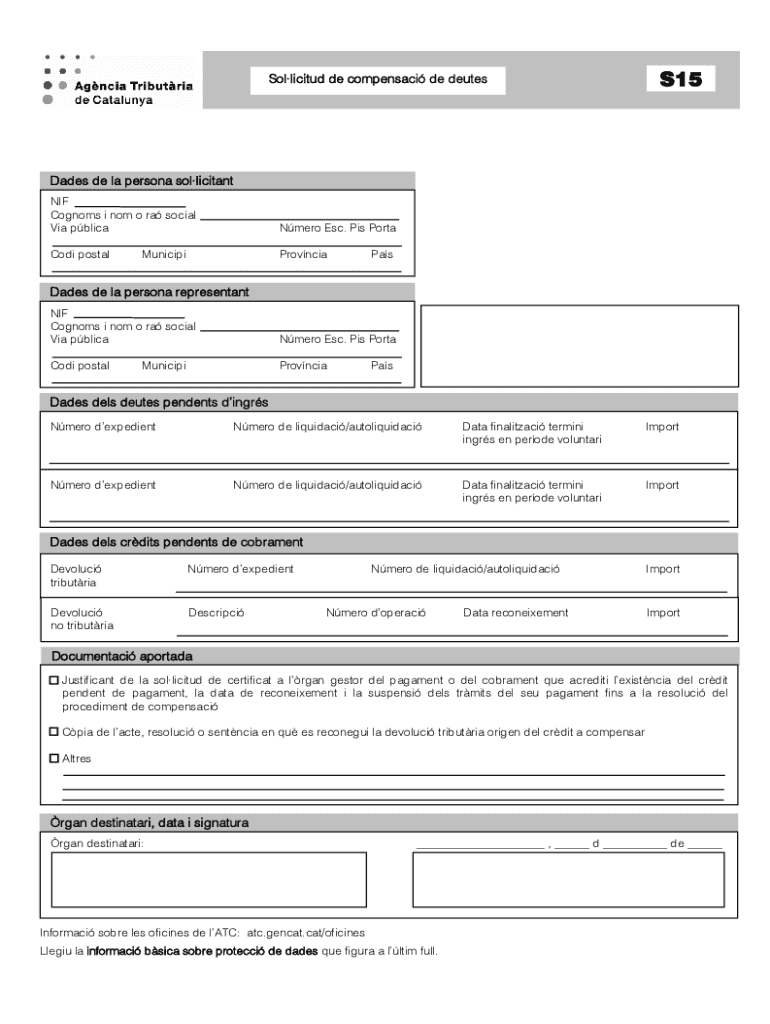
The "Sol licitud De Compensaci De Deutes" is a formal document used primarily to request the compensation of debts. This involves reporting any outstanding debts alongside pending credits owed to an individual or a representative. The goal is to facilitate the matching and offsetting of debts against credits, resulting in a balance. The form plays a crucial role in personal and business financial management, as it can streamline the debt settlement process.
Purpose and Utility
- Debt Offset: By offsetting debts with credits, individuals or businesses can potentially reduce their financial liabilities.
- Financial Clarity: This document helps in maintaining transparent financial records, especially when dealing with multiple creditors or complex financial scenarios.
- Legal Compliance: It ensures that users adhere to local financial laws and regulations, particularly in the context of debt reporting and management.
Use in the United States
Although the form originates from Catalonia, understanding its components can aid in addressing similar financial processes within the U.S., especially if you're dealing with international or cross-border financial activities.
Steps to Complete the Sol licitud De Compensaci De Deutes
Successfully completing the Sol licitud De Compensaci De Deutes involves several detailed steps:
-
Gather Personal Information: Begin by collecting all relevant personal details, such as your name, address, tax identification number, and contact information. This information lays the foundation for identifying you and validating your claim.
-
List Outstanding Debts: Compile a comprehensive list of all outstanding debts that need to be compensated. This includes the creditor’s information, the amount owed, and any pertinent reference numbers or dates.
-
Document Pending Credits: Detail any credits that are pending collection. This should include information regarding the debtor, along with the credit amount, referencing any relevant documentation.
-
Attach Necessary Documentation: It's important to attach all required documents, such as contracts, bills, or legal agreements, that support both the debt and credit claims. Proper documentation ensures the credibility of the submitted information.
-
Review and Sign: Carefully review all the entered information for accuracy. A signature is generally required to authenticate the form.
-
Submit the Form: Follow the submission guidelines, which may involve sending the form by mail, submitting it online, or delivering it in person.
Considerations During Completion
- Accuracy: Enter accurate and up-to-date information to avoid delays or rejections.
- Legal Consistency: Ensure all details align with applicable legal guidelines to prevent any compliance issues.
Required Documents for Submission
To effectively submit the Sol licitud De Compensaci De Deutes, several documents are necessary to corroborate the claims made within the form:
- Debt Agreements: Any contracts or agreements that specify the terms of the debt.
- Credit Receipts: Documentation of credits owed to you, including proof of transactions or promised payments.
- Identification Proof: Valid identification to verify the personal information provided.
- Tax Documentation: If relevant, tax-related documents that might influence the debt or credit amounts.
Document Tips
- Keep Copies: Retain copies of all submitted documents for personal records.
- Organize Wisely: Ensure all attachments are clearly labeled and organized according to the order they are referenced within the form.
Legal Use and Compliance
The legal aspect of filling out and submitting the Sol licitud De Compensaci De Deutes is vital:
- Compliance with Tax Authorities: The form must comply with the regulations set forth by the Agència Tributària de Catalunya for Catalonia and equivalent in Spain, as it involves financial disclosures.
- Protection of Personal Data: Given that sensitive information is involved, ensure data protection principles are observed.
Legal Considerations
- Verification: Make sure all financial figures and personal details are checked and verified prior to submission.
- Legal Counsel: In complex cases, consider consulting a legal advisor for guidance on the proper completion and submission of the form.
Who Typically Uses the Sol licitud De Compensaci De Deutes
This form is generally employed by:
- Individuals: People who have multiple debts and credits and wish to balance their financial situation.
- Financial Representatives: Lawyers or financial agents acting on behalf of clients to manage and consolidate their financial obligations.
- Businesses: Companies with outstanding debts and credits wishing to streamline their balance sheets.


Common Scenarios
- Debt Reconciliation: Handy for individuals or entities needing to reconcile debts quickly for personal or tax reasons.
- Financial Management: Utilized as a comprehensive tool for managing diverse financial relationships.
Key Elements of the Sol licitud De Compensaci De Deutes
Understanding the key elements of the form is pivotal for its successful utilization:
- Personal and Contact Information: Essential for identification and communication purposes.
- Details of Debts and Credits: Specific information detailing all financial obligations and entitlements.
- Supporting Documentation: All relevant documents validating claims of debt and credit.
Highlighted Features
- Essential Fields: Mandatory sections that must be filled to qualify for form processing.
- Optional Sections: Fields that provide additional information but do not affect the core validity of the request.
State-specific Rules for the Sol licitud De Deutes
Rules and regulations for this form may vary by region:
- Catalonia-Specific Guidelines: Since the form originates from Catalonia, compliance with regional regulations is crucial.
- U.S. Adaptations: For dual citizens or international transactions, adaptations may be necessary to align with U.S. financial and legal standards.
Regional Variations
- Documentation Requirements: Variations can exist in the types of documents required based on local laws.
- Submission Protocols: Different regions may enforce diverse submission methods and deadlines. Always verify with local authorities.
Penalties for Non-Compliance
Ignoring the proper use of the Sol licitud De Compensaci De Deutes can result in penalties:
- Fines: Failure to accurately report debts or credits may lead to financial penalties from tax authorities.
- Legal Action: In severe cases, non-compliance can result in legal action or an audit.
Examples of Potential Penalties
- Late Submission: Missing deadlines can incur fines.
- Misreporting: Providing inaccurate information might trigger investigations or result in additional charges.
Examples of Using the Sol licitud De Compensaci De Deutes
Understanding practical applications reveals the form's utility:
- Example 1: An individual offsetting a student loan with pending tax refunds to reduce the overall debt burden.
- Example 2: A business using the form to match supplier credits against outstanding invoice payments.
- Example 3: An expatriate balancing cross-border financial obligations to simplify international financial management.
Practical Applications
- Debt Settlement: Facilitating smoother debt settlement through organized documentation.
- Financial Cleanup: Implementing the form during audit preparations to enhance financial transparency.
These outlined sections provide an in-depth exploration into the utility, process, and legal implications surrounding the Sol licitud De Compensaci De Deutes, ensuring comprehensive understanding and effective application.




