01. Edit your form online
Type text, add images, blackout confidential details, add comments, highlights and more.

Type text, add images, blackout confidential details, add comments, highlights and more.

Draw your signature, type it, upload its image, or use your mobile device as a signature pad.

Send it via email, link, or fax. You can also download it, export it or print it out.
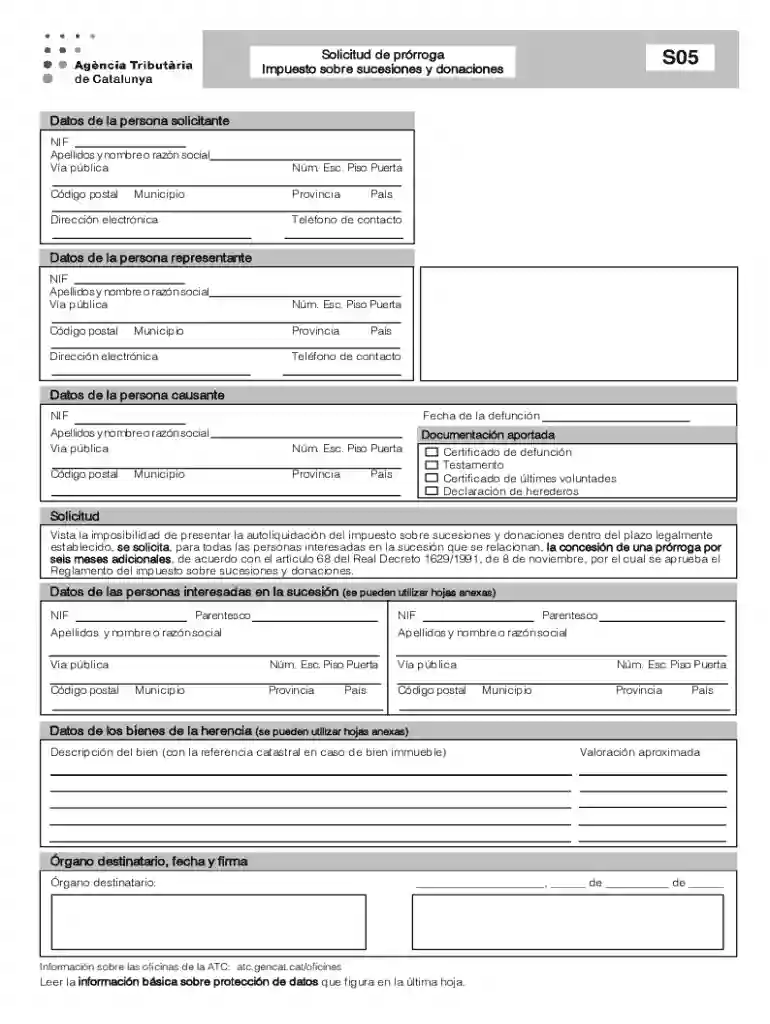
A "Solicitud De Prórroga," or request for an extension, generally refers to a formal petition made to extend the deadline for a specific obligation. In the context of inheritance and donation tax, this form is used to request additional time to file taxes due to the inability to submit a self-assessment by the original deadline. It is vital to understand that such requests must align with relevant regulations, and they are subject to approval based on the reasons provided.
The main purpose is to provide taxpayers with additional time to gather necessary information and ensure accuracy in reporting. Typically, this involves providing detailed personal information such as the identity of the applicant, representative details, and specifics about the inheritance or donation in question.
Gather Necessary Information: Before filling out the Solicitud De Prórroga, collect all personal and financial information related to the inheritance or donation. This includes details of the deceased, interested parties, and any inherited assets.
Complete Personal Details: Fill out sections with personal information, including your full name, address, and contact information. If applicable, include representative details and their relationship to the applicant.
Provide Inheritance Details: Clearly describe the inherited assets, any associated liabilities, and other relevant financial information necessary for accurate processing of the request.
Specify the Reason for Extension: Clearly state the reasons for requesting an extension. This section should provide a valid explanation, aligning with applicable regulations and demonstrating the necessity for more time.
Determine Extension Length: Standard procedures allow for a six-month extension. Ensure that this request is formally stated, and provide any additional information as required by regulations.
Sign and Submit the Form: Review all entries for accuracy before signing. Submission methods vary—ensure you select the appropriate submission channel as per your state's guidelines.
Utilizing a Solicitud De Prórroga ensures compliance with tax laws and prevents potential penalties due to late filing. It's particularly beneficial for:
Avoiding Penalties: By formally requesting an extension, you secure additional time without the immediate risk of incurring late fees or penalties.
Ensuring Accuracy: Complex tax situations often require more time to gather accurate supporting documentation. An extension allows thorough preparation.
Managing Unexpected Delays: Unforeseen circumstances, such as delays in obtaining necessary information, can disrupt timely filing. An extension provides an official buffer to accommodate such situations.
Applicant: The person requesting the extension, often directly involved in managing the estate or the tax affairs of the deceased.
Representative: An individual authorized to act on behalf of the applicant, typically involved in legal or financial matters concerning the estate.
Inherited Assets: Items or property received posthumously, which must be assessed for tax purposes.
Self-Assessment: The process where the taxpayer values the inheritance and calculates the resulting tax obligation.
Regulations: Legal guidelines governing the eligibility and process for requesting an extension.
The Solicitud De Prórroga must adhere to legal standards to be effective. It serves as a formal request that, when used correctly, is protected under federal tax laws for offering extensions. It must be filed in accordance with deadlines established under the ESIGN Act, which also governs electronically signed and submitted requests. This ensures both the authenticity and legality of the electronic form submission.
Different states may have specific rules or variations in the Solicitud De Prórroga format and submission requirements. It is essential to:
Check Local Regulations: Verify any state-specific guidelines that could affect your submission's acceptance and processing.
Stay Informed on Variances: Each state might vary in how they handle extensions, particularly with deadlines and supporting documents.
Consult State Tax Authorities: Engage with local tax offices for precise instructions and compliance tips.
Failing to file a Solicitud De Prórroga or meet existing deadlines can lead to several consequences:
Late Fees: Incurring additional costs for each missed deadline.
Interest Accumulation: Interest may accrue on taxes owed from the original due date until the tax is paid.
Legal Consequences: Persistent non-compliance can attract more severe penalties, including legal action or audits.
When preparing to file a Solicitud De Prórroga, ensure you have:
Identification Documents: Valid proof of identity for the applicant and representative.
Tax-related Information: Comprehensive data on the inheritance value, existing liabilities, and deductions.
Supporting Evidence: Any documents that justify the extension request, such as legal impediments or delays in information procurement.
Consider these practical scenarios for greater context:
A Complex Estate: Inheritance includes diverse assets requiring time-intensive appraisals or sales before taxes can be accurately assessed.
Representatives with Limited Access: A representative might need time to gather financial documents from various locations.
Unexpected Documentation Delays: In cases where critical documents are delayed, requesting a prórroga provides legal time relief.
By understanding these detailed aspects of the Solicitud De Prórroga, taxpayers can better navigate the process, ensure compliance, and avoid unnecessary penalties.
At DocHub, your data security is our priority. We follow HIPAA, SOC2, GDPR, and other standards, so you can work on your documents with confidence.