01. Edit your form online
Type text, add images, blackout confidential details, add comments, highlights and more.

Type text, add images, blackout confidential details, add comments, highlights and more.

Draw your signature, type it, upload its image, or use your mobile device as a signature pad.

Send it via email, link, or fax. You can also download it, export it or print it out.
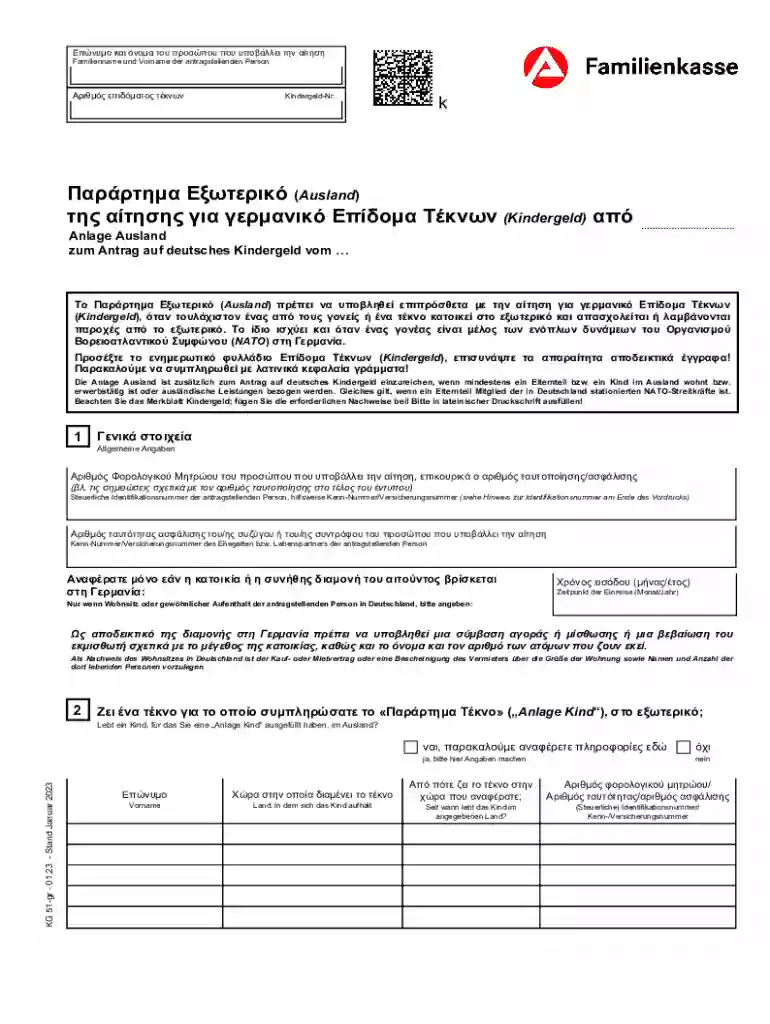
The "zum Antrag auf deutsches Kindergeld vom" is a form used to apply for the German Child Benefit, known as Kindergeld. This form is crucial for individuals residing or working abroad who wish to claim child benefits for children living outside Germany. Kindergeld serves as a financial aid for families, supporting the cost of raising children. The form requires detailed personal information, as well as specific documentation proving residency, employment status, and eligibility for the benefit. It is essential to provide accurate information to ensure proper processing and avoid any delays in receiving the benefit.
To use the form effectively, follow these steps:
Gather Necessary Information: Collect personal details, including tax identification numbers and documentation of your residency and employment status.
Complete Each Section: Fill out sections regarding personal information, children's details, and any foreign family benefits received.
Attach Required Documents: Include proof of residence, employment, and any existing benefits from other countries.
Review for Accuracy: Ensure all information is correct and up-to-date to prevent issues in processing.
Submit Form: Submit the application following the guidelines provided, which may be via mail, online, or in-person, depending on the requirements of the German Family Benefits Office.
Completing this form involves several key steps:
Provide Personal Information: Include full name, address, and contact details.
Enter Tax Identification Numbers: List your tax ID and any relevant numbers needed for processing.
Detail Your Employment Status: Documentation proving employment should be included to verify eligibility.
List Children’s Details: For each child, include birth certificates and details of their residence.
Disclose Foreign Benefits: Declare any family benefits received from other countries to ensure transparency.
Sign and Date: Ensure the application is signed and dated to validate your submission.
Eligibility for Kindergeld requires:


The submission must include:
Failing to adhere to the form's requirements can result in:
Overall, attention to detail and compliance with the application process is critical to obtaining the Child Benefit efficiently and effectively.
At DocHub, your data security is our priority. We follow HIPAA, SOC2, GDPR, and other standards, so you can work on your documents with confidence.