01. Edit your form online
Type text, add images, blackout confidential details, add comments, highlights and more.

Type text, add images, blackout confidential details, add comments, highlights and more.

Draw your signature, type it, upload its image, or use your mobile device as a signature pad.

Send it via email, link, or fax. You can also download it, export it or print it out.
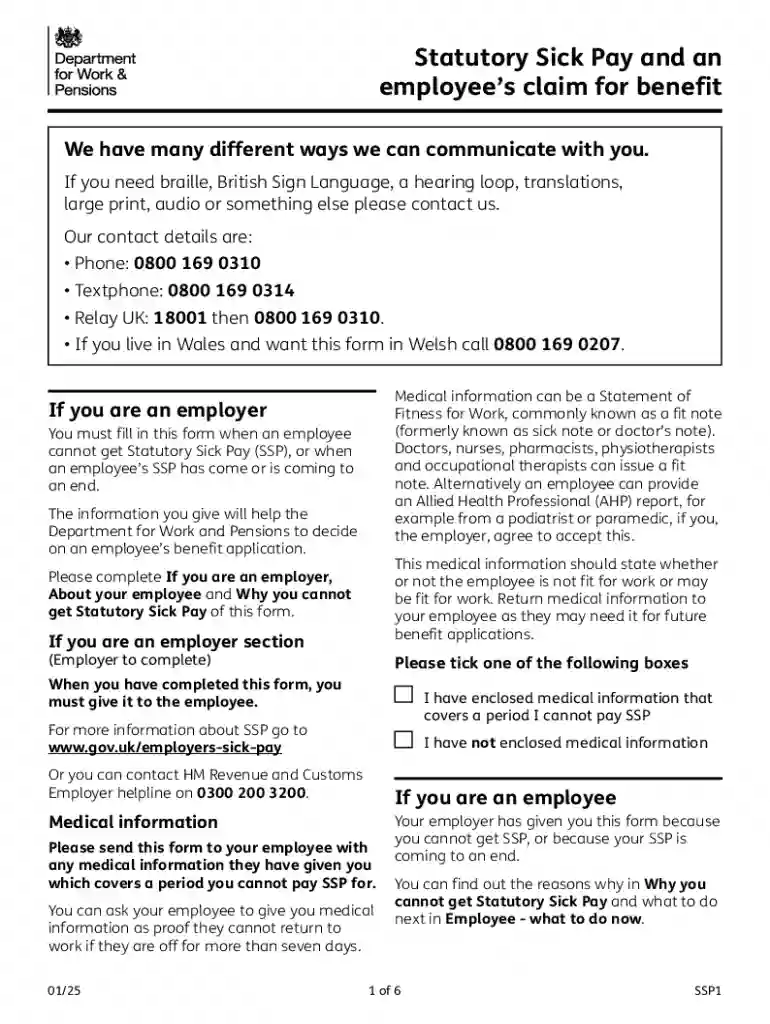
The SSP1 form is a critical document within the realm of employment and sick pay regulations, primarily used in the context of Statutory Sick Pay (SSP). Employers issue this form to employees who are ineligible for SSP, providing a formal declaration and explanation of the decision. The SSP1 serves both as a notice and a record, ensuring transparency and accountability in employment practices regarding sick pay benefits. Understanding its role and functionality can empower both employers and employees to navigate the legal landscape effectively.
The usage of the SSP1 form revolves around its dual purpose as a notification and a request for further action. Employers initiate this form when it's clear that an employee not eligible for SSP. This could be due to various reasons, such as not meeting the minimum earnings threshold or being sick during a period when SSP is not applicable. Employees then use this form to support their claim for other benefits, such as Employment and Support Allowance, by submitting it alongside their application. Therefore, the SSP1 acts as both an informative document and a supporting appendage for subsequent benefit claims.
Employer Information: Start by filling in your company details, including the employer's name and address. It's crucial that this section is clear and accurate to avoid potential confusion or delays.
Employee Details: Enter the employee's full name, National Insurance number, and employment start date. Ensure this information matches the official records currently held by the employer.
SSP Eligibility Status: Clearly state the reason why the employee is not entitled to SSP. This might include scenarios like the employee not having sufficient earnings or the incapacity falling outside SSP entitlement periods.
Supporting Details: If applicable, provide any details relevant to the employee's absence or why SSP is not being paid, such as the timeframe of illness or specific company policy references.
Signature and Date: Ensure the form is signed and dated by an authorized person within the organization. This certifies the accuracy of the information provided and signifies official communication with the employee.
To effectively use the SSP1 form, understanding the eligibility criteria for SSP is essential. Typically, employees must earn at least the lower earnings limit to qualify for SSP. Additionally, they should have informed the employer about their sickness within the stipulated timeframe. Situations that make an employee ineligible, and hence trigger the use of SSP1, include commencing illness during maternity leave, lack of proper notification, or instances where the sickness extends beyond the maximum SSP duration. Thus, knowing these prerequisites helps recognize when issuing an SSP1 is appropriate.


Several documents complement the SSP1 form, acting as verification or supporting evidence for its issuance. Employers should prepare any records showing the employee's earnings below the lower earnings limit. Additionally, physician's reports or medical certificates substantiating the illness period may be referenced. In some cases, the employment contract detailing sick pay clauses or eligibility might be necessary. Collecting these documents ensures that the information provided on the SSP1 is defensible and comprehensive, minimizing disputes.
The SSP1 form holds legal significance as it protects both employers and employees under the statute regarding sick pay entitlements. It provides a definitive statement when SSP is not applicable, shielding employers against wrongful claims and offering employees a transparent path for further benefit claims. Furthermore, by formally documenting the reasons for SSP ineligibility, it demonstrates compliance with employment laws and regulations, ensuring all parties are informed and their rights observed.
While the SSP1 form follows national guidelines, specific states within the U.S. may have additional rules or complementary programs that affect its use. Some states might offer their versions of sick pay legislation, which could influence the SSP1's context or details. Employers must familiarize themselves with both federal and state regulations to ensure full compliance and avoid unnecessary complications. It's also prudent for employees to be aware of localized statutes that might provide further assistance or dictate different procedural aspects when dealing with SSP1.
Failure to properly issue or manage the SSP1 form can lead to several consequences for employers. These might include fines, legal challenges, or audits by labor authorities, as non-compliance signifies a breach of statutory responsibilities. For employees, not utilizing the SSP1 correctly can delay or disqualify their claims for alternative benefits, underscoring the need for due diligence and adherence to processes. Both parties should approach the SSP1 with precision to guard against such pitfalls.
Consider an employee whose earnings fall below the qualifying threshold for SSP. The employer issues an SSP1 explaining their pay history and the decision rationale, thereby allowing the employee to apply for other benefits like Employment and Support Allowance. Another instance might involve an employee on long-term leave beyond the standard SSP duration; the SSP1 declares the exhaustion of SSP eligibility, prompting the next stage in benefit applications. These scenarios highlight the form's utility in structured workforce management.
We've got more versions of the Ssp1 form. Select the right Ssp1 version from the list and start editing it straight away!
At DocHub, your data security is our priority. We follow HIPAA, SOC2, GDPR, and other standards, so you can work on your documents with confidence.