Church Exemption 2026

Get Form
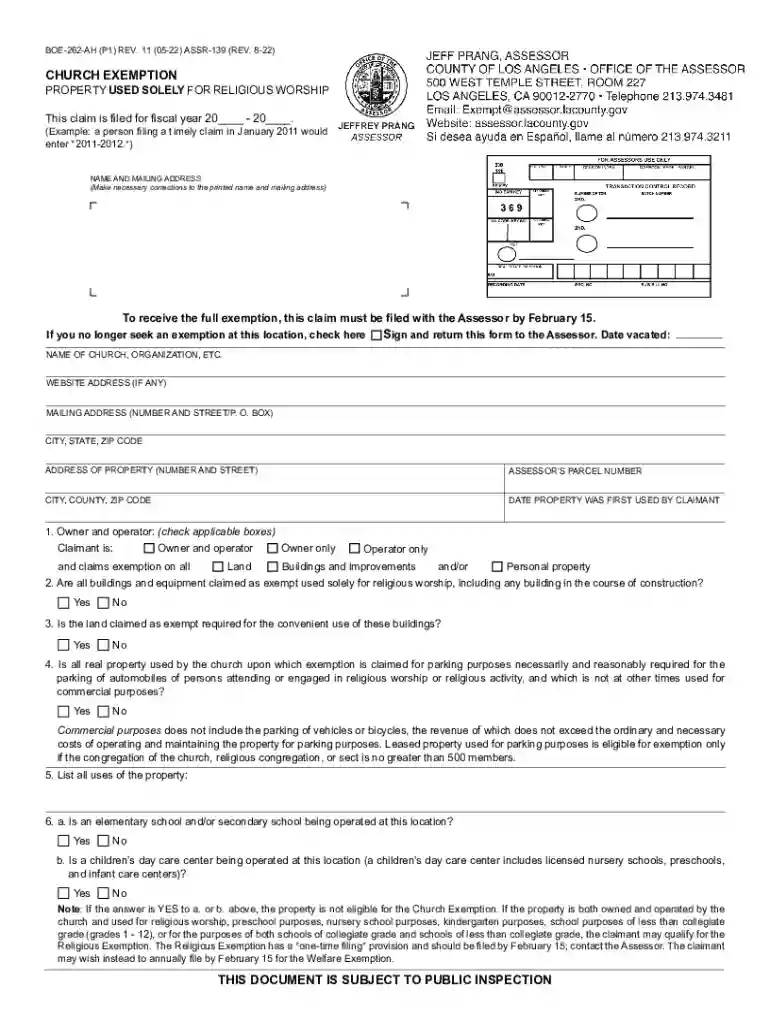
Church Exemption Preview on Page 1

Here's how it works

01. Edit your form online
Type text, add images, blackout confidential details, add comments, highlights and more.

02. Sign it in a few clicks
Draw your signature, type it, upload its image, or use your mobile device as a signature pad.

03. Share your form with others
Send it via email, link, or fax. You can also download it, export it or print it out.

Definition & Meaning

The Church Exemption refers to a property tax exemption specifically designed for properties that are used solely for religious worship. This exemption allows religious organizations to exempt specific properties from property taxes, reducing financial liabilities associated with owning such properties. Organizations typically apply for this exemption through local tax authorities, and it requires proof that the property is used exclusively for religious purposes.

How to Use the Church Exemption

To effectively use the Church Exemption, religious organizations must ensure that their properties are utilized strictly for worship or religious activities. Clear documentation and evidence of the property's use are essential. Additionally, maintaining a record of services and religious activities conducted on the property can support an organization's ongoing eligibility for the exemption. Consistent oversight and internal audits can aid in compliance with local tax regulations concerning the Church Exemption.

Practical Tips

  • Maintain detailed logs of activities conducted on the property.
  • Keep architectural plans or other documentation showing the space's exclusive religious use.
  • Regularly review your exemption status to ensure continued compliance.

How to Obtain the Church Exemption

Obtaining the Church Exemption requires several steps, starting with understanding the specific requirements set forth by the local tax authority. Organizations will need to submit an application form with relevant documentation that proves the property is used for religious purposes. This may include proof of ownership, usage records, and sometimes, a statement from church officials outlining the property’s primary use. It is crucial to provide accurate and comprehensive information to avoid denials or delays.

Step-by-Step Process

  1. Research Local Requirements: Understand the local jurisdiction’s requirements regarding church exemptions.
  2. Gather Documentation: Assemble necessary documents, such as proof of ownership and usage records.
  3. Complete Application: Accurately fill in the application form for the exemption.
  4. Submit Application: Send the completed form and supporting documents to the local tax authority by the designated deadline.
  5. Follow Up: Reach out to the tax authority to confirm receipt and inquire about apporval status.

Eligibility Criteria

The eligibility for the Church Exemption involves several criteria that must be met by the property or organization seeking the exemption. First and foremost, the property must be used exclusively for religious worship or activities. Additionally, the organization should be recognized as a religious entity. In some areas, the size or location of the property may also influence eligibility. Understanding and meeting these requirements is crucial for securing the exemption.


decoration image ratings of Dochub

Common Eligibility Requirements

  • The property must be owned by a recognized religious organization.
  • It should be used exclusively for religious worship.
  • The religious organization should be a registered nonprofit.

Steps to Complete the Church Exemption

Completing the Church Exemption involves carefully following the requirements outlined by the local tax authority. From gathering necessary documentation to ensuring precise completion of application forms, each step is integral to a successful submission. Ensuring that all sections of the application are filled out and supported with evidence can help in avoiding delays.

Detailed Steps

  1. Identify Necessary Documentation: Gather all documents required to support the application.
  2. Review Documentation Requirements: Double-check that all documents correctly comply with jurisdiction criteria.
  3. Complete the Application Form: Fill out each section accurately without leaving gaps.
  4. Attach Supporting Documentation: Include proof of property use, ownership, and any other supportive evidence.
  5. Submit by Deadline: Ensure the completed application is submitted well before the deadline.

Filing Deadlines and Important Dates

Adhering to filing deadlines is a critical aspect of ensuring eligibility for the Church Exemption. Missing these deadlines can result in ineligibility or penalties. Typically, applications must be submitted by a specific date each year to be considered for the full exemption.

Key Deadlines

  • Annual Submission Deadline: Applications are usually due by February 15 to qualify for the full exemption.
  • Renewal Deadlines: Any required renewals or re-qualifications must be completed by the same annual deadline.

Required Documents

Accurately preparing and providing all required documents is essential when applying for the Church Exemption. These documents support your application and demonstrate the property's use as meeting exemption criteria.

Commonly Required Documents

  • Proof of ownership or lease agreement for the property.
  • Documentation of religious activities conducted on-site.
  • Official statements or letters from church officials supporting the claim.

State-Specific Rules for the Church Exemption

Each state may have distinct rules or additional conditions for granting the Church Exemption. Understanding these state-specific requirements is essential for religious organizations applying for this property tax relief.

Examples of State Variations

  • Some states might require specific evidence of nonprofit status beyond federal recognition.
  • Certain jurisdictions might have unique forms or additional supporting documentation.
  • Variations in requirements for renewal and ongoing exemption maintenance.

Understanding these aspects can assist in ensuring a smooth application process for the Church Exemption.

be ready to get more

Complete this form in 5 minutes or less

Get form

Got questions?

We have answers to the most popular questions from our customers. If you can't find an answer to your question, please contact us.
Contact us
Mississippi charges a 7% sales tax. Two cities, Jackson and Tupelo, impose a local sales tax of 1% and 0.25%, respectively. The sales tax on food products eligible for purchase with food stamps is 5%. Remote vendors must collect and remit sales tax if their annual sales to Mississippi customers exceed $250,000.
There is no overall exemption from use tax in Mississippi that applies to churches; however, there is a use tax exemption for churches purchasing religious literature, video materials, audio materials or photographs for the propagation of the churchs creed.
The Church Exemption is the most restrictive of the three exemptions available to a church since the organizations property must be used solely for religious worship and other activities reasonably necessary for the accomplishment of the churchs religious purposes.
Con 2: Exempting churches from taxation forces taxpayers to subsidize religion, while costing the government billions in tax revenue. Read More. Pro 3: Most churches follow the rules and would struggle to exist without the tax exemption.
Since our countrys founding, churches have been tax-exempt from federal taxes, but it wasnt until 1894 (Tariff Act) that it became official. Although the Tariff Act was later declared unconstitutional, the church tax exemption was reinstated by the Revenue Act of 1913.

Security and compliance

At DocHub, your data security is our priority. We follow HIPAA, SOC2, GDPR, and other standards, so you can work on your documents with confidence.

Learn more
ccpa2
pci-dss
gdpr-compliance
hipaa
soc-compliance