






Definition and Meaning
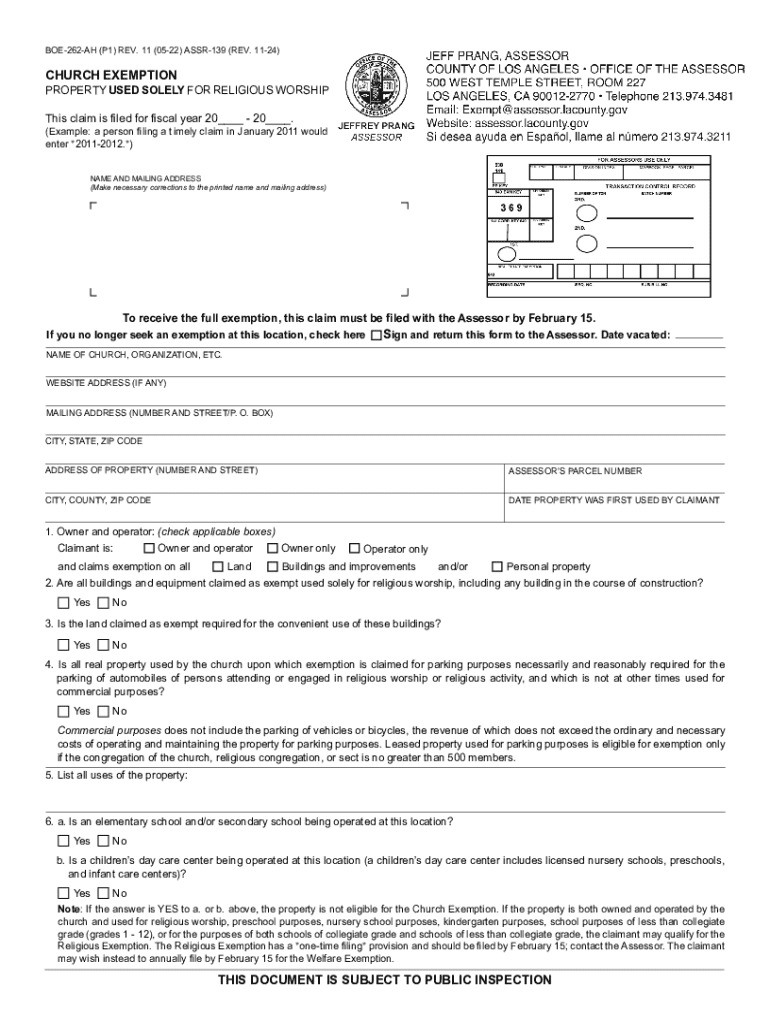
The Boe-262-ah (p1) Rev 11 (05-22) Assr-139 (rev 11-24) form is a claim form used for church property tax exemption. It applies specifically to properties dedicated solely to religious worship. This document outlines the guidelines and requirements that churches need to meet to qualify for tax exemption on relevant properties, offering significant financial relief to religious organizations by reducing their tax burden.
Purpose of the Form
- Tax Exemption: The primary purpose of this form is to enable churches to claim an exemption from property taxes.
- Eligibility Verification: It ensures that only properties meeting the criteria for religious worship usage are exempted.
How to Obtain the Form
Securing a copy of the Boe-262-ah (p1) Rev 11 (05-22) Assr-139 (rev 11-24) form involves several options:
- Online Access: Most local county assessor offices offer downloadable versions from their websites.
- In-Person Requests: Visit your local assessor’s office to collect a paper copy.
- Mail Requests: Some offices may provide the form via mail upon request.
Necessary Locations
- Local county assessor's websites
- Physical assessor’s office locations
Steps to Complete the Form
- Gather Required Information: Collect details of the property, ownership documents, and any relevant proof of usage for religious worship.
- Complete Identification Sections: Fill in church details, including name, contact information, and property description.
- Provide Usage Justification: Describe the property’s use to prove its sole dedication to religious worship.
- Attach Supporting Documents: Include necessary documents that verify property ownership and religious use.
- Review and Sign: Ensure complete accuracy of entered information before signing the form.
- Submit Before Deadline: The completed form should be submitted to the assessor by February 15 to qualify for the full exemption.
Eligibility Criteria
The form can be complicated, and understanding who qualifies is crucial:
- Property Ownership: The property must be owned by a recognized religious organization.
- Usage Exclusivity: The property must be used exclusively for religious worship.
- Filing Deadlines: All submissions must be timely to ensure eligibility, emphasizing the importance of the February 15 deadline.


Important Terms Related to the Form
Several terms are key to understanding and accurately completing the Boe-262-ah (p1) Rev 11 (05-22) Assr-139 (rev 11-24):
- Assessor: The official responsible for determining property value and tax eligibility.
- Exemption: Legal permission to exclude certain properties from taxation.
- Religious Worship: Activities specifically related to the practices of a religion.
Filing Deadlines and Important Dates
- February 15: This is the critical deadline for submission each year to qualify for the full exemption.
- Annual Submission: Churches must reapply each year to maintain their tax-exempt status.
Penalties for Late Filing
- Filing beyond the deadline may result in reduced exemption benefits or a complete denial for that year’s taxes.
Required Documents
To ensure a complete submission, gather the following:
- Proof of Ownership: Deeds or property titles.
- Documentation of Use: A narrative or other supporting materials illustrating exclusive use for religious worship.
- IRS Recognition: Documentation showing that the organization is recognized by the IRS as tax-exempt.
Key Elements of the Form
When dealing with the Boe-262-ah (p1) Rev 11 (05-22) Assr-139 (rev 11-24):
- Property Information: Crucial details about the property in question, including size, location, and nature of use.
- Exemption Basis: Explanation of why the property qualifies for exemption, necessitating a focus on religious worship activities.
- Signature Line: Indicates agreement and accuracy of the provided information, mandatory for a valid submission.