






Definition & Meaning
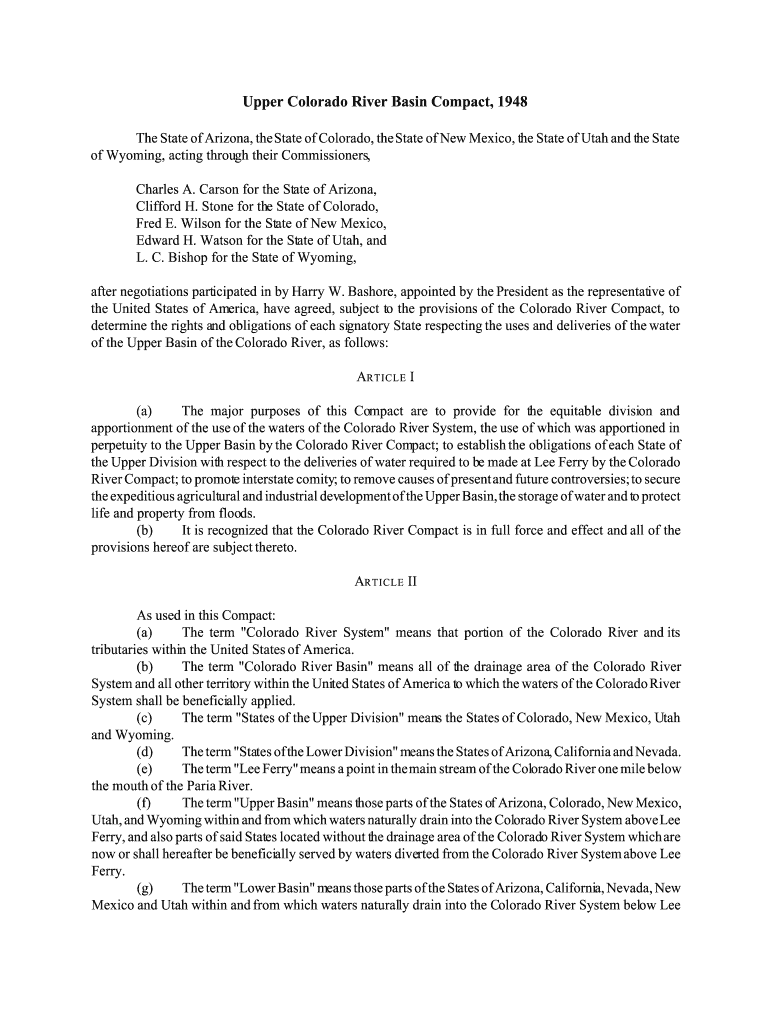
The Upper Colorado River Basin Compact is an agreement signed in 1948 by the states of Arizona, Colorado, New Mexico, Utah, and Wyoming. This Compact establishes the rights and obligations of these states concerning the usage and delivery of water from the Upper Basin of the Colorado River. It is designed to ensure a fair distribution of water resources among the member states while fostering agricultural and industrial development, preventing conflicts, and mitigating flood risks.
Key Objectives
- Equitable water distribution
- Promotion of development
- Conflict prevention
- Flood protection
Specific Allocations
The Compact specifies water allocations for each signatory state, considering their varied needs and environmental factors.
Steps to Complete the Upper Colorado River Basin Compact
Completing the Compact involves several essential steps, each of which plays a critical role in ensuring compliance and proper execution.
Ratification Process
- State Legislature Approval: Each state’s legislature must ratify the Compact for it to take effect.
- Congressional Approval: Following state ratification, Congressional approval is required to finalize the Compact.
Implementation Techniques
- Water Use Management: States must develop procedures for managing water use according to the Compact’s guidelines.
- Monitoring & Reporting: Each state is responsible for monitoring water usage and reporting data to the Compact's governing body.
Important Terms Related to the Compact
Understanding the terminology within the Compact is crucial for comprehending its full scope and implications.
Key Terms
- Upper Basin: Refers to the region of the Colorado River Basin located above Lee Ferry.
- Allocation: The specific amount of water designated to each state.
- Curtailment: Restrictions on water use during shortages to ensure compliance with the Compact.
State-Specific Rules
The Compact allows for state-specific rules that reflect the unique requirements and conditions of each participating state.
Arizona
- Arizona has flexible water utilization strategies due to its arid climate.
- The state focuses on conservation and efficiency to meet Compact obligations.
Colorado
- Colorado’s policies emphasize sustainable water resource management and agricultural support.
- Innovative water-saving technologies are promoted.
New Mexico
- New Mexico implements stringent monitoring systems to ensure adherence to allocation limits.
- Encourages public participation in water conservation efforts.
Legal Use of the Compact
The legal framework of the Compact outlines the permissible uses of allocated water, which must adhere to specified guidelines.
Permissible Uses
- Agricultural Irrigation: Water can primarily be used for crop production.
- Industrial Development: Supporting industry while maintaining environmental sustainability is allowed.
- Municipal Use: Includes supporting city and township water needs, subject to allocated limits.
Examples of Using the Compact
Practical application of the Compact demonstrates how states effectively manage their water resources.
Real-World Scenarios
- During droughts, states collaborate to redistribute water under curtailment guidelines.
- Joint water conservation projects funded by multiple states to optimize Colorado River resource allocation.
Eligibility Criteria
The Compact applies to states that form the Upper Basin of the Colorado River. Each state must meet certain eligibility criteria to partake in the Compact’s benefits.


Criteria for Participation
- Must be a signatory state with legislative and congressional approval.
- Compliance with resource management and reporting standards must be met.
State-by-State Differences
While the Compact provides a unified framework, each state may approach its obligations differently based on local needs.
Variations Across States
- Arizona: Emphasis on drought-resistant crops.
- Colorado: More focus on supporting its significant ski industry through water management.
- New Mexico: Implementing technology for efficient water usage in agriculture.
- Utah: Strategies include maintaining reservoir levels for recreation and fishery management.
Quick Facts
- The Compact was signed on October 11, 1948.
- Requires both state and federal legislative approval for implementation.
- Overseen by the Upper Colorado River Commission.
By understanding these aspects of the Upper Colorado River Basin Compact, stakeholders can ensure responsible water management that benefits each participating state while adhering to legal obligations.