Definition and Purpose of the Iowa Do Not Resuscitate Form
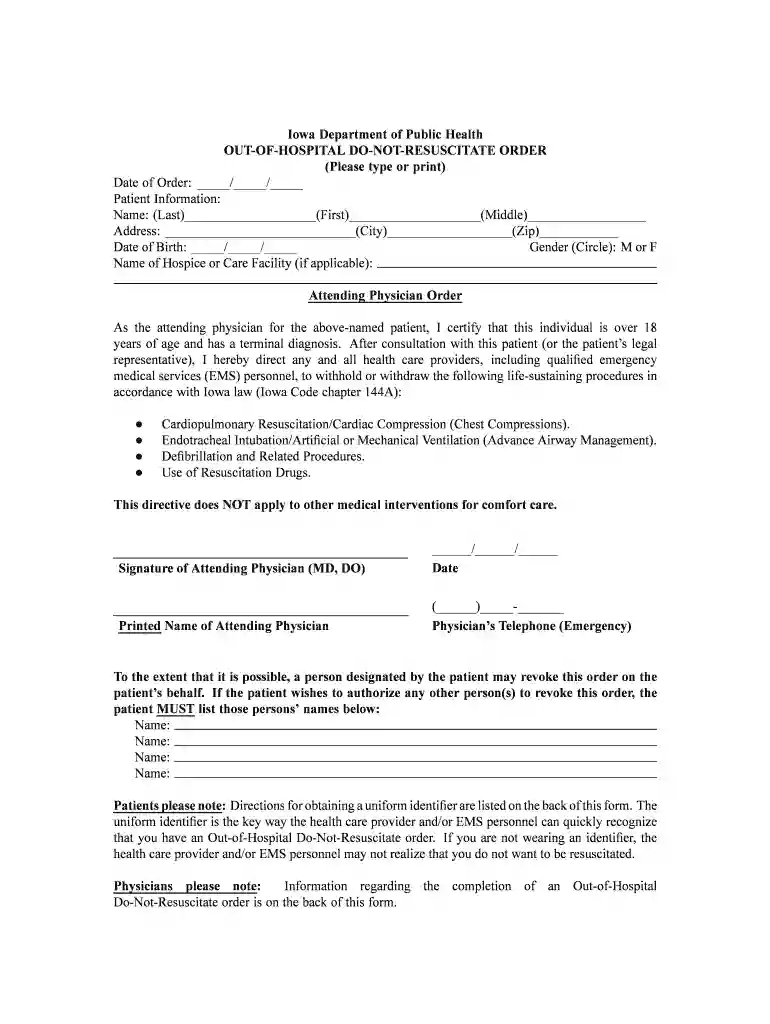
The Iowa Do Not Resuscitate Form, often abbreviated as DNR, is a legal document issued by the Iowa Department of Public Health. It allows individuals with terminal conditions to instruct healthcare personnel, including emergency medical technicians, to refrain from employing life-saving measures like cardiopulmonary resuscitation (CPR) and intubation in out-of-hospital settings. This document is invaluable for patients who wish to forego aggressive medical interventions in favor of comfort care.
Key Elements of the Iowa Do Not Resuscitate Form
Several critical components must be accurately filled out for the DNR form to be valid:
- Patient Information: Personal details such as name, date of birth, and address must be included.
- Physician Certification: A licensed physician must verify and certify the patient’s terminal diagnosis.
- Signer Authorization: The form must be signed by the patient or an authorized individual, such as a legal guardian or healthcare proxy.
- Revocation Guidelines: Instructions on how a patient can rescind the DNR order if they choose to change their decision.
Steps to Complete the Iowa Do Not Resuscitate Form
Filling out the DNR form requires careful attention to ensure legality and compliance:
- Gather Necessary Information: Start with collecting all relevant personal and medical details to be included on the form.
- Consult with a Physician: Discuss your decision with your healthcare provider, who will certify your medical condition.
- Complete the Form: Fill out the form accurately, ensuring all sections are comprehensively addressed.
- Secure Required Signatures: Obtain signatures from the necessary parties, including your physician and, if applicable, your healthcare proxy.
- Store the Form Accessibly: Keep the completed form in a readily accessible location to ensure it is available during medical emergencies.
Legal Use of the Iowa Do Not Resuscitate Form
The DNR form must be used according to legal guidelines to ensure its enforceability:
- Adherence to state-level regulations is crucial; the form should conform to Iowa's specific legal framework.
- An authorized physician's signature is mandatory for the form's validity.
- Patients or their proxies must keep the document in a place where it can be found quickly during an emergency.
State-Specific Rules for the Iowa Do Not Resuscitate Form
Each state has specific protocols regarding DNR forms. In Iowa:
- Patients should also obtain a uniform identifier, like a bracelet, which alerts emergency medical personnel of the DNR status.
- The DNR order is typically valid outside of hospitals, in settings such as nursing homes or private residences.
How to Obtain the Iowa Do Not Resuscitate Form
Accessing the DNR form involves a straightforward process:
- Visit the Iowa Department of Public Health website to download the form.
- Alternatively, discuss with your healthcare provider who can provide the correct document.
- Ensure the form version is current to avoid compliance issues.
Important Terms Related to the Iowa Do Not Resuscitate Form
Understanding terminology associated with the form:
- Out-of-Hospital DNR: Refers to DNR orders applicable outside a hospital setting.
- Revocation: The act of formally rescinding or canceling the DNR order.
- Palliative Care: Medical care focused on providing relief from the symptoms and stress of severe illness.
Why Use the Iowa Do Not Resuscitate Form
This form is crucial for maintaining autonomy over medical treatment:
- It ensures that healthcare providers respect the patient’s end-of-life care preferences.
- By completing a DNR form, patients and families can avoid unwanted resuscitation attempts, promoting dignity during the final stages of life.
Examples of Using the Iowa Do Not Resuscitate Form
Real-world scenarios include:
- An elderly patient in hospice care chooses a DNR to ensure only comfort measures are taken.
- A patient recently diagnosed with an irreversible disease uses the DNR form to prevent invasive life-saving actions in out-of-hospital environments.
How to Use the Iowa Do Not Resuscitate Form Effectively
To make sure your wishes are followed:
- Regularly discuss your wishes with family members and caregivers to ensure they are aware of the presence and location of the DNR form.
- Update the form and your medical professionals periodically or when health conditions change.
- Consider wearing a medical bracelet for quick recognition by emergency personnel.