Delaware Medical Orders for Scope of TreatmentDelaware 2026

Get Form
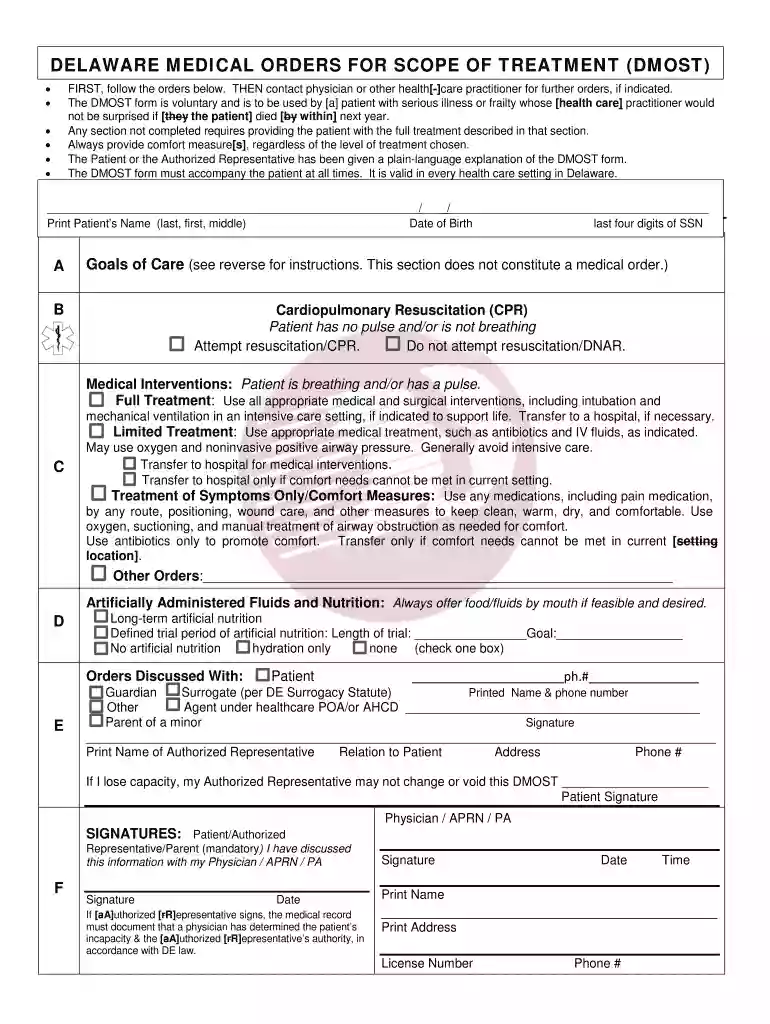
Delaware Medical Orders for Scope of TreatmentDelaware Preview on Page 1

Here's how it works

01. Edit your form online
Type text, add images, blackout confidential details, add comments, highlights and more.

02. Sign it in a few clicks
Draw your signature, type it, upload its image, or use your mobile device as a signature pad.

03. Share your form with others
Send it via email, link, or fax. You can also download it, export it or print it out.

Definition & Purpose of the Delaware Medical Orders for Scope of Treatment (DMOST)

The Delaware Medical Orders for Scope of Treatment (DMOST) form is a crucial document that specifies the wishes of individuals facing serious medical conditions regarding their treatment preferences. It is designed to improve communication between patients, their healthcare providers, and medical facilities to ensure that the patient's care preferences are honored. This official form is utilized to document decisions on various medical interventions, such as resuscitation, mechanical ventilation, and artificial nutrition. The DMOST form is intended to be portable across various healthcare settings within Delaware, ensuring continuity of care.

Steps to Complete the Delaware Medical Orders for Scope of Treatment

Completing the DMOST form involves several key steps to ensure that it accurately reflects the patient's wishes:

  1. Consultation: Begin with a detailed discussion with a healthcare professional about the patient's current health status and potential treatment options.
  2. Decision-Making: Patients, often in consultations with family members or legal guardians, should decide on their preferences for medical treatment, including life-sustaining measures.
  3. Form Completion: The healthcare provider will help fill out the form based on the patient's choices, ensuring each section aligns with discussed decisions.
  4. Signatures: The form must be signed by the patient (or their legal decision-maker) and a licensed healthcare professional to validate it.
  5. Distribution and Accessibility: The completed form should be shared with family members, stored with medical records, and carried with the patient to different healthcare settings.

Legal Use of the Delaware Medical Orders for Scope of Treatment

The DMOST form is legally recognized across healthcare settings within Delaware. This recognition ensures that a patient's documented treatment preferences are respected by medical personnel. The form acts as a standing medical order and is emphasized in emergency medical circumstances where immediate decisions are necessary. Failure to adhere to the wishes expressed on a valid DMOST could have legal implications for healthcare providers. It's important that the form is completed accurately and signed by authorized individuals to ensure its enforceability.

Key Elements of the Delaware Medical Orders for Scope of Treatment

When reviewing and completing the DMOST form, several key sections require attention:

  • Identification Information: Patient's name, date of birth, and identification details.
  • Goals of Care: General statements about the patient's treatment goals.
  • Cardiopulmonary Resuscitation (CPR): Options regarding whether or not to perform CPR.
  • Medical Interventions: Preferences for interventions such as intubation, mechanical ventilation, and hospitalization.
  • Artificial Nutrition and Hydration: Decisions on the use of feeding tubes or intravenous hydration.
  • Signatures: The form must include official signatures from the patient and a healthcare provider.

Who Typically Uses the Delaware Medical Orders for Scope of Treatment

The DMOST form is predominantly used by patients with life-limiting conditions or frailty who wish to have their medical treatment preferences documented in advance. This includes individuals diagnosed with terminal illnesses, chronic progressive diseases, or those who anticipate declines in health. It is also often used by family members or legal representatives to ensure the wishes of incapacitated individuals are documented and followed.


decoration image ratings of Dochub

State-Specific Rules for the Delaware Medical Orders for Scope of Treatment

Delaware mandates that the DMOST form is voluntarily completed and easily accessible to healthcare providers. The state's regulations emphasize that the form should accompany the patient across all settings, be it hospital, home care, or other facilities, to enhance consistent adherence to patient choices. Healthcare providers in Delaware are required to discuss the form's implications and support patients in adequately understanding their choices before documentation.

How to Obtain the Delaware Medical Orders for Scope of Treatment

Patients or authorized representatives can obtain the DMOST form from licensed healthcare providers, hospitals, or online through healthcare facilities' websites. Healthcare professionals often provide it during consultations for end-of-life care planning or as part of discharge planning processes for chronically ill patients.

Examples of Using the Delaware Medical Orders for Scope of Treatment

Consider these real-world scenarios highlighting the use of DMOST:

  • Scenario 1: A 75-year-old with advanced heart failure decides against resuscitation; the DMOST helps paramedics understand her wishes during a cardiac arrest.
  • Scenario 2: An ALS patient prefers minimal medical interventions; the hospital staff refers to the DMOST upon admission to ensure consistency in care delivery.
  • Scenario 3: A cancer patient opts for palliative care rather than aggressive treatments; the DMOST guides medical staff in implementing aligned care approaches.

Important Terms Related to the Delaware Medical Orders for Scope of Treatment

Understanding specific terms can enhance clarity when dealing with the DMOST:

  • Life-Sustaining Treatment: Interventions that extend life, such as mechanical ventilation.
  • Palliative Care: Supportive care focusing on relief from symptoms rather than cure.
  • Advance Directives: Legal documents like DMOST detailing patient wishes for future health care.

These terms and their proper use enhance the effectiveness of the DMOST in communicating patient wishes across varying healthcare situations.

be ready to get more

Complete this form in 5 minutes or less

Get form

Got questions?

We have answers to the most popular questions from our customers. If you can't find an answer to your question, please contact us.
Contact us
The MOST (which stands for Medical Orders for Scope of Treatment) is a document that quickly describes your loved ones wishes. The doctor completes it after a deep conversation with your relative about how much intervention they wantor dont wantat the end of life.
The Delaware Medical Orders for Scope of Treatment (DMOST) means a clinical process to facilitate communication between health-care professionals and patients living with serious illness or frailty who whose health care practitioner would not be surprised if they died within the next year or, if the patient lacks
Delaware Physician License Basic Eligibility Requirements USMLE Time Limit: Passing Steps I - III of the examination must occur within seven years. *The USMLE time limit starts from the first successful completion PGT (US/Canada Medical Graduate): One year PGT (International Medical Graduate): Three years2 more rows
Discuss your decision with your physician and a legal advisor to ensure the DNR order reflects your medical situation and complies with state laws. Incorporate as Part of a Comprehensive Advance Directive: Consider including the DNR order in a broader advance directive or living will.
The LaPOST document provides communication with the receiving health care team about the treatments desired and goals of care. This helps assure that the patients wishes are respected and comfort maintained as he/she moves from one care setting or level of care to another.

Security and compliance

At DocHub, your data security is our priority. We follow HIPAA, SOC2, GDPR, and other standards, so you can work on your documents with confidence.

Learn more
ccpa2
pci-dss
gdpr-compliance
hipaa
soc-compliance
be ready to get more

Complete this form in 5 minutes or less

Get form