01. Edit your form online
Type text, add images, blackout confidential details, add comments, highlights and more.

Type text, add images, blackout confidential details, add comments, highlights and more.

Draw your signature, type it, upload its image, or use your mobile device as a signature pad.

Send it via email, link, or fax. You can also download it, export it or print it out.
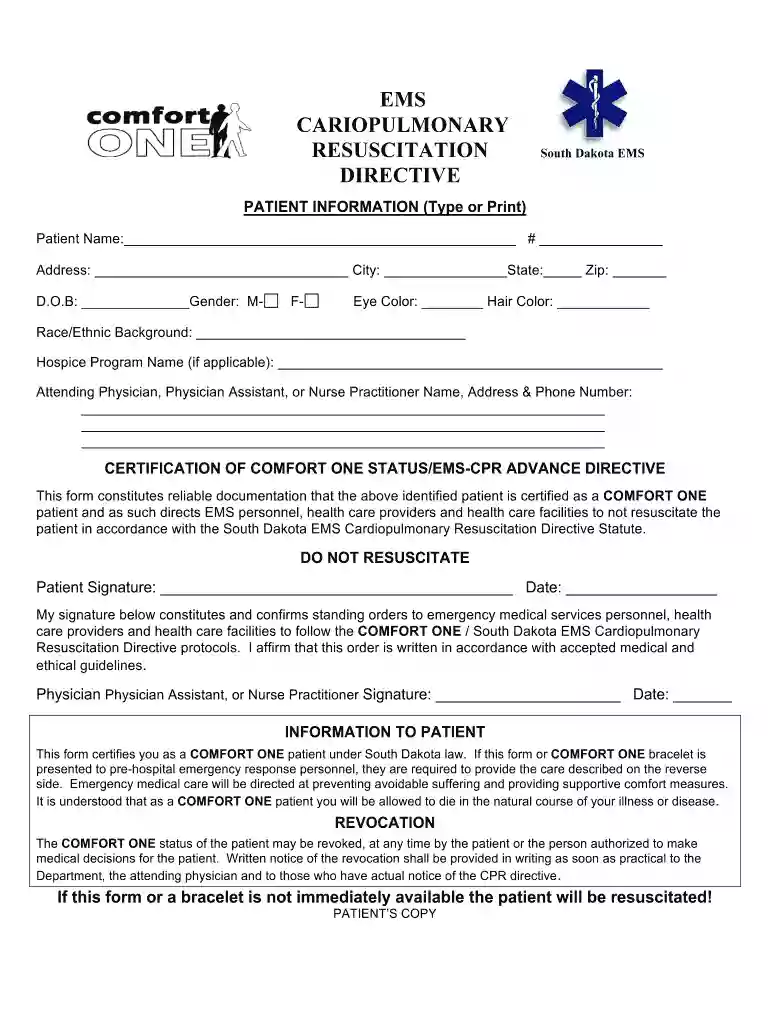
A Do Not Resuscitate (DNR) form in South Dakota, often referenced as the "COMFORT ONE" document, is a legal directive used to communicate a patient's wish not to undergo cardiopulmonary resuscitation (CPR) in the event of cardiac or respiratory arrest. This form provides clear instructions for healthcare providers and emergency medical service personnel to follow, ensuring that the patient's desires are respected during critical moments. The COMFORT ONE protocol emphasizes providing comfort care over aggressive lifesaving measures, aligning treatment with the patient's end-of-life care preferences.
The South Dakota DNR form contains several critical components that must be accurately completed to ensure its validity and effectiveness:
These elements together ensure that the form serves as a comprehensive guide to honoring a patient's end-of-life wishes.
To procure a South Dakota DNR form, individuals can:
It's vital to ensure that you obtain the most current version of the form, as laws and regulations concerning medical directives can evolve.
Filling out the South Dakota DNR form requires careful attention to detail. Here are the steps typically involved:
The DNR form is predominantly used by individuals with terminal illnesses, chronic health conditions, or the elderly who decide against CPR due to personal, medical, or quality-of-life reasons. It is also relevant for those who wish to maintain control over their end-of-life care decisions, ensuring their preferences are respected irrespective of the situation.


The South Dakota DNR form is a legally binding document. It must be signed by both the patient and a physician to be considered valid. It directs medical staff not to perform CPR if the patient goes into cardiac or respiratory arrest. State laws govern its use, and failure to adhere can lead to legal and ethical implications for healthcare providers.
Several key terms associated with the South Dakota DNR form include:
Understanding these terms helps in providing clarity and context when discussing or implementing a DNR order.
South Dakota adheres to specific regulations regarding the execution and recognition of DNR forms:
These rules ensure that the DNR forms are respectfully implemented within the state's legal framework.
Consider the case of an elderly individual with advanced-stage cancer who chooses to prioritize quality of life over aggressive treatment. They may complete a South Dakota DNR form to ensure they receive only palliative care in emergencies.
Similarly, a patient with severe chronic heart disease might opt for a DNR to avoid invasive procedures in their final days, using the form to clearly outline their wishes to medical professionals.
At DocHub, your data security is our priority. We follow HIPAA, SOC2, GDPR, and other standards, so you can work on your documents with confidence.