01. Edit your form online
Type text, add images, blackout confidential details, add comments, highlights and more.

Type text, add images, blackout confidential details, add comments, highlights and more.

Draw your signature, type it, upload its image, or use your mobile device as a signature pad.

Send it via email, link, or fax. You can also download it, export it or print it out.
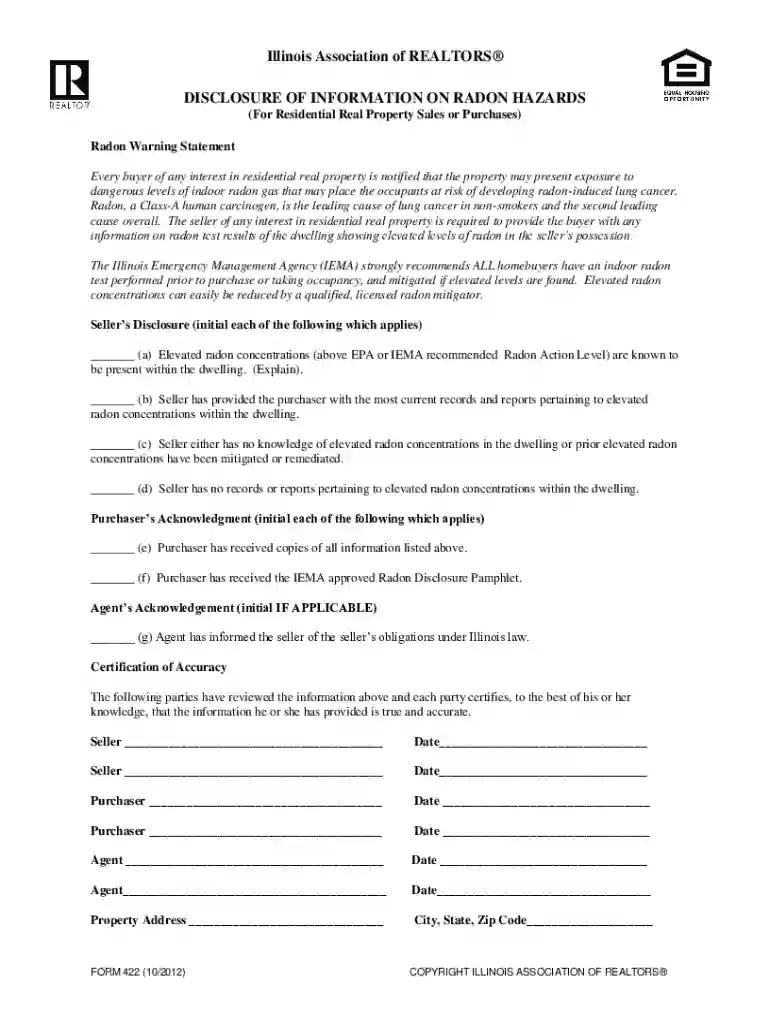
The Chicago Association of Realtors Radon Disclosure Form is an essential document used in residential real estate transactions to inform potential buyers about the presence and risks associated with radon gas in a property. Radon is a naturally occurring radioactive gas that can accumulate indoors, posing significant health risks such as lung cancer. The disclosure form serves to ensure transparency and compliance, requiring sellers to detail any known elevated radon levels and encourage buyers to perform their own radon testing before finalizing a purchase.
To effectively use this form, sellers need to complete it as part of the property disclosure process. Begin by accurately documenting any known radon tests previously conducted on the property, along with their results. Detail any mitigation measures already taken, such as the installation of radon reduction systems. Buyers should carefully review the form, considering the disclosed information to decide if further testing is necessary. It is crucial for both parties to fill and understand this form, as it represents legal acknowledgment of radon levels at the time of sale.
Gather Previous Test Results: Sellers should collect any documentation related to radon testing performed on the property. This includes test dates, organizations that conducted the tests, and detailed results.
Disclose Mitigation Measures: Indicate if any radon mitigation efforts have been made, such as system installations or professional evaluations. Provide dates and recognized contractors where applicable.
Fill Acknowledgement Sections: Both sellers and potential buyers must read through the form and acknowledge their understanding by signing appropriate sections.
Provide Additional Resources: Sellers can offer contacts for radon testing services, ensuring buyers have access to accurate information for further inspection if desired.
Finalize and Submit: Once everything is complete and both parties have signed, include the form in the final package of real estate transaction documentation.
The form is legally binding in the real estate sale process within Illinois, specifically requiring compliance under state laws regarding environmental disclosures. The legal framework mandates that sellers must accurately report known radon levels, and failure to do so can result in legal repercussions, including liability for undisclosed issues. Buyers are encouraged under legal advisement to acknowledge the form and pursue independent testing, gaining firsthand assurance of safe radon levels in the residence.
The primary users of this form include:


The form encompasses several critical elements, including:
In Illinois, state regulations require sellers to disclose known radon levels, consistent with environmental safety standards. The form should conform to Illinois-specific legislation designed to protect buyers from environmental hazards. It's crucial for sellers to understand these state requirements to avoid non-compliance penalties. Additionally, variations might exist within local counties, requiring further consultation with real estate professionals familiar with local legislation.
Consider a residential property in Chicago with previous radon levels. The seller must fill out the disclosure form detailing the historical data and any remediation efforts undertaken, such as venting systems. In this scenario, a buyer reviewing this information decides to conduct an independent test, confirming safe levels. This process illustrates the form's utility in ensuring transparency and guiding informed real estate decisions.
Sellers are obligated to report:
Failure to fulfill these disclosures could result in legal action due to nondisclosure violations, emphasizing the importance of accurate and thorough completion of the form.
At DocHub, your data security is our priority. We follow HIPAA, SOC2, GDPR, and other standards, so you can work on your documents with confidence.