01. Edit your form online
Type text, add images, blackout confidential details, add comments, highlights and more.

Type text, add images, blackout confidential details, add comments, highlights and more.

Draw your signature, type it, upload its image, or use your mobile device as a signature pad.

Send it via email, link, or fax. You can also download it, export it or print it out.
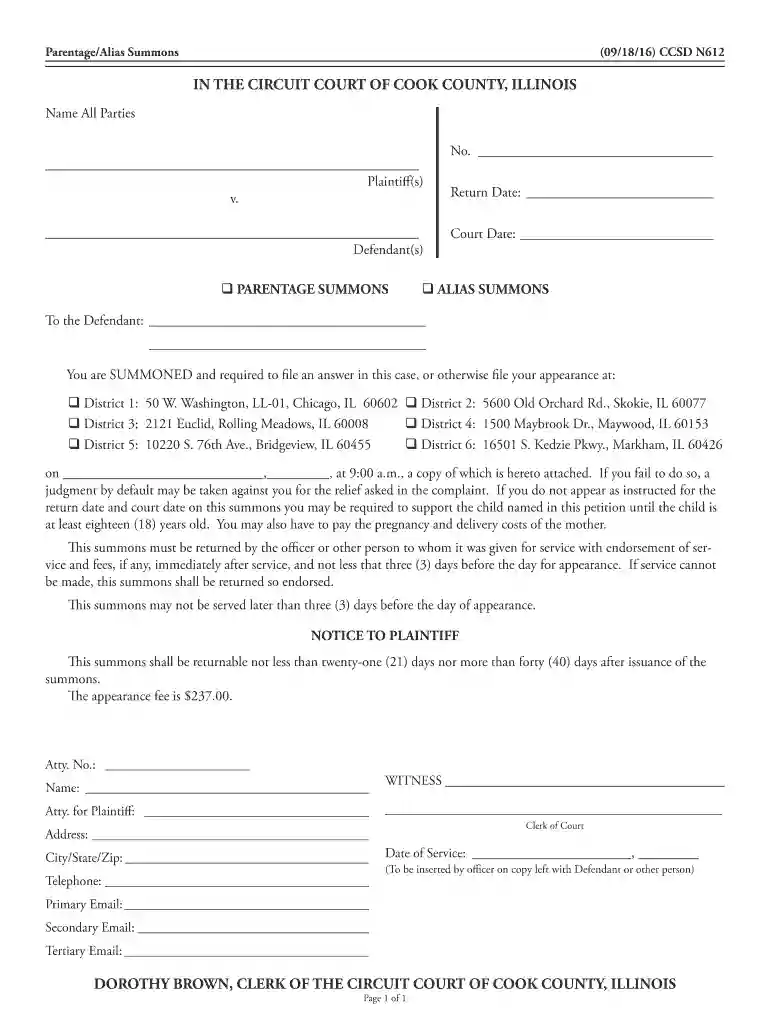
A Parentage Alias Summons is a legal document issued by the Circuit Court, typically in the context of family law in the United States. This summons is primarily used to notify a defendant of a legal action regarding the establishment of parentage, often involving questions of paternity or maternity. The term "alias" indicates that the summons is a follow-up, likely because the original summons was not served. This document is crucial in ensuring that the legal process is followed properly, and all parties are informed.
To obtain a Parentage Alias Summons, you must first engage with the court that is handling the parentage case. Typically, the Circuit Court in the relevant jurisdiction, such as Cook County in Illinois, will be responsible for issuing these summonses. Individuals or their legal representatives can request the form from the court clerk's office, ensuring that all required details about the case are communicated effectively. It's essential to provide accurate contact information for all parties involved to facilitate successful service.
Completing a Parentage Alias Summons involves several detailed steps:
Accurate Party Details: Ensure the correct names and addresses of the plaintiff and defendant are included.
Case Information: Write the court's name, the case number, and the judge’s details, if applicable.
Service Date Specification: This includes detailing when and how the summons must be served.
Court Appearance Details: Clearly state the court date and time by which the defendant must respond or appear in court.
Each field requires careful attention to detail to avoid delays or inaccuracies that might affect the case's progress.
The use of a Parentage Alias Summons is critical in legal proceedings concerning parentage. It ensures that the defendant is officially notified and given an opportunity to respond. The summons helps uphold fair legal processes by making certain all parties are informed and have a chance to present their side of the matter. This is especially important in sensitive cases involving child support, custody, or visitation rights, where the court's decisions significantly impact families' lives.
Typically, family law attorneys and plaintiffs in parentage cases use the Parentage Alias Summons. Legal representatives may leverage this document on behalf of their clients, who could be either the custodial or non-custodial parent seeking to establish or dispute parentage. The document might also be used by state agencies in cases where a child is under state care, and the establishment of parentage is necessary for legal or support purposes.


The Parentage Alias Summons comprises several key components:
These elements are designed to make the summons clear, unambiguous, and enforceable.
The legal basis for a Parentage Alias Summons lies in the requirement for due process, which mandates that legal proceedings are conducted fairly and orderly. The summons not only notifies the defendant of the legal action but also imparts the legal obligations that follow. For instance, it may detail the necessity to file an official response or to attend court hearings. Failure to comply with a summons can result in legal fallout, including default judgments.
Laws and regulations governing the issuance of parentage alias summonses can vary between states. For example, some states may have particular rules regarding how and when a summons must be served to be considered legally adequate. Understanding these nuances is essential for ensuring compliance and avoiding complications in the legal process. Checking with local court rules and possibly seeking legal counsel can help navigate these state-specific intricacies.
Non-compliance with a Parentage Alias Summons can lead to substantial penalties. If a defendant fails to respond or appear in court as directed, the court may issue a default judgment, which could adversely affect the defendant's legal rights or obligations. In some cases, an arrest warrant may be issued for failure to comply. Thus, understanding and adhering to the summons is crucial to prevent any legal repercussions.
The Parentage Alias Summons can often be managed both in digital and traditional paper formats, depending on the court's resources and the jurisdiction's administrative procedures. While electronic systems improve efficiency and speed, some courts may still rely on paper delivery. It's vital to confirm the preferred method with the local issuing court and ensure that the format chosen meets all legal requirements for service.
We've got more versions of the Parentage Alias Summons form. Select the right Parentage Alias Summons version from the list and start editing it straight away!
At DocHub, your data security is our priority. We follow HIPAA, SOC2, GDPR, and other standards, so you can work on your documents with confidence.