






Definition and Meaning
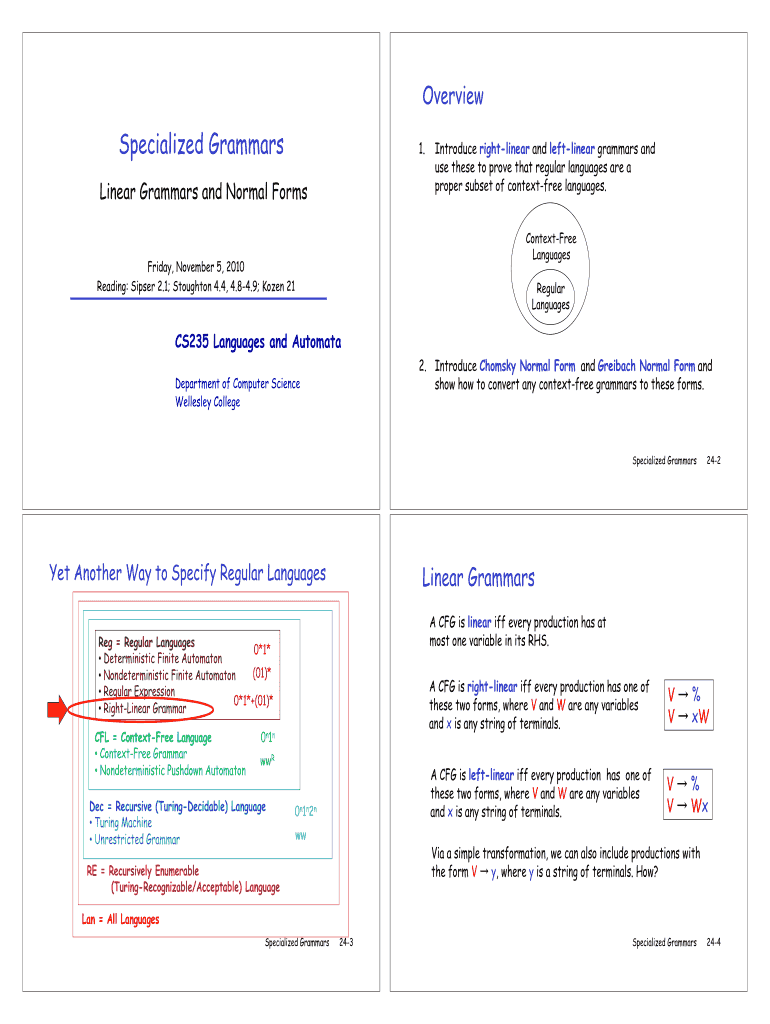
The "Slides: Specialized Grammars: Linear Grammars and Normal Forms - cs wellesley" refer to educational materials that focus on specific types of grammars within the context of formal language theory. These slides are typically utilized in computer science courses to explain linear grammars and various normal forms, such as Chomsky Normal Form (CNF) and Greibach Normal Form (GNF). Understanding these concepts is essential for comprehending the structure of formal languages and their applications in parsing algorithms and automata theory.
Linear grammars form a crucial part of context-free grammars where productions have at most one non-terminal symbol on the right-hand side. This makes them an important topic of study for students interested in theoretical computer science and linguistics.
Key Elements of the Slides
These slides cover a range of key concepts related to specialized grammars, including:
- Linear Grammars: Explores their structure and how they differ from other grammar types.
- Chomsky Normal Form (CNF): Discusses how any context-free grammar can be converted into an equivalent CNF.
- Greibach Normal Form (GNF): Explains the transformation of grammars to GNF where productions adhere to a certain format.
- Right-linear and Left-linear Grammars: Examines their properties and relationship with finite automata.
- Equivalence to Finite Automata: Describes how linear grammars are interconnected with automata theory.
How to Use the Slides
To effectively engage with the slides on "Specialized Grammars: Linear Grammars and Normal Forms," students should:
- Familiarize with Basic Concepts: Understand the fundamentals of formal languages and parsing before diving into specific grammar forms.
- Follow Logical Progression: The slides typically progress from basic definitions to more complex transformations like converting grammars into CNF or GNF.
- Take Notes on Key Points: Highlight transformations and equivalences, particularly the steps involved in grammar conversions.
- Engage with Examples: Work through provided examples to see theoretical concepts applied in practice.
Who Typically Uses the Slides
The slides are primarily used by:
- Students in Computer Science Courses: Particularly those studying formal languages, automata theory, or compiler design.
- Researchers in Theoretical Computer Science: Those exploring new applications or optimizations involving formal language theory.
- Educators: Course instructors who are teaching these topics typically use such slides to impart structured grammar knowledge.


How to Obtain the Slides
Students or educators can obtain the slides by:
- University Course Portals: They may be provided directly through a course management system or university library.
- Department Websites: Some computer science departments, like that of Wellesley College, may offer access through their online resources.
- Direct Requests: Contact the course instructors or department to request access or copies of the slides.
Steps to Complete Understanding
For comprehensive understanding of the slides:
- Review Each Slide Thoroughly: Pay close attention to terminology and structures discussed.
- Conduct Additional Research: Use supplementary texts or resources to clarify complex topics.
- Engage in Discussions: Participate in study groups or forums to discuss interpretations and questions.
- Practice Transformations: Attempt converting grammars into different normal forms independently.
Important Terms Related to the Slides
Key terms for understanding these slides include:
- Context-Free Grammar (CFG)
- Terminal and Non-Terminal Symbols
- Production Rules
- Syntax Parsing
- Deterministic and Non-Deterministic Automata
Examples of Using the Slides
Examples in the slides might involve:
- Grammar Conversion Exercises: Convert a given context-free grammar into CNF or GNF.
- Parsing Demonstrations: Show how a string can be generated from linear grammars using derivation trees.
- Finite Automata Equivalents: Demonstrate how right-linear grammars can represent regular languages via finite automata.
These examples help solidify the theoretical concepts presented and demonstrate their application in real-world computational contexts.