Lincolns Suspension of the Writ of 2025

Get Form
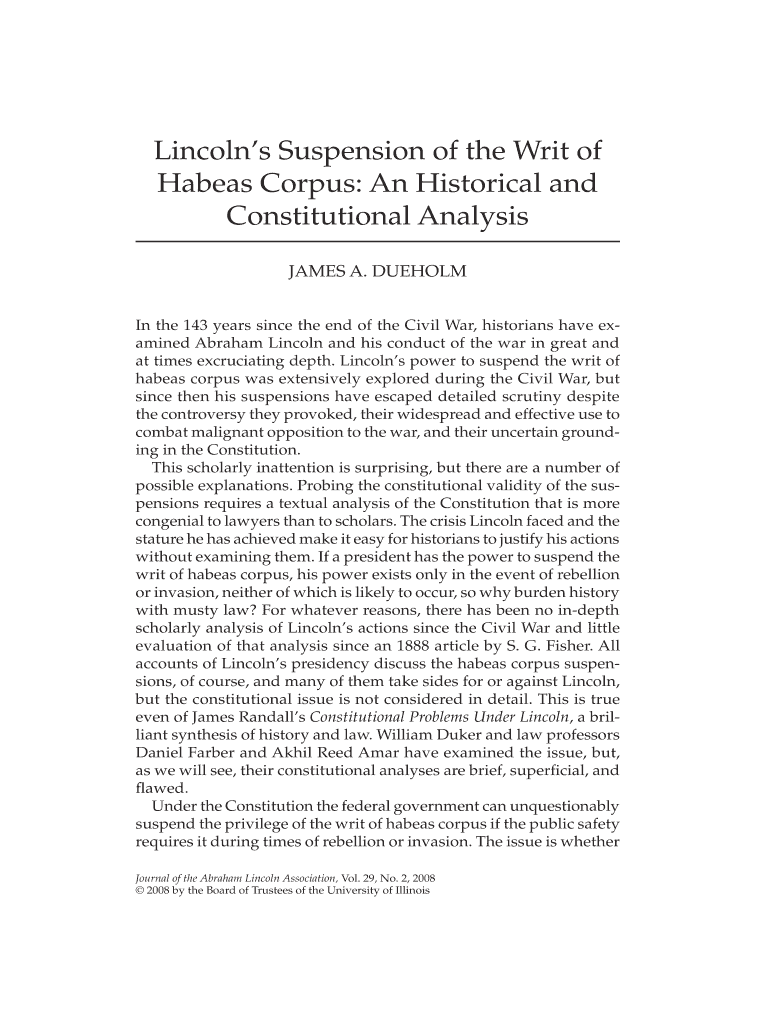
Lincolns Suspension of the Writ of Preview on Page 1

Here's how it works

01. Edit your form online
Type text, add images, blackout confidential details, add comments, highlights and more.
02. Sign it in a few clicks
Draw your signature, type it, upload its image, or use your mobile device as a signature pad.
03. Share your form with others
Send it via email, link, or fax. You can also download it, export it or print it out.

How to use or fill out Lincolns Suspension of the Writ of with our platform

Form edit decoration
9.5
Ease of Setup
DocHub User Ratings on G2
9.0
Ease of Use
DocHub User Ratings on G2
  1. Click ‘Get Form’ to open it in the editor.
  2. Begin by reviewing the introductory section, which outlines the historical context and significance of Lincoln's suspension of habeas corpus. This will help you understand the purpose of the form.
  3. Fill in your personal information in the designated fields, ensuring accuracy as this information is crucial for any legal implications.
  4. Proceed to the sections that require detailed responses regarding your understanding or stance on Lincoln's actions. Use our platform’s text tools to elaborate on your thoughts clearly.
  5. If applicable, sign the document electronically using our signature feature, ensuring that your consent is recorded properly.
  6. Review all filled sections for completeness and clarity before saving or sharing your document directly from our editor.

Start using our platform today for free to streamline your document editing and signing process!

be ready to get more

Complete this form in 5 minutes or less

Get form

Got questions?

We have answers to the most popular questions from our customers. If you can't find an answer to your question, please contact us.
Contact us
On April 27, 1861, Lincoln suspended the writ of habeas corpus between Washington, D.C., and Philadelphia to give military authorities the necessary power to silence dissenters and rebels. Under this order, commanders could arrest and detain individuals who were deemed threatening to military operations.
Presidents Lincoln and Bush both unconstitutionally suspended habeas corpus during a time of war because the writ of habeas corpus is a fundamental right and suspension is a power granted only to congress.
The writ of habeas corpus is a legal remedy against arbitrary detention, and its suspension allows authorities to detain individuals without immediately charging them with a crime. The suspension of the writ does not apply to all arrests.
755 (1863), entitled An Act relating to Habeas Corpus, and regulating Judicial Proceedings in Certain Cases, was an Act of Congress that authorized the president of the United States to suspend the right of habeas corpus in response to the American Civil War and provided for the release of political prisoners.
President Lincoln suspended the writ of habeas corpus during the Civil War in order to address the threat to national security posed by Confederate sympathizers who actively worked on sabotaging the Union war effort. Suspension of habeas corpus allowed the government to arrest and detain individuals without trial.

People also ask

President Lincoln Suspends the Writ After the Civil Wars start, President Abraham Lincoln ordered General Winfield Scott to suspend the writ of habeas corpus near railroad lines amid fears of a rebellion in Maryland that would endanger Washington.
The third time habeas corpus was suspended was under former President Theodore Roosevelt, who suspended this protection in two provinces of the Philippines during a rebellion in 1905. The fourth and last time habeas corpus was suspended was in 1941, during former President Franklin Delano Roosevelts administration.