






Definition and Meaning of Cross-lingual Sense Determination
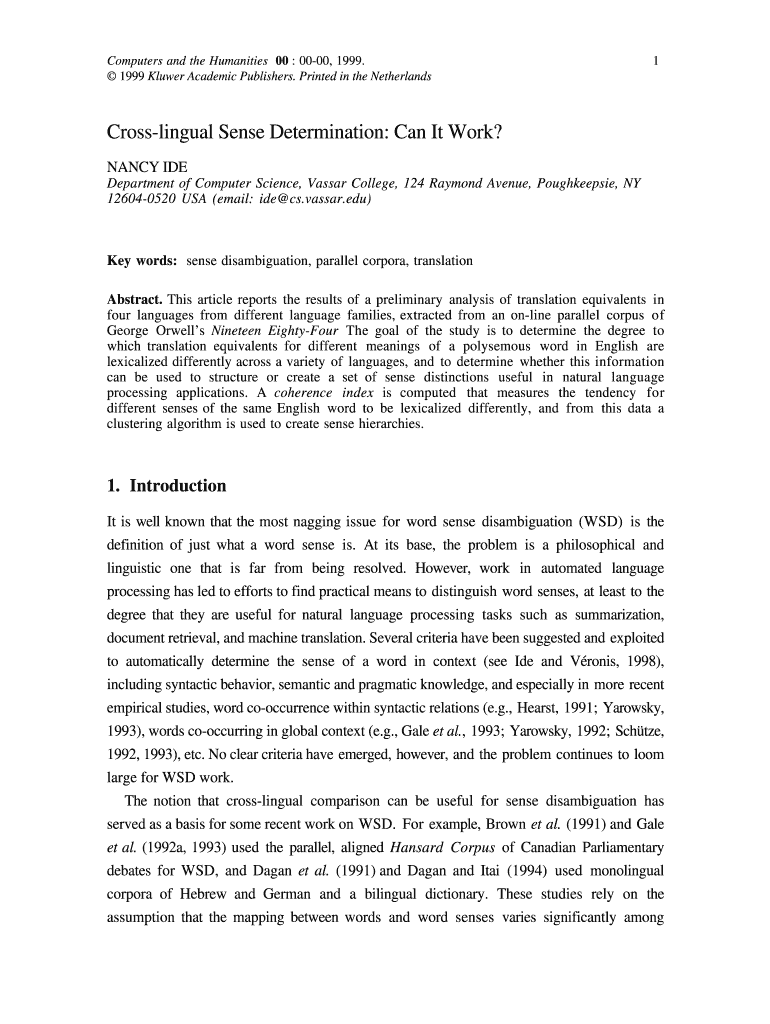
Cross-lingual sense determination involves identifying the correct meaning of words across different languages. This process is crucial in understanding how languages express concepts that might not have direct translations. It addresses polysemous words, which are words with multiple meanings, and evaluates how these meanings are expressed in different languages. By using tools such as an online parallel corpus of literary works like George Orwell's 'Nineteen Eighty-Four', researchers analyze translation consistency and word usage across languages.
How to Use the Cross-lingual Sense Determination: Computer - cs vassar
Researchers and developers can use cross-lingual sense determination to enhance natural language processing applications. This involves leveraging parallel corpora to analyze how words translate across languages, aiding in tasks like word sense disambiguation (WSD). By understanding various meanings of words in multiple languages, users can develop multilingual applications with better comprehension and accuracy.
Important Terms Related to Cross-lingual Sense Determination
Understanding key concepts is vital for those engaged in cross-lingual sense determination research:
- Polysemous Words: Words with multiple meanings that require context to resolve ambiguity.
- Word Sense Disambiguation (WSD): A task in computational linguistics aimed at determining which sense of a word is activated by its use in a particular context.
- Parallel Corpus: A collection of text in two or more languages where segments of translated text correspond alignment-appropriate parts of the original language.
- Coherence Index: A metric used for evaluating the consistency of word translations across contexts and languages.
Key Elements of the Cross-lingual Sense Determination: Computer - cs vassar
Essential components of cross-lingual sense determination include:
- Utilization of parallel corpora to analyze translations.
- Implementation of clustering algorithms to organize word senses and hierarchies.
- Development of coherence indices to measure translation consistency.
- Development and testing with various natural language processing models to validate approach effectiveness.
Examples of Using Cross-lingual Sense Determination
Cross-lingual sense determination can be used in various applications:
- Multilingual Search Engines: Improving search result accuracy by understanding query intent across languages.
- Machine Translation Systems: Enhancing translation quality by distinguishing word meanings in context.
- Assistive Tools for Language Learners: Providing more nuanced vocabulary learning by illustrating different usage contexts in various languages.
Software Compatibility for Cross-lingual Sense Determination Research
Conducting research on cross-lingual sense determination often requires specific software and tools:
- Natural Language Processing Libraries: Libraries such as NLTK, spaCy, and TensorFlow provide utilities for creating models and analyzing text data.
- Data Analysis Tools: Platforms like R and Python with Pandas facilitate the statistical analysis of translation data.
- Visualization Software: Tools such as Matplotlib or Tableau help display relationships and findings clearly.
Versions or Alternatives to the Cross-lingual Sense Determination: Computer - cs vassar
In the evolving field of cross-lingual sense determination research:
- Researchers can explore alternative approaches like using neural networks for better polysemy resolution.
- Developing newer corpora that capture socio-linguistic nuances to provide broader language data insights.
- Incorporating domain-specific language processing to enhance specialized vocabulary translations, catering to industries such as law or medicine.
Business Types That Benefit Most from Cross-lingual Sense Determination
Specific business sectors can benefit significantly from enhancements in cross-lingual sense determination:
- Multinational Companies: By improving translation and localization of marketing materials, these businesses can better penetrate global markets.
- Content Creation and Management: Publishers can ensure that multilingual content retains its original message accurately, catering to a diverse readership.
- E-Learning Platforms: Providing context-rich vocabulary and comprehensible language content for users worldwide.
Digital vs. Paper Version for Data Management
Cross-lingual sense determination activities predominantly benefit from digital formats:
- Data Analysis: Digital tools allow for efficient storage, processing, and retrieval of language data.
- Real-time Updates: Changes in linguistics data can be updated instantly, ensuring researchers always have access to the most current information.
- Accessibility: Digital platforms facilitate access from anywhere globally, supporting collaborative and remote research activities.
This structured content provides a comprehensive view, offering insights for researchers, developers, and businesses involved in or benefiting from cross-lingual sense determination.