
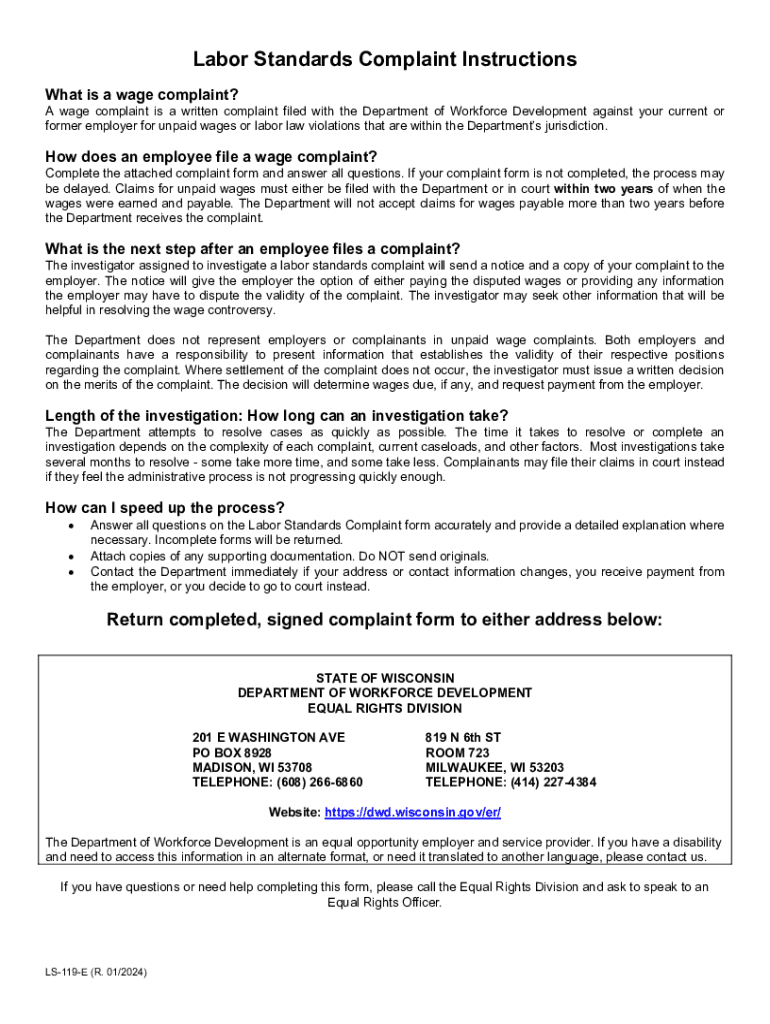







Definition & Meaning
The LS-119-E, Labor Standards Complaint, is a crucial document used to report violations of labor laws, specifically concerning wage disputes. It serves as a formal grievance mechanism for employees who believe their rights regarding wage and hour laws have been breached. This form plays a vital role in ensuring compliance with fair labor standards and provides a structured way for employees to voice their concerns. Understanding the LS-119-E form is essential for anyone dealing with labor disputes, as it encapsulates both the legal framework and procedural requirements for lodging a complaint.
How to Use the LS-119-E, Labor Standards Complaint
When filing a complaint with the LS-119-E form, the employee must clearly specify the nature of the labor violation, whether it's unpaid wages, overtime discrepancies, or other pay-related issues. Detailed accounts of the situation, including dates, times, and any correspondence with the employer, should be documented in the form. It's also important to gather all supporting documents that substantiate the claims made in the complaint. Once completed, the form can be submitted through the appropriate channels for review.
Common Examples of Usage
- An hourly worker realizes they've been paid less than the agreed amount and uses the form to claim unpaid wages.
- An employee who consistently works overtime without receiving overtime pay can file a complaint highlighting these discrepancies.
- Workers who feel their employer has incorrectly classified them to avoid paying benefits or higher wages may also utilize this form.
How to Obtain the LS-119-E, Labor Standards Complaint
The LS-119-E form can be obtained through multiple avenues to ensure accessibility for all potential complainants. Typically, it is available on the official website of the local Department of Labor or the specific state workforce development department. Additionally, many government offices offer the form in physical locations for those who prefer or require a paper version. Downloadable PDFs are common, allowing users to fill out the form digitally or in print, whichever suits their needs best.
Steps to Complete the LS-119-E, Labor Standards Complaint
- Gather Necessary Information: Collect all pertinent details regarding the complaint, including personal information, employment details, and specifics about the alleged violation.
- Fill out Personal and Employment Details: Enter information such as your name, address, employer's contact information, and employment start date.
- Describe the Complaint: Clearly articulate the nature of your complaint, referencing specific instances of the alleged labor law violations.
- Attach Supporting Documents: Include any documentation that supports your claim such as pay stubs, time sheets, and correspondence with your employer.
- Review and Submit: Double-check the filled information for accuracy and completeness, then submit the form through the designated submission method.
Important Considerations
- Ensure all fields are completed accurately to avoid delays in processing.
- Keep a copy of the submitted form and all supporting documents for your records.
Who Typically Uses the LS-119-E, Labor Standards Complaint
The primary users of the LS-119-E form are employees who believe their employer has violated wage and hour laws. This includes workers across various industries who may encounter issues such as unpaid wages or denial of overtime pay. Labor unions and employee advocates often assist individuals in completing this form to ensure accurate submissions. In some cases, employers might review the form to understand the nature of complaints brought against them and rectify issues proactively.


Key Elements of the LS-119-E, Labor Standards Complaint
Several critical components are essential to the LS-119-E form:
- Employee Identification: Details about the complainant's identity and employment situation.
- Employer Information: Accurate details regarding the employer in question, including contact information and address.
- Nature of Complaint: A detailed description of the wage or labor standard violation.
- Supporting Evidence: Documentation provided to substantiate claims made within the complaint.
Detailed Explanation of Components
- Employee Identification helps ensure that the complaint is traceable and the employee's case is accurately documented.
- Complaint Description should be comprehensive, including specific details that illustrate the extent of the violation.
Required Documents
When filing the LS-119-E, several documents may be necessary to provide context and evidence for the complaint:
- Pay Stubs: Demonstrate discrepancies in wages paid versus expected.
- Time Sheets: Provide evidence of hours worked, particularly for overtime claims.
- Correspondence Records: Emails or letters exchanged with the employer regarding wage issues.
- Employment Contract/Agreement: Outlines agreed-upon wages and conditions, serving as a baseline for any disparity claims.
Examples of Supporting Documents
- In a scenario where overtime pay is disputed, providing time sheets that document hours worked beyond the normal schedule could strengthen the claim.
- For unpaid wages, showcasing the employment agreement alongside pay stubs can highlight divergences between promised and actual payment.
Form Submission Methods (Online / Mail / In-Person)
The LS-119-E form offers multiple submission methods to cater to different preferences and accessibilities:
- Online: Many departments provide an online portal where the form can be submitted directly.
- Mail: Hard copies can be mailed to the appropriate governmental department address.
- In-Person: Some complainants might choose to deliver the form in person at designated offices, allowing for direct assistance from staff.
Advantages of Different Methods
- Online Submission is convenient and often faster, offering automatic confirmations.
- Mail and In-Person Submissions provide tangible proof of receipt and may be preferred by those uncomfortable with digital processes.
Penalties for Non-Compliance
Employers found to be in violation of wage and labor standards through the LS-119-E complaints face several potential penalties:
- Financial Penalties: Businesses may be subjected to fines and required to pay back wages owed.
- Legal Repercussions: Severe or repeated violations may result in legal action, affecting the company's reputation and financial standing.
- Increased Regulatory Scrutiny: Non-compliant employers may attract more frequent audits and investigations by labor authorities.
Real-World Implications
- An employer who fails to rectify wage discrepancies after an LS-119-E complaint might not only incur fines but also damage their brand reputation.
- Continual non-compliance can hinder a company's operational capacity, as they focus resources on legal defenses instead of growth.
Variations and Exceptions
While the LS-119-E form is standardized, variations may exist based on regional regulations or specific labor laws. In some states, additional information may be required, or the process may involve interacting with different branches of the labor department. It's crucial to consult local guidelines to ensure comprehensive and compliant submissions.




