01. Edit your form online
Type text, add images, blackout confidential details, add comments, highlights and more.

Type text, add images, blackout confidential details, add comments, highlights and more.

Draw your signature, type it, upload its image, or use your mobile device as a signature pad.

Send it via email, link, or fax. You can also download it, export it or print it out.
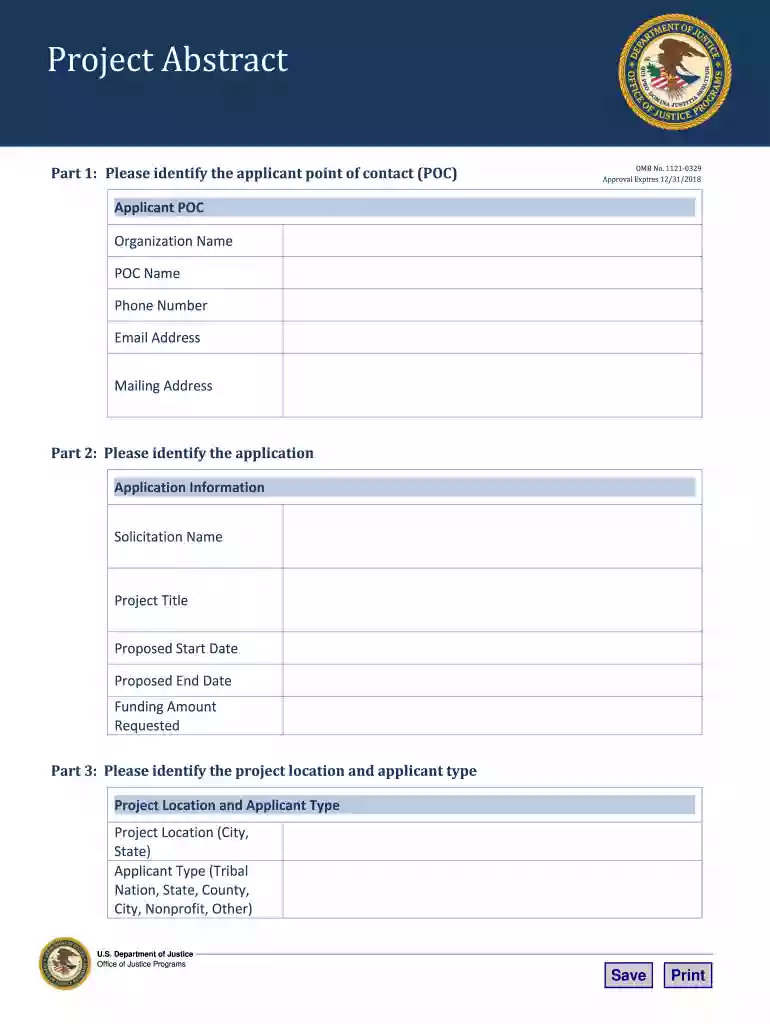
The Project Abstract Template serves as a standardized form for summarizing project details, particularly in contexts such as grant applications and reports for governmental or academic institutions. It provides a succinct overview of complex projects, offering critical information that stakeholders need to understand a project's purpose, methodology, and anticipated impacts. The template typically includes sections for problem statements, project goals, strategies, partnerships, expected outcomes, and consents related to public sharing. Designed to ensure clarity and consistency, the template facilitates efficient review processes and communication between project teams and their audiences.
Using the Project Abstract Template involves several structured steps. First, identify all necessary project details that need to be included, such as the project title, applicant information, and contact details. Next, clearly articulate the problem statement the project addresses. This section should succinctly describe the issue and its relevance. Then, outline the primary goals and objectives of the project, ensuring they are specific, measurable, attainable, relevant, and time-bound (SMART).
Proceed to detail the strategies and methodologies you will employ. Mention any partnerships with other organizations or stakeholders and your team's qualifications. Then, project the potential outcomes and impacts of your project. Ensure to include a section for granting consent regarding the public sharing of the project details if applicable. When filling out the template, provide concise yet comprehensive information to maintain clarity and prevent misunderstanding.
Gather Information: Collect all relevant data, including project objectives, methodologies, expected outcomes, and team qualifications.
Draft Problem Statement: Clearly define the problem your project intends to address. Ensure the problem is backed by data or research to highlight its significance.
Outline Goals and Objectives: Define what the project aims to achieve. Use the SMART criteria to make these objectives actionable and measurable.
Detail Strategies and Methodologies: Describe the techniques and processes you will use to meet your objectives. Include data collection methods, analysis processes, and project management strategies.
List Partnerships and Collaborations: Mention any organizations or stakeholders that will be involved in the project. Explain their roles and contributions.
Describe Anticipated Outcomes: Detail the expected results and impacts of the project. Use quantitative and qualitative measures to forecast achievements.
Review Consent for Public Sharing: Decide and document whether the project details can be publicly shared, addressing any legal or ethical implications.
Finalize Document: Proofread the completed template for accuracy and coherence. Make necessary revisions to ensure clarity and precision.
Project Title and Introduction: A concise title that captures the essence of the project, followed by an introduction setting the context.
Applicant and Contact Information: Details of the individual or organization submitting the project abstract, including contact details for communication.
Problem Statement: A clear definition of the issue the project seeks to resolve, supported by data or research.
Goals and Objectives: Specific aims the project intends to achieve, described using the SMART framework.
Methodologies: A description of the methods and strategies to be used, including data collection and analysis techniques.
Partnerships and Collaborations: Information about any partners involved, their roles, and the collaborative processes to be employed.
Anticipated Outcomes: Expected results and their potential impact, described with relevant metrics.
Consent for Public Sharing: A section addressing whether and how the project's abstract can be shared publicly.
The Project Abstract Template is widely used by various individuals and organizations, including:
Researchers: Often required in academic settings to summarize research proposals and findings.
Grant Applicants: Utilized by those seeking funding to provide a concise overview of their project to potential funders.
Nonprofit Organizations: Used in project reporting to governmental or private grant providers.
Government Agencies: Required for certain public work projects or collaborations, ensuring transparent communication of project intentions and expected outcomes.
Corporate Teams: Employed in internal or external project pitches, providing stakeholders with essential project details.


Academic Research Proposal: A university professor uses the template to outline a new research project's goals, methodology, and expected impact to secure funding from a national research grant.
Nonprofit Funding Application: A nonprofit organization submits a detailed project abstract to potential donors, highlighting their strategy to address homelessness in an urban area.
Corporate Innovation Pitch: A corporate team fills out the template to propose a new tech solution to executives, detailing the problem being addressed and the anticipated market impact.
Several versions and customized alternatives of the Project Abstract Template exist, catering to specific needs:
Government-Specific Templates: Some agencies, like the U.S. Department of Justice, provide tailored templates with sections specific to their reporting requirements.
Academic Journal Abstracts: These are often simplified versions of the project abstract, focusing on summarizing research findings for publication.
Corporate Project Briefs: Customized for corporate environments, emphasizing strategic alignment with business goals and metrics for success.
Nonprofit Grant Summaries: Focused on highlighting the social impact and the alignment with funders' missions.
These variations serve different purposes but maintain the core function of succinctly summarizing project details for various stakeholders.
We've got more versions of the Project Abstract Template form. Select the right Project Abstract Template version from the list and start editing it straight away!
| Versions | Form popularity | Fillable & printable |
|---|---|---|
| 2018 | 4.8 Satisfied (121 Votes) |
At DocHub, your data security is our priority. We follow HIPAA, SOC2, GDPR, and other standards, so you can work on your documents with confidence.